Wednesday, September 14, 2005

Blogosphere 2005

Everyone's blogging these days. Except when they're inactive.

The Big 6: me, Idris, Alex, Luke, Zaz, Atlanta guys. Luke's is purely personal, but he's often funny, in Luke's way, and he's a presence, so he's in. The others are of general interest, although Alex and I tend to write about our team a lot.

Others to look at: Tim Murray, Hartti Suomela, Jim Biancolo, Marshall Goff, George Cooke (who has made it into ultimatetalk! Attaboy, George.) . Tim has been writing about himself, but the others are trying to do something of more general interest.

I think we'd all agree that we'd like to get more comments, and that people shouldn't be afraid of hogging bandwidth or taking over someone else's blog. They are there to entertain and to provoke discussion, as long as it's not NUA/Z-Boys annoying blather.

Mine is the most read, although Alex would of course argue that it's not because of content but because of name. He also forgot to mention that more people link to me. I often find other blogs by checking out my Referrals on sitemeter.com and see a new one. Also I egosurf once in a while at technorati, but that doesn't seem too comprehensive for the little blogs.

Idris was the first of us to go online, and is often the most refreshingly honest because he's not playing this year and doesn't seem to care if he burns his bridges.

Alex is Jim lite. But please pay him a visit to get his hits up. He has had some interesting retrospectives on Worlds and Tuneup. I think it'd be a good idea to do some more retrospectives, maybe on other tournaments, or on matchups against particular opponents. It seems that most of our recent games against Sub-Zero have been one-pointers, so it'd be fun to look at the ones we won.

Luke is all over the place, talking about skiing or eating pancakes or losing his wallet in a dumpster ten years ago.

Zaz is putting out the best material now, but he'll slow down. I bet he wishes that some of this would have been put in the book, but you don't always think of everything the first time around. Definitely put this on your reading list if you want to improve your team.

Atlanta guys (actual title is "Coaching Techniques") talk about strategy and coaching, with some things like "Chain keeps losing in the finals" and interviews with World Games players.

We all comment on each other's site, too.

Tim Murray, most famous in ultimate for being the victim of my first Callahan, had an interesting inside look at Sub-Zero's very DoG-like victory at this year's Tuneup.

Hartti used to play with the Finnish national team before moving to the Bay Area for grad school 5-6 years ago. He is trying to come up with some improved high-tech stat-keeping and stat-analysis systems.

Jim Biancolo is a Masters player in New England. His blog is one about fitness, with some links and comments on modern research on fitness for "combat sports."

Marshall Goff mixes general commentary with commentary on me and an occasional photography post. Some of his pictures are in the book by Zaz and me (he said one of his friends asked, "Hey, how's your book doing?"). But he talks about Mixed, so.

George Cooke is a late entry. Look for some more insights into the inner backroom dealings of the UPA, since George is the National Mixed Director and was a chair of the World Games Selection Committee, plus he's a helluva nice guy.

PS. Track 4, Jim 3. Made it through this week's workout, running hard to the end despite too high of a heart rate and no one around to call me names for not finishing.

PPS. Started the new job, at the same place that my wife works. We talked about work over dinner tonight. If she starts golfing, we will have NO separation in our lives.


Monday, September 12, 2005

Cougars!

All hail the mighty Cougars, champs of the C division of the Sudbury Men's Modified Fast-Pitch Softball League!

Things looked bleak early, as they scored five in the first and five in the second while our cleanup hitter grounded into a 5-3 double play (one of two on the evening and three in the series) to kill a rally. We scratched out a run in the 2nd beginning with a 10 foot swinging bunt by yours truly. There were some defensive miscues and missed plays that allowed them to get that big lead, and I thought it was more likely that we were going to be victims of the mercy rule than to come back. But our D got better and they stopped whacking the ball so hard (a big lefty on their team hit it pretty well over the fence the first time but had two deep but harmless flies to me after that), and we limited them to one run over the next four innings.

Meanwhile, down 10-2, I came up with a runner on first in the fourth. The other team is a "sample size of one stats-based defensive approach" team which looks at what the guy did the last time and assumes that's what he does all the time. So, they yell out "Watch for the bunt!" "Hey," I said, "how about 'watch for the home run?'" I had taken two borderline strikes the time before, so after a first pitch ball, the pitcher was probably expecting me to take it and threw a down the middle low pitch, and wham, I lined it over the fence with plenty of room to spare. This seemed to bring some life back to the team, and we added two more that inning, and five the next to tie it up.

After a scoreless sixth, they pushed across two in the final inning, and had a runner nailed trying to advance to kill the rally. This may be a surprise to my frisbee teammates, but I had a full layout bid on a flyball (banged up my knee and elbow a little) in that inning. I thought I caught it, but when I opened my eyes up, the ball was not in my mitt. Rats, definitely would have made the front page of the Town Crier with that one. Down two in our final cuts, the first two batters got on, then a wild pitch put them at 2nd and 3rd. I was really thinking "walk off home run", and when I saw a pitch I thought was similar to the previous one, I took my cut, but it was only when the ball was nestling in the second baseman's mitt after a routine popup did I realize that the ball was outside, also, and I should have used the "outside pitch bad" rule instead of the "low pitch good" one. Fortunately for us, though, our next hitter got a single to tie the game (advancing to second on the throw home), and the following one got another well-placed bloop to bring the title home.

I think the team is still in the parking lot as I type this. I had to get home to relieve the babysitter (not a euphemism).

Final stat line of .439/.455/.756, with an OPS 100 points higher than it was last game. Whew.

Sunday, September 11, 2005

old people can still play,

some days. Yesterday was horrible. I felt like a typical 40 year old, kinda slow to get moving, and never had fourth gear, let alone fifth. Sprints at the end were brutal, almost like it was my first time out for the year.

But today was good. My defense was nothing to speak of, but I cut well on offense, which as we all know is all that matters.

That's one of the things that has hit me as I've aged. There are a lot more days when I feel a lot less than 100%. I was trying today to figure out how much better today was than yesterday. Mooney would say "infinitely", others would say "100%", I'm inclined to say "10 times better" (although I probably would have meant "10 times as good"), but it's something significant. I'm sure I could reduce the number of days like Saturday with a more rigid workout schedule (but the rest of life interferes with that sometimes), or something steroid-like for recovery, or trying to adapt my game a little bit more to reflect the reality of being 40 and trying to kick some punk's ass.

A side note: I don't think the presence of a 40 year old at the elite level means that ultimate isn't ready for big time. It's not as if there are a bunch of 40 year olds who are doing the same thing at 40 that they were doing at 27. Look at baseball's elderly: Barry Bonds, Randy Johnson, even the 38 year olds like Schilling or Larry Walker. They aren't journeymen.

Friday, September 09, 2005

Reasons no one goes undefeated at Nationals anymore

1. Kids today just aren't as tough as in the old days.
2. Teams 5-8 are better than they used to be (and 9-16, for that matter). The closeness of the games would seem to bear this out. There were only a handful of games on day 1 where the loser scored less than 10.
3. Teams 1-2 aren't as good as they used to be. It may be that the top players are spread out among more teams. It may have been true that DoG had like 6 of the top 15 or 4 of the top 10 or some such x of y players in the game, but I doubt that any of the teams now is better than 3 of 15 or 2 of 10 (although I'll be damned if I could come up with a reasonable list of the top 15). One reason for this could be that you need seasoning and exposure to become one of these super-elite, after or while you develop your raw skills. In the old days, maybe you needed to be part of a top 4 team to get that exposure, but now, kids get it in college and playing with whore teams and getting plenty of chances to put it on the line.
4. The schedule is hectic, especially compared to the 12 team Nationals up through 1995. Back then, it was 2 games per day, with 90-120 minutes in between. The 14 team schedule cut the break down to an hour between cap and the next round (and I remember that first year that at least one women's game was delayed because the previous game lasted for more than an hour past the cap because they couldn't score in the wind). Especially in the heat, which wasn't a problem in 94, 95, 96, 98, and 99 (and maybe 97, too), it's tough to grind it out for that many in a row.
5. Less importance in winning all your games, since you know that other teams are also going to struggle, and there's no guarantee you're going to get an easy quarters by winning all your pool play games. It's still more likely, but not as much of a certainty as before.
6. Shorter games. It's easier to pull off an upset in a game to 15 (or 13, with the caps) than in one to 19.

Thursday, September 01, 2005

The Indefensible

I once proposed this defense, partly seriously, but it hasn't been implemented yet. It's just a variation on the offsides trap.

A possible new Defense for the O

Premises, all true to varying degrees
  • The O has trouble getting turnovers against any reasonably skilled team.
  • Even reasonably skilled teams have weak links
  • All passes have some risk to them, and “good” passes have an acceptable rate of return for a given risk.
  • A plan that is good is theory is bad in practice if the players you have can not possibly execute the plan.

THE DEFENSIVE IDEA: Encourage the turnover-prone throwers on the other team to make risky throws. For example, let a bad hucker on the other team get a somewhat open long cutter so he can overthrow him.

RATIONALE: We all have (or should have) developed a set of risk/reward curves for our throws, with a different curve for each opponent or level of difficulty for opponent or game situation. Another way to look at this is that you’ll consider many things when considering whether to throw a particular huck: how good the other team is, how windy it is, how good the deep defender is, how good the receiver is, how open the player is, where on the field you are, what the score of the game is, etc. A situation can change just a little, but the risk changes from “worthwhile” to “unacceptable”. So, if your offense is so good that you will certainly score if you make short passes, then it makes no sense to try a huck that has a 90% chance of completion (disregarding for the moment such factors as fatigue, long-term strategy, practice, confidence, etc.).

I have to say that occasionally, the best chance that the O has at getting a turnover is if the other team misses on a huck. We are banking that the other team fails to realize that the risk/reward curve has changed.

Defensively, we need to make only small adjustments to the faceguard/last back defense.
“Last back” has to delay on the switch so that the pass gets thrown. When you switch/poach, you can either try to prevent the pass by switching as soon as you see it (and so that your teammate can also switch), or you can try for the block by switching as late as possible so the thrower doesn’t realize you’re going until it’s too late. This D would favor waiting. We get burned now by switching too soon and they get a free underneath cut.
We need to have some way to let the team know whether the player with the disc is a good hucker or a bad one. The two ways we could set this up would be either “if players A or B get the disc, we want them to huck” or “if anyone except X or Y gets the disc, we want them to huck.” We would want some guys on Furious to huck, but not Cruickshank. Perhaps the player covering A or B yells “FORCING!” when it is apparent the player is going to catch it (but not when he’s about to catch it, as that’s unsportsmanlike conduct).
We probably will want to force a few players back to the disc. So, perhaps A and B get forced back to the disc, while the others are faceguarded and forced away.

Another variation would be to encourage certain players to try difficult break mark passes.

Wednesday, August 31, 2005

Track 4, Jim 1: the Comeback begins

First good track workout of the year. I felt strong throughout, maintained consistent times, ran a little faster on my last ones, and feel a little tired and sore today. I won't bore you again with the times, but I feel better about myself. If this continues, perhaps I'll run with the team sometime this year just to let them know who the alpha male is.

Tips for a good workout:
  • Don't run too fast on the first couple reps. If you're already well-calibrated, go ahead, but many don't know xactly what they're capable of on a given day.
  • Maintain an even pace in a rep and over the course of a workout. As a rule of thumb, add 1-1.5 seconds per 100m per extra 100m of the rep. For example, if you run a 32 s 200m, that's 16 s/100m, so run a 300 at a 17-17.5 s/100m pace (51-52.5 s), and run a 400 at a 18-19 s pace (72-76).
  • Make 5-10 good, solid strides at the start of every 100m within a rep. At the start and end of every curve, make sure that you don't falter by concentrating on this.
  • Don't grimace, it only lets people know you're out of shape. As one of my son's books said, "Smile a lot."
  • Know what the markings of the track mean so that you can compare your times. If you're just starting out with these or if you don't have a watch, then it doesn't really matter if you run 200 or 210. But if you're charting your progress and rely on your times to help you figure out how hard you're working and whether you can push more, it's important.
  • But be aware of the precision of these times, especially on the 100s, especially when other people have the watch. Your 14.2 might easily be a 15.1 or a 15.6 even.


PS. Tomorrow is my last day at this job, I'll be in Santa Cruz for the weekend, and I'll be traveling somewhere in New England Monday-Friday, so I don't know when my next blog will be.

Tuesday, August 30, 2005

BTK

Not exactly topical, but something made me think of this the other day.

How could you not be in favor of killing this guy? Well, I suppose I could think of a few reasons:
1. Keep him alive to torture him.
2. Let the other prisoners have their way with him.
3. Perform experiments on him to understand the nature of evil.
4. Give him a chance to reform, to find peace, to watch TV in a comfortable cellblock, to let him think about why he's been a bad boy.

Ok, you probably guessed I don't believe that last one.

Some will argue for a version of #4, that it's actually a worse punishment to let him live his life in jail. If that's the case, then perhaps lesser killers should be executed because life in prison would be the cruel and unusual punishment reserved only for the worst of the worst of the worst.

Anyway, I know that he received 10 life sentences instead of death, but I wonder what the over/under is on when some other sadistic mf will give him his just sentence. And how much longer it would be before some wacko libertarian will bitch about the violation of his rights.

PS. I had to renounce my libertarian teachings because I think they're just too weak on national security and they're too isolationist. Plus even in my heyday, I always thought the ACLU was ridiculous (headline from the once-funny Onion: ACLU Fights for KKK's Right to Burn Down ACLU Headquarters) for arguing that psychotics have some right to be psychotic even when innocent (but random) people will be harmed or killed.

Thursday, August 25, 2005

summer league

Maybe I'm rare among club players, but I owe a lot of my career to summer league. It's where I started, I developed a lot of my skills there, and I've used it for conditioning and competition.

I've had several stages to my summer league career:

  1. 1983-1986, Pittsburgh. Every game is important, perhaps more important than club.
  2. 1990-1993, early GE teams in the Boston Club League (ne "Corporate"). Every game is important, but it's just Corporate.
  3. 1994-1999, later GE teams and early Tech. The tournament is important.
  4. 2000-present, later Tech and SwillMillGrill. Eh, who gives a shit, except I hate to lose to crappy teams.


Pittsburgh. Ah, to be a Throbber again. About half the team was guys my age, while the other half (the "old guys") were about 25 when we started, almost all of us graduates of Baldwin High School. The link was the Williams brothers, Lance and Todd, who both played with the Pittsburgh team (Steel City Slag) which split up for the summers to form the summer league. Games were intense, and we had big rivalries with the Mars Gnu Kidds, Squirrel Hill Swine, and the hated North Side Sliders. We all really cared about the team, and in 1986, I started my ultimate writing career doing news articles like this one about each of the games, complete with a stat page. It's recognizable as my writing, some aspects of it better even, some worse. Mostly what I got from this was a love for the game and the desire to play intense ultimate.

Early GE. The Jugs (short for Juggernaut) were one of the top teams in Corporate, winning a lot of close games and being a perennial semifinalist. The early teams were pretty much Alex, Dennis, and me dominating the playt (we'd often joke before an important point with Earth or DoG that we had better "corporate league" it to make sure we scored), with the actual corporate players filling in as best they could. Maybe one or two of them had ever played outside of this team, and we had some bad luck in losing players just as soon as they began to get decent. But all of them were GE employees or good friends with GE employees. We lost in semis in 1990 and the finals in 1991 before winning it all in 1992. 1993 marked the end of the phase, as Alex was on his trip of America and Dennis was nowhere to be found. But this marked an important part of my development, as I had to be the handler for the team instead of being the cutter. With Alex back for the tournament, we again made semis, or possibly just missed.

Later GE/early Tech. By 1994 or 1995, we had picked up some friends who were club players (Lance and Shelagh) and so had a stronger team, but it wasn't the same. We made it to the finals in 1994 despite a losing record in the regular season, then won it all in 1995. Later teammate Greg Levy dislocates my finger in the semis on an attempted point block and forever ruined any chance he had at making it big in Boston ultimate. In the finals, either Dennis or I (depending on who was keeping score) set a Fantasy League single game record with about a +15. But the team was on its last legs. We stretched it out for another two years, though. In 1997, Dennis tore his ACL getting outrun on one of my hucks, we went 2-4 (Alex pretty much destroyed our chances at squeaking into the semis by point differential by turning it over like a half dozen times against our hated enemies Spawning Alewifes), and I played every single point of the weekend, making the first cut virtually every time. The following year, we abandoned our old friends and joined up with (Lincoln) Tech. Maybe it's just me, but this year marked the end of Corporate league being good. We made it through the 5/2 division in the tournament unscathed, then got really drunk the next 2 hours while waiting for the 4/3 division champ for a Unification game. That team featured 7 or 8 players who had just competed at the real World championships the week before (let's see, Forch, Safdie, Cogan, Parham, Shana, Kate Leslie, must have been someone else, oh, how could I forget Doug, who watched me catch the final goal and prance), while we just had me, Alex, Jordan, Jackie, and a bunch of onetime club players (Goliath B vs Goliath, I guess). Parham wanted us to forfeit because we were drunk, but I coaxed her into playing for a half then we would call it off if they wanted. We went up 2-0, maintained the lead through much of the game, then scored an exciting final goal (Jim throws it away, Jim gets it back, Jim catches a huck from Jordan for the best victory ever). Then we drank some more. The following year, the competition in the 5/2 div was pathetic, as we won like 15-7 in the elimination games. We had a similar break but with not as much drinking, and we lost a heartbreaker to the universally-hated Gretzky (with like all of their players being active club players).

Later Tech/SMG. And that was it, pretty much, for my meaningful summer league stories. I stopped playing very many games during the regular season, I didn't attend the tournament every year (and around this time, DoG started having practices on tournament weekend), and it just doesn't matter to me much. I'll sub out a lot at the games, work on my individual defense instead of poaching, drink during halftime. But it still bothers me when we lose games we shouldn't. We blew a big lead against a college-plus team that had no business winning the game, then got completely blown out against a high school-plus team that hadn't won a game yet but somehow still had an attitude (we were pretty wiped out by that point, being old and all, and one of us having had practice beforehand). I didn't show up for the B division games on Sunday.

Next: opinions on summer league.

world games stats, analysis

Hartti Suomela has some analysis over on his blog. I've been laying low on this front.

Next up for me is a review of my history in summer league and some comments on the state of summer league.

Wednesday, August 24, 2005

Cougars S-ball

The Cougars rebounded last night with an oddly uninspired and uninspiring 19-7 victory in Game 2 of the best of 3 finals of the Sudbury Men’s Modified Fast-Pitch Softball C Division. We had lost 5-2 in Game 1 last Friday, after sweeping the semifinals earlier in the week.

We had already earned promotion to the B Division by winning the regular season title with a 12-4 record. I was our late game SS for most of the season, manning the leftwardmost position on the defensive spectrum for our 8:15 games while another fellow played there for the 6:45 games (I generally don’t go to games before the boy goes to sleep, while the other fellow works late shift). I’ve got good range and a very strong arm, but had trouble getting comfortable fielding grounders this year, while the other fellow doesn’t make as many plays but is surer with the glove. Economically, it’s probably close to a wash, but perhaps there’s a greater psychological cost to an error than the psychological gain from an outstanding play. Or maybe it’s the other way around, but in any event, I was playing the outfield in the playoffs, where my arm and range should still be strengths while I didn’t have to worry about any bad hops.

The outlook wasn’t good for a while. We didn’t score in the first, while their leadoff hitter beat out a bunt, then hustled to second because no one was covering the base, where he scored on a hit. Again we were scoreless in the second (I hit a rope right at the LCF), and they pushed across another. Again no runs in the third (and we had averaged 14.5 runs per game in the regular season), while they got 2. At this point we had scored only 2 runs in 10 innings in the series.

The home plate ump seemed bipolar this game, varying the strike zone depending on whether the hitter or the batting team was ahead or behind. We benefited from this in the top of the 4th, as our leadoff hitter took a 2 strike pitch that should have rung him up but was called a ball, then went on to draw a walk that started an 8 run rally (I had an E-5 or infield single in there). I came up again in the 6th with a runner on first and no outs, and hit my first homer of the season (and oddly only the third of the season for the team that went over the fence, while we were serving up at least 1 per game to our opponents), a fly ball down the line that just carried the fence. We added another run that inning, then scored another 8 runs in the last inning with 2 outs, making the final three outs as anti-climactic as they could be.

Unfortunately, the other team will not be able to field a team for the scheduled finale on Friday, and we can’t field a team next week, and our pitcher will be gone the week after, so we’ll probably just be declared co-champs or co-participants.

I had a disappointing year at the plate, hitting .421/.425/.684, creating about 11 runs per game. I was struggling with my mechanics in the middle of the season, as I think I was dropping my shoulder and hitting it into the air too much. (I attribute the start of the slump to being told to relax out there, as I generally just try to hit the ball very hard every time and so went to the plate with a glare.) I refuse to bunt, and every time I’ve tried to go to right field I’ve hit the ball feebly. Perhaps I’ll spend some time at the batting cage before next season to work on the latter. Oh, well. All in all, it’s better to win the C Division than to lose it.

Wednesday, August 17, 2005

Just when you thought you've done it all

I worked at GE when I first moved to Boston, and they had a pretty sweet boondoggle they took part in. It was a Corporate Track Meet, and they would fly in their employees from all over the country to run relay races against other big corporations. I ran some 200s and 400s for them, and decided to run some track meets on my own.

For one of them, I ran a 400m at full speed (probably about a 53 then). A fast, all-out 400 can wreck you for the rest of the day, and no more than 10 minutes later, I had to run a trial in the 200m. I walked over on wobbly legs, started to get down into the blocks, then had to walk over to the side of the track and throw up. (I ran anyway and didn't qualify.)

Until today, that was the only athletic-related vomiting I'd experienced.

This week's scheduled workout: 2x200, 3x400, 6x200, 2x400, 2x200.
Played corporate on Tuesday, so I ran the workout this morning, a vacation day. (if you're not interested in a luke-type description of my day, skip ahead.) The boy got up a little early today and my wife had to leave for work early, so we hung out for a little bit. Wednesday's breakfast is cereal (also M+F; Tues is pancakes, Thurs is bagel+cc, Sat/Sun are usually pancakes or waffles fresh (Tues' pancakes are reheats)). He likes his cereal, so much that on the non-cereal days, if you try to eat cereal while he's downing a bagel, he'll stop eating the bagel and say "own bowl cereal". So, when feeding him on those days, I make my coffee, empty the dishwasher, pack my snacks, look through my mail, whatever. But today was cereal day, so none of that is important. But I still made my coffee, and finished my second cup along with a banana pretty close to 9 when the nanny started work. I then took off to the nearby Wayland track.

There was some future soccer mom pushing a stroller along with her friend walking laps, some girls field hockey team practicing on an adjacent field, and some tennis camp going on behind the stands, but otherwise I was alone. It's always tougher running alone. This time I did have the benefit of being confident about the distances I was running (although it was skimpily marked; I eventually figured out that what I thought was the 300 m mark was not). Jogged a couple laps, but which time the moms had taken off. Did the "active warmup" thing for 5 minutes, and started off. I told myself to run 33/34 for these 200s, and did. Next up were 3 400s. I paid attention to my 100m splits, and tried to make sure that I got 10 good strides in at the beginning of each 100m segment, a little mental trick that I've found to be helpful in maintaining pace. Uneventful, really, running 76-78-78, way off my peak workout times of 68-70, and even the 71-74 times of recent years, but a steady pace. After a break came the 6 200s, which I ran remarkably consistently, all of them between 34.0 and 35.0. My pulse was generally around 160 about 30 seconds after I finished a rep. I talked myself into keeping on target for the 400, and had a very nice set of splits en route to another 78, although I had to work extra to keep my stride going for that last 100. I panted hands on knees, and a few seconds later the coffee and the banana and the growing heat and the age and the early wakeup and everything made me nauseous, so I stumbled to the side of the track and had a little puke come up into my mouth. If I had already been at the edge of the track I would have puked full-blown, but I held it up out of courtesy and managed to avoid the full puke. Workout done. I've had track workouts in the past where I had worked so hard that it actually hurt me to open my eyes, but I had never thrown up. Sad.

Followed it up with 18 holes of golf. I had a nice seven-hole stretch where I was even par, but hit a lot of truly bad shots (several bladed irons, two sand shots I couldn't put on the green, pitch shots chunked or overshot) and so stumbled to a 90. One of my playing partners took about five mulligans, gave himself 3-6 footers, improved a lie when he really shouldn't have, and may have even shaved a stroke or two off his score. I don't play by the strict Rules of Golf (I'll take practice shots sometimes, I'll take 1 footers occasionally, I'll treat in-bounds lost balls as lateral water hazards, if I nudge my ball during address I won't take a penalty, and if I'm frustrated I'll move my ball out of a fairway divot, but I view all those as practical common-sense non-tournament adjustments), but I didn't like this too much. But otoh, I wasn't playing against this guy, he just happened to be in my foursome, so what do I care? I guess I don't, except he almost "beat" me. I was almost hoping that one of his par-3 mulligans would go into the hole, so he would have squandered his once-in-a-lifetime hole-in-one.

Anyway, wanted to make a too-detailed, rambling post. Next up: an inning-by-inning recap of Monday night's men's modified fast pitch softball C division playoff game.
Summary: For a variety of reasons, I had a minor throw-up that ended today's track workout, but I'm ok.

Monday, August 15, 2005

more from Jim the D guy

Offensive players are such simple creatures of habit, and as a result their individual moves and team structures can be figured out simply by watching them for long enough. And they're selfish, too. And lazy. And they cry when they break a fingernail.

This is most obvious off a called play, especially one where each player's motions are choreographed. If your man isn't a featured cutter, there's an excellent chance that he won't be cutting hard (selfish and lazy). As soon as you see him sorta but not really cut, you know that a set play is going to the place just vacated. And the thrower is afraid of incurring the wrath of the play creator (who is probably the coach or captain who is in charge of subbing), so he's going to throw it because "it's the play". Poach block, give and go for the goal, boo-yah.

Even if there is just a four-man string called, if your guy is cowering on the sideline or just mingling with the other sheep, he's not in the play. If he is alert and separating himself from potential picks, well, at least he's not an idiot, but he's live, so get up there in his face. (Just a secret between us defenders: hack the shit out of him early and often. So what if he calls a foul because you grabbed his arm as he was running by you? It stops the flow, right?) And take note whether he lines up in one part of the stack when he's in the play and another when he's not.

But your savvy and attention to detail will really pay off during the flow. Some self-proclaimed smart guys will claim that they take what you give them, but they are so used to playing against stupid defenders that a smart defender will be able to set them up. (Well, it's not so much we're stupid as we're egotistical. "Ooh, I'm so fast, I'm just going to run by him." But simple physics shows that just a half second head start will usually be too much to overcome. Try this experiment during your next track workout. Take the 2nd fastest and 2nd slowest players and have them race. Give the slow guy a one yard head start, and let him start whenever he wants, with the fast guy reacting. The over/under on when the fast guy will catch him is 40 yards.) Make him think that he can just run straight after a token fake, but you will already be moving in that direction, with your excellent positioning preventing him from going the other direction.

But you don't have to "set up" the cutter in order to play good defense. Just know his habits. So-and-so always fakes for the dump and cuts up the line. Whats-his-name jukes at you and cuts in. blah-blah fakes in and sprints straight deep. It's not a fake if you know what he's doing.

And this applies to marking even more. Learn what he does to break the mark, or if one fake always leads to a particular throw.

No matter how good you are, you're still going to lose 4 out of 5 confrontations. Just try to minimize your losses in those 4 and make that occasional victory a big one.

Friday, August 12, 2005

Alternate universe: Jim as a D player

Over the next few weeks, I might try to explore some alternate timelines just for fun. What if I hadn't moved to Boston? What if I had joined up with Titanic in 1990 instead of waiting for 1992? What if Mooney had thrown a simple backhand instead of that hammer?

But those all have easy branching points, and it doesn't seem that hard to follow an alternate path. What if, instead, I had been a D player?

Oh, I know what you're saying. "Jim, would you really want to have half of your brain sucked out? And you've always seemed too honest to be willing to resort to thuggery."

So, I don't know whether to make this a not-so-subtle jab at D players or whether to write this honestly. Hmmm.

It would be easy to make a little list, like:
  1. O guys never have to layout, so they're pussies.
  2. O guys don't have to be in shape since they only play one point at a time, and if they are any good, they'll be off the field in 10 seconds.
  3. Did I mention O guys are pussies?
  4. Re #1 and #3, they call any little contact. "Ooh, excessive breathing, that's a foul!"
  5. The rules were clearly written by an O player who needs help to avoid being completely shut down everywhere on the field.
  6. Throwing is so overrated.
  7. Offenses should score every time, and no, not because we defenders suck.

Eh, this'll have to do for now.

Monday, August 08, 2005

Okay, maybe not "suck"

We played way above/at/way below expectations this weekend in finishing 2nd at the Colorado Cup. Team highlights were a 15-7 spanking of Doublewide and yet another one point victory over Sub-Zero in the de facto semifinal, and lowlights were two losses to Bravo and a two-point win over Sack Lunch and a two-point loss to Kaos after we had clinched our finals berth.

It seems ludicrous and highly inconsistent to claim that we were short-handed by having only 18 or 19 players, but we were missing five guys who probably expect to play a bunch of O points, and as a result we had a very tight O rotation. (I believe that the D also had some sort of rotation, as I think I recognized a few of the guys going in and out at various times, but don't quote me on that.) I suspect that my team will always have either too many or too few players.

I had one of my 10* best Callahans this weekend, too. It was 10-10 in a game to 12 against Sub-Zero, we had just turned it over in their end zone, and I was covering some tall, skinny kid. After a few swing passes, they had it on their goal line on the backhand side, and my guy comes running in at a high count for the dump, but I uncharacteristically play good defense on him, and the turnover is pretty much a done deal by the time the pass is thrown, but I'm close to enough to slide/trip/dive to catch it for the goal.

After a turnover in the Doublewide game, they were in a spread stack and so my man and I were near the sideline. "He's three times your age," one of them quipped. I corrected him by holding up two fingers. To verify, I asked him his age, and he was indeed half of my 40 years. Kids. I'm much more fixated on ages this year than I was last year. It seems much more remarkable in ultimate than in other sports for a person to be able to say "I was playing before you were born." Heck, I was playing wiffeball when I was 5, but it would be really strange if I tried to invoke that if I was playing some 34 year old.

I commented while hobbling to the cars that it has been a long time since I felt satisfied with a second-place finish. This, despite the O never really having a great game and having some pretty crappy stretches, and the D having its own struggles. But we played well enough to make the finals, the endzone O looked nice a few times, no one got seriously hurt (ignoring the one pass in the Sub-Zero game that sent two of our guys off the field in unrelated incidents), and we had plenty of training opportunities. So, ok.

* - Positions 2-10 are currently blank, unless you count that one I had at practice that one time.

Friday, August 05, 2005

Why does everyone on rsd think we suck?

Theodore Hex authored a preview of the Colorado Cup on rsd.

He wouldn't be surprised if we lost to Sack Lunch, and thinks that Kaos "could beat" us. (Wags will note that Kaos had the disc twice on double-game point against us last year at Labor Day.) And without Moses and Zip (who has played one tournament for DoG in the last two years) this weekend, what are we to do?

Kick T. Hex's ass, that's what. Damn kids today got no respect.

grumble, grumble.

Wednesday, August 03, 2005

Lessons from an imperfect track workout.

Tried to run 2x200, 3x300, 4x400, 3x300, 2x200. Ran 2x200, 3x300, 2x400, 2x320, 2x200.

What happened?

1. Have goals.
2. Know what to do to meet those goals.
3. Eliminate unnecessary mental hurdles.
4. Listen to your body, but don't be a pussy.

I was trying to get the workout in quickly, so I didn't bother driving to a track (maybe 10 minutes away), and instead just run in my neighborhood, having used a google maps web app to get distances between streets in the hood. Fortunately, there are several "blocks" that are about either 200, 300, or 400 m. Unfortunately, the accuracy of my mouse click is probably no better than 5 or 10 m, so I was never sure if I was running 190 or 210. That by itself isn't a big deal, but I wasn't sure if the split time of 32 s was based on 190 or 210. I used to be very good at pacing, knowing my time within a second without needing to look at a watch. Now, I need to check my 200 split and even my 100 split to know whether I'm going too hard or if I'm just being a pussy for breathing hard.

So, I wasn't sure if that 31 in my first 200 was good or bad. It felt more like a 33. The first "300" was 51 (felt like a 54), followed by true-feeling 56 and 57. The first 400 was a 32/43 split 75, followed by a 33/45 split in the next 400. I improvised and gave myself additional rest as it was hot and I was hotter. The next leg was going to be the first of two more 400s, but I stopped after about 320 (67) as I was slowing down and not feeling very good. Another 68, finished up with 2 more 31-32 200s. Heart beat was still about 120 20 minutes later. I feel okay now, an hour later, after having eaten (one good thing about running in the neighborhood).

Friday, July 29, 2005

picking a US All Star team

There have been a lot of comments in the previous post about the World Club teams, one of them a question from Mick asking whether the US is going to send an all-star team one of these Worlds.

Here are some questions:
1. Would an all-star team be our best team?
1a. Of the top 20 players in the game, how many of them would commit to this team and the whole tryout process?
2. Does the Champies champ deserve to go regardless of whether they're the best team that the US could send?
3. Is this just too logistically difficult?
4. What about Mixed and Masters?

Would an all-star team be our best team?
Yes, for sure, given even a couple weekends of practice together. Schemes aren't that complicated, and enough of the top players will have played together on club teams that familiarity won't be too big of a problem.
Of the top 20 players in the game, how many of them would commit to this team and the whole tryout process?
And would be selected by the selection committee, I should add. Idris seemed to think that a lot of the best players weren't on the team, while of course acknowledging that the ones selected were pretty damn good. Perhaps with the team being coed, some of them were less excited about the idea, or maybe they were passed over because they wouldn't be good coed players, or perhaps they just couldn't find the time for the whole tryout and practice camps. Anyway, this is an issue. With the Champs going, virtually all of them go.
Does the Champies champ deserve to go regardless of whether they're the best team that the US could send?
Maybe. I know some of my teammates back in the day felt strongly about this one. And there is something to be said about familiarity, and being able to practice and train together frequently.
Is this just too logistically difficult?
This has been why the US has never seriously contemplated it before (there was a point/counterpoint editorial and questionnaire about 15 years ago in the newsletter, I'm sure you all remember). The US is just so damn big and the top players are spread out among enough teams that it would be really hard to pick the team and have them play together enough. Australia may be of comparable size, but their top players are mostly on two or three teams.
What about Mixed and Masters?
Would these teams be restricted to players who played in those divisions in the fall series? Could you apply or try out for both Open and Masters? I say that if you're holding tryouts and want the best, you take the best. This would probably infuriate the "true" Mixed and Masters players, however.

Tuesday, July 26, 2005

picking teams for 2006 World Clubs

The timing (November 2006) and location (Perth, Australia, on the west coast, 11 618 miles from Boston) of World Clubs next year will undoubtedly lead to a weak field. How many of the US teams who attend Nationals will also attend Worlds in near-full force? I think the UPA might have to make some changes to the eligibility rules in order to get competitive teams.

Below are some ideas to improve the quality of the US teams that do attend.

But first, here are the simplified eligibility rules for rosters:
  1. Teams are selected in descending order of finish at Nationals, extending to Regionals somehow if not enough teams from Nationals choose to go (happened as recently as 1995, when there were about a dozen US teams at Worlds). (Oh, and if your team is a bunch of dicks, you might not get picked either.)
  2. Anyone on the team in the qualifying year or the playing year is eligible.
  3. Anyone not on another roster in the playing year is eligible.
  4. An additional 3 or 5 players can be added to the roster.

Problems:
  1. Teams that do go will probably be short-handed by a lot.
  2. There might not be enough Nationals teams that choose to go, forcing Regionals-level teams to go. (And how do you determine whether NW#5 should go over S#4?) And since WFDF uses Worlds rankings to help determine bid allocations for the next Worlds, this could affect the US in 2010 as well.
  3. The qualifying tournament is more than a year before the event.

Ideas (UPA would have to get WFDF approval on these):
  1. Significantly expand the number of ringers allowed.
  2. Allow teams in the same region to combine.
  3. Allocate, say, half of the spots to Nationals qualifiers, and hold a separate qualifying tournament for the remaining spots. Set an early deadline (May 15) for Nationals teams to commit, then hold the qualifying tournament in June. Put strict requirements on the rosters for these qualifying tournaments, e.g., all players must either play with that team in the fall series or they must attend Worlds. The situation you want to avoid is having a group of ringers qualify the team but then not attend Worlds.

Monday, July 25, 2005

U-S-A! U-S-A!

The US brought home the gold at the World Games. I'd be interested to hear analyses of the games, insights into what made certain teams more successful, how the males and females played together, who hooked up at the parties, etc.

The US spread out their goals thrown and caught pretty well, compared to the Aussies, who seemed to rely on Tom Rogacki (4 GC, 22 GT) and Matt Dowle (17 GC, 9 GT).

That is all.

Friday, July 22, 2005

World Games stats

Source: Rosters at http://ressourcen.wige-data.de/infosystem/?lang=en&sport_id=16. Germany and Finland list women first. Japan and Canada list men first. US and Australia integrate.

Scores and goal scoring at http://www.wfdf.org/wg2005/scores.htm.

Day 1 completed: Men 1188 goals caught, 156 goals thrown. Women 69 goals caught, 30 goals thrown. (Note: I think this is a 4M/3W game, as rosters are 6M/5F.)

US is about average, with 28% of GC and 18% of GT done by women. Japan is worst, with only 5 GC and 3 GT by women. Totals (please scroll down):


TeamM-GCM-GTW-GCW-GTTotal%W-GC%W-GT
US283211723%28%18%
Canada172816431%48%13%
Austr253212725%32%18%
Japan21235315%19%12%
Finland141811736%44%28%
Germany132314231%52%8%
Totals118156693027%37%16%

Tuesday, July 19, 2005

Mixed strategy

So, a question for the Mixed players out there.

A lot of Mixed teams, some of them good ones, just seem to throw it to their guys. Let's call this the Hang Time strategy. Meanwhile, other teams go out of their way to design plays and offenses to focus on the women. Let's call this the Red Fish Blue Fish strategy.

The Hang Time strategy seems to be used by teams that have exceptionally athletic men or exceptionally unathletic women, while the RFBF strategy is used by teams without exceptionally athletic men or with exceptionally good women frisbee players.

The question is: What strategy would you expect a team with good men and good women or mediocre men and mediocre women to be most successful with?

(There are other questions like: why is the RFBF Strategy considered more strategic, and could each team improve by using a bit more of the other Strategy.)

What did the fantasy stats for the US WG team at Potlatch show? In 2001, the guys had 42 goals thrown, 34 goals scored, and 37 turnovers, versus 10, 19, and 10, respectively, for the ladies. At the 2001 WG, it was 102, 74, 75, vs 12, 38, 28.

George Cooke said that he thought that the women on the 2005 team were going to be the throwers.

And how about a more typical situation where you don't have any dominant players or athletes, just your run-of-the-mill semi-serious Mixed team. What should they do, and what is it that they actually do?

Monday, July 18, 2005

more on drills

I didn't mean to be so negative last time about drills. I was mostly commenting on drills for advanced club teams, not for beginning teams that need to work on basics like catching and 20 yard passes that don't turn over. If that's your team, then it'd be very inefficient to spend much valuable practice time on subtle skills (maybe a little just to get players thinking and to make it fun).

My wife is putting together a women's team and I sat in on their practices this weekend. They had low numbers, so had to do drills and just drills. They ran a nice combination of break-mark throws and cutting to the break mark, with plenty of time for each group of O and D to discuss what went right and wrong and how to improve.

They also did Idris' cutting drill (make a move within 3 steps, decide within 1 or 2 steps whether to continue, and if not go the other way), which went well but suffered a little because the D wasn't that good. (Even when I was running through on D as 3/4 speed, I was still making plenty of mistakes, but I don't think they read the mistakes at all, and instead went through their planned motions. I had read them my new "five rules" of cutting, and they seemed responsive, although I don't know how much they were able to incorporate.

Anyway, I thought of a couple things you could do by yourself with 6-10 discs.
1. Throw long passes to an exact point, or to a small marked-off area (say, 5 yards by 10 yards).
2. Throw successively longer passes. Begin by throwing at a target 30 yards away. Your next throw has to be longer than your first. Continue until you fail. Long passes often fail because you're just throwing to throw them too hard. Most golf shots are not hit at 100%, because they aren't nearly as controllable.
3. Discathon. Set up a course, or go through a sparsely-wooded area. Two discs. Throw one, run after it, throw the second just before you pick up the first.

With two people:
1. Throw and run, pretending you're making specific cuts.
2. Throw in a crowded area with restricted passing lanes, say, a street with a bunch of parked cars, or again, in a sparsely-wooded area, or around the house. This forces you to contemplate the throwing lanes, and will help you figure out how to deal with poachers and cloggers.
3. Throw standing still, pretending you have a marker who occasionally fouls you.

Thursday, July 14, 2005

drills, good and bad

In general, I don't like drills, because they usually seem stupid to me. They take too much time while doing little, they teach bad habits, or they're too basic.
Drills I like:
  • 3 on 3 on a mini-field. Lots of touches, cutting, and high stall count passes, no chance to hide.
  • Seegerball or any of its variants. Any game involving two teams, a field, and multiple balls/discs. Teaches fast break offense, O and D with man advantages, and evaluating risky strategies. And fun, too, especially if there is violence involved.
  • Some version of the cutting drill. This is the only conventional drill on the list, where you have lines of people doing about the same thing. I like it because it focuses on a technique that includes decision-making rather than just mechanics.


Drills I hate:
  • The endzone drill. Dump, swing, loonnng cut from the back, repeat. Especially bothersome when you add defense or require x completions in a row. ALTERNATIVE: split up into two teams, flip the disc 10 yards out, one team is on O and the other is on D.
  • The endzone drill. I hate it that much, it deserves two places.
  • The comeback drill. Two lines, one player cuts, throw the disc. Zook! Thwack! It's only mildly better when you cut at an angle. Barely tolerable when a marker is added. ALTERNATIVE: poke your eye with a needle.
  • Any drill where you add an incentive (an extra minute on an Indian run for everyone on the team, say) that changes the way people do the drill. For instance, take the drill where one player runs back and forth for 90 seconds and the other throws him leading passes. Without that incentive, I try to work on useful but difficult passes, say, pretending the mark is all over me and I have to stretch out to get the pass off. But with that incentive, I'm much more likely to take the "100%" pass that I don't need to work on. ALTERNATIVE: reduce the penalty, or eliminate it while stressing the mental images that make the drill good.


Good drills: get lots of reps, offer a chance to reflect on whether you did the right thing or not, require decision-making, fatigue you, mimic some aspect of ultimate.

Bad drills: have lots of down time, have poorly-designed incentives, have an easy way to get around the purpose of the drill, simulate something artificial.

Maybe it's just the way that my mind works, but I can instantly see the flaws in and ways to get around a drill that someone else designs.

Tuesday, July 12, 2005

sound ideas from crazy Frank

If Frank didn't exist, Idris would have had to invent him.

Our old friend Billy Berrou has actually had some good ideas (i.e., ideas that I agree with) mixed in with his rantings. Let's try to compile a list.

  1. West Coast teams travel too much.
  2. Some people hold on to the disc for too long.
  3. Elite teams cheat on the mark.
  4. You can be a triple threat by throwing the disc for yards, dishing it to someone who then makes a throw for yards, or doing the give and go for yards.
  5. Sometimes it is about position and not yards.
  6. The swimmy swim is the move of the future.


What am I missing?

I'll expound on just two of these for now.
Some people hold on to the disc for too long. We'll sometimes play a "three second O", where we pretend that the stall count is 3 (except it doesn't actually count as a stall if you get to 3). As you might expect, the disc moves quickly, but what you might not expect is that you can still make long cuts and other cuts for yardage. To play this O, you need to be able to anticipate, both as a cutter and as a thrower. Basketball stat geek Dean Oliver, author of Basketball on Paper and a good friend of some West Coast frisbee players, suggested that one good metric for the fluidity of an offense would be how long it takes to release the disc. And who can forget Jam's unstoppable Plinko offense?
The triple threat. Right now, there is a hierarchy in throwing options. You look to throw for yards, then if that's not there, you look to get the disc into better position, and then after that maybe you cut for the give and go. Perhaps it would make for a more efficient offense if throwers looked to dish it as a primary option.

Or, we can just continue to pile on, which is fun.

Thursday, July 07, 2005

sudden death

I was pondering the flip the other day, and whether you could avoid giving the flip winner an advantage in a capped game. One way would be to play to time, or perhaps the first half is to a fixed, even number of goals. Then the Atlantans were talking about it on their blog, and I remembered a suggestion from TMQ.

Make all games win by 2, and if it's tied at the cap, you play an extra point of sudden death, but with a twist. Have another flip. The flip loser determines where on the field the disc is to be put into play and in which direction, and the flip winner gets to pick whether to play O or D. Presumably the loser will pick a point where they think their chances of scoring are 50:50. If there's no wind, that point would probably be deep in the endzone and near a sideline. If it's a moderate wind, that point might be at the 30 yard line going upwind.

Further, you could make the whole game this way to change the O/D balance. Do away with the pull, which is boring anyway and which my team is no good at, start off each point with the disc at a predetermined point (midfield for lower skills, 10 yards deep in the endzone for high skills), and then let them go. In this scenario, you would give the scored-upon team the disc all the time. Teams can still sub between points, and maybe you can have a five- or ten-second period before the disc is live where the teams are allowed to run around to set up. On windy days, you could specify that upwind points start at midfield while downwind points are in the endzone, to make every point close to 50/50.

What do you think? Where is your neutral point?

Rules for cutting

Rules for cutting

1. Cut sharp.
2. Cut hard.
3. Cut decisively
4. Think, but only before or after the cut.
5. Know when to just run.


Cut sharp. Don’t round your cuts. Plant on one foot, push off hard, and go. The longer it takes you to change direction, the less separation you will get from your defender.
Cut hard. Don’t jog out there when you are actively cutting. One place where this is especially important is at the start of a deep cut. For your first 3-6 steps, go all out without looking up or back, until you’re near top speed and have some separation and can check back to see whether the throw is up and where it’s going. Further, cut hard when you’re the decoy in a called play, or else an astute defender will know that it’s a fake.
Cut decisively. As Idris said, “Oh, you had ‘em.” You really only have time for one or two efforts before you become a clog. Commit to something, if that doesn’t work, quickly try something else, and if you don’t think you’re open in the first three steps, get the hell out of the way.
Think, but only before or after the cut. During the setup phase of the cut, you might have a chance to think about what you’re going to do, and can try to manipulate the defender into giving you a straight path to the disc. But once you are in motion, you can only react. You need to internalize all the small details (defender body position, field space, playing conditions)
that let you know whether you’re open or not without having to think about it. After the cut, you can think about what it was that made it work or not so that you build up your experience, until eventually it will become more of an instinct.
Know when to just run. You need to learn when you can just sprint in a straight line and be open. Fortunat calls these “opportunity cuts.” These arise when you know that the disc has changed positions but the defender does not, because you have kept him busy enough that he can’t check in. But this also arises in the middle of a faking sequence, when you can recognize the exact moment that the defender has committed himself to another direction and you can cut behind him.

Tuesday, July 05, 2005

learning the game

A loyal reader writes:
who have been the major influences in your ultimate career? from whom did you learn? were they players you emulated? opponents that forced you to get better? teammates who actively taught and coached you?
or is your style all your own, sprouting from your head like athena from zeus?

The short answer is, no one taught me nuthin', though I have learned from people, and that's why I am how I am, for better or worse.

One of the frisbee accomplishments that I'm most proud of is that I feel that I helped to create an open, almost academic atmosphere of knowledge sharing. Although some teams still guard their "ideas" and playbooks, you'll now find a lot of high-level players freely (or for $19.95 from Human Kinetics!) passing down whatever they know about the game to whoever wants to listen.
You kids today don't know how lucky you have it. I can't remember a single piece of direct instruction or advice from the first 10 years of my career. (Of course, there have been times in my life when you couldn't tell me anything.) There was always some general team-level strategy, but it never translated into "you need to do this or that, which you can do by implementing the following."
The two things that did help me were playing with and against some top players, and hanging out with Dennis and Alex (or maybe that's four things, depending on how you count it).
Playing with top players allows you to see repeatedly the things they do and the decisions they make, in a way that getting schooled 15-2 twice a year at tournaments does not. It also helps you get over your fear of them, and lets you think, "Hey, I can do that." You're also able to separate the truly top players from those who are simply good complements who would not stand out in weaker surroundings. One such standout that sticks in my mind as I write this is Jeremy Seeger, who was fundamentally perfect.
Playing and hanging out with the Tea Party in the years 1989-1994 was also important, as these were really my formative years in my understanding of the game. We talked about frisbee, we figured things out, we were able to try out the ideas on a good team. Even if we were just rehashing things others already knew (but were keeping secret!), it felt like we were on the cutting edge of technology, and it was exciting.
And I guess there is a third (or fifth) thing that made me me, and that is the writing. Having to describe what it was that I did forced me to think about it more, and to learn from it. You really need feedback in order to improve, and if it doesn't come from a teammate or opponent, you have to do it yourself.
Having said all that, I think some of the drills we've been using the last few years (but not that one you all know I hate) are good at teaching.

Thursday, June 30, 2005

efficiency curves


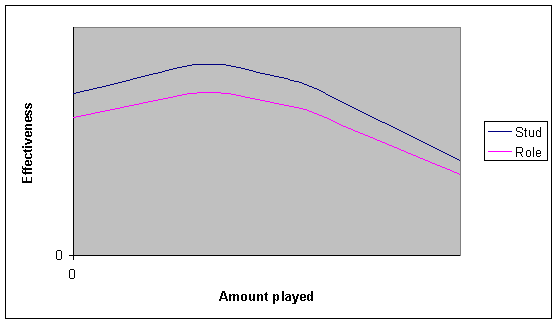
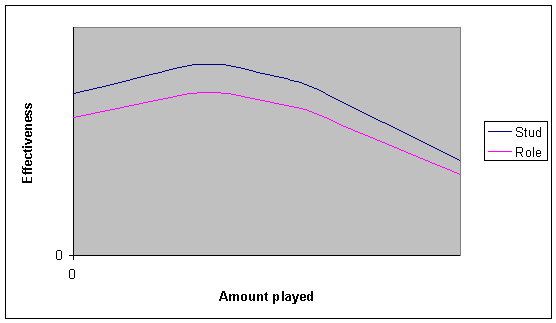
There are two “efficiency curves” that are relevant to playing time and role. One of them is how a player’s performance varies based on how much he’s put in. The other is how his performance varies based on how much he’s asked to do.
At the one extreme, it’s hard to be effective playing every 10th point. At the other, too much play leads to fatigue or pacing and a similar decrease in effectiveness. You want your team to be at a sweet spot where your stars play as much as they can without losing effectiveness while getting your role players enough time to be effective, while maintaining the flexibility to ride one or the other a little more due to a hot or cold hand or an injury.
The first graph shows what I’m guessing a typical curve is for a stud and a role player, and a replacement player. (You can think of the x axis as either “readiness” or “points played”.) I think the shape of the curve is about the same for everyone, with the exception that well-conditioned athletes won’t drop off as quickly with lots of play.

So, the question for subbers is, can you incorporate this model into your subbing scheme? How much does a player have to play in order to be near his peak effectiveness? How much is too much before you start to see fatigue-related errors? Have you experimented with designating some role players to “on” one game (maybe they’ll play 8 points) and “off” the next (0-2 points) instead of being half-on (5 points) for both? Do players rebel against this?

The other curve shows how a player can bear a load when he’s in. On offense, if a player’s full job was to cut for goals, he’d be more effective than if he also had to work the disc. On defense, a player might be able to prevent the third handler from doing a lot, but would be toasted by the star cutter.

A good role player will actually be better than the stud at the subordinate tasks like filling or clearing or reacting to the poach, but the reason that the stud is the stud is that he will be effective when it’s his job to be the first cutter or to break the mark or to cover the top cutter.

Anyway, I’m not really sure what you’re supposed to do with this, but I’ve been thinking about it and wanted to write it up, so there.

Monday, June 27, 2005

#98

This weekend was the estimated 98th tournament victory of my career, as DoG outlasted everyone (including the fans) to win the Boston Invitational (ne Easterns).

I heard one of the tryouts say excitedly to a friend that this was his first tournament victory. I often don't remember how few teams actually win tournaments, even those teams that do well. In the three years I played with Earth Atomizer, years in which we made Nationals twice (once going 3-2) and the semis at Worlds, we won exactly one tournament, the Clambake in 1990, which oddly enough was the one tournament that Earth went to that NYNY and Titanic did not.

I started writing down my tournament results in 1992, the year some Earth friends got bought out by Titanic, and after which I've been averaging half a dozen wins a year (full results below). Prior to that, I think I won 16 tournaments in my first 10 years:
1989-1991: Clambake 1990, Mars 1991 (with Pittsburgh)
1983-1988 in Cleveland: We won Sectionals in 1988, 1987, (I didn't play in 1986), 1985. Probably a couple OMITs.
1983-1989 in Pittsburgh: Fall Sectionals in 1986. There were spring Sectionals back then, too, and I was probably on the winning team 3 times then. There were 3 summer league titles. I think I had two other Mars titles in addition to 1991.

Victories by year from 1992-present: 6, 5, 9, 6, 8, 8, 11, 5, 6, 6, 5, 3, 4, 1. In 1998, I was on the winning team at Hawaii, Fools, Hingham, Corporate League, and Get Ho Ho Ho!, along with DoG victories at Turkey Swamp, Mothers Day, Easterns, Sectionals, Regionals, and Nationals. Funny, though, when I look at the little black stat book for that year, the two items that jump out are a 2nd place finish at Poultry Days and a 13th-16th place finish at Tuneup. The Poultry Days loss really should have made my list of worst losses, but it slipped my mind. We were a little short-handed that tournament (playing with Red Fish Blue Fish), and had maybe 9 or 10 for the finals. We seemingly had the game in control, though, going up 7-2. I only remember two details of the demise: Steve Finn made a layout bid on what would have been the winning goal (or it may have been earlier) and just got a finger on it (unfortunately, the pass was intended to a woman standing open behind him), and Marky Mark caught the game-winner but Matt Greff got the credit in the newsletter. Oh, and I missed my flight anyway because I hung around the fields for too long. For Tuneup, I had written on my web page "Interesting schedule, but too much for a hot day. 6 games on Saturday, all of them close. Went 2-1 in the first pool, advanced to the top half. Then went 1-2 in that pool, beating eventual champion Ring by 1, but losing to NY by 1 after being up late and to Sockeye by a few, and so we were sent to the B pool. We went down 7-2 to Red Tide, then have a spirited comeback to tie it at 10-10, next point wins. But they completed another huck to win it and send us drinking. Small squad again."

Anyway, we won this weekend. There was one point in the quarters with at least five turnovers per team. Later, Lyn was trying to ingratiate himself with Alex and me, and noted, "Well, the important thing is that the three of us weren't in that point." "No," I corrected him, "the important thing is that Alex and I weren't in that point. It's ironic that you weren't in that point." Al and I chuckled like schoolgirls about that one.

Thursday, June 23, 2005

Roster limits of 15

Suppose the UPA institutes a roster limit of 15 players for the fall series. What effect will this have?

80% of teams will be worse in absolute terms. The overall level of play will probably decline. There will be more parity.

How will various teams be affected?
All teams will be hurt a little because practices will be harder to do.
The best teams from big cities will be hurt a little because of this.
Conglomerate teams will be hurt significantly as practices become much more difficult to field 7s, and players decide to stay locally.
Second teams from big cities will be significantly better. There might even be enough interest in a third competitive team.
Small-market teams that currently do not lose players to conglomerate teams will be hurt a little because of the practice effect. Small-market teams that currently lose players will be helped a lot.

Why will play decline?
With this few tournament players, the level of play will have to decrease because players won’t be able to maintain that intensity and quality playing 50% more. (Roster of 21: play 1/3 of the time. Roster of 14, play ½ of the time. ½ is 50% more than 1/3.)
Practices will have no subs and won’t be intense. Many practices won’t even have 7 on 7, which means no zone or junk D practice, funny offensive lines (2 handlers, 2 middles, 1 deep?), and unrealistic spacing.
Some good players will retire/play coed rather than compete on a lesser men’s or women’s team.
Some decent players will want to play but won’t make it on any roster, and unless there is a critical mass of them and at least one or two are organizers, they’ll be out of luck.

On the other hand,
Players will have to condition better, so maybe that will raise the play.
Second-string elite teamers will now be playing bigger roles on lesser teams, bumping down those players to a lower level.

And another thing:
There will be more tournaments, as teams decide that they can’t get that much out of 6 on 6 practices and so will decide to go a relatively weak tournament. Having more tournaments that are competitive is definitely a good thing, but what is the cost? Perhaps it is that teams won’t practice much. Maybe this would lead to a rise in conglomerate teams who get together at tournaments every weekend.

And one more thing: I’ve been discussing this from a team level, but of course it is individuals who play. I listed a few types who would be hurt by this, but who is going to be helped?
Players who would prefer to be a big fish in a small pond but all the other fish prefer a big pond. (Ok, let’s be a little kinder to them: perhaps they think that it will be better for their career if they spend a year or two playing full-time at AAA instead of practicing with and riding the pine on a big league team, and without roster limits there would be no AAA team for them.)
Players on a team whose natural roster limit is 15. They actually won’t get any better or get to play more, but their best opponents will be a little worse. (Otoh, maybe their chances at making Nationals are lessened. Red Tide might have been good enough to beat Dark Horse twice when it counted, but they probably weren’t good enough to beat Dark Horse reinforced with a few of the extra players from DoG.)

Discuss.

Tuesday, June 21, 2005

blowouts and upsets

Are there too many of these in ultimate? Are upsets so unlikely that most games are a given? A couple months ago, during the ever-so-boring winter, I took a look at the RRI for club teams for 2004 (rankings are no longer available on the UPA site since the 2005 season is going on). One nice feature of this Bradley-Terry model is that you can easily convert rankings to expected point differentials.

The next logical step is to convert point differentials into expected winning percentages. I want you to make a quick guess on the following problem. If the rankings predict a 15-12.5 victory, how often will the underdog actually win?

Baseball teams that outscore their opponents by that ratio will win about 59% of their games (96 wins in a 162 game season). NFL teams: 63% (10-6). Soccer teams: 55% (counting ties as half-wins). NBA: 94% (77-5). Ultimate: my brief, severely flawed study shows 65% for women's games and 85% for men's. An earlier brief, less-flawed study came up with an estimate of 67-75%. (The other estimates use a version of Bill James' Pythagorean Theorem, which says that the expected winning percentage is A^N/(A^N + B^N), with N=2 for baseball. Other sports' exponents: NFL 3, NBA 15, soccer 1.2, ultimate 4-6. If you had a sport where every game was 1-0, the exponent would be 1.)

I took all the games for the top 27 ranked teams in 2004, and grouped them according to the number of goals a lower-ranked team should score against them. For instance, where the score should be anywhere between 15-14.99 and 15-14, the higher-ranked men's teams were 59-34. (Incidentally, I think the one defeat for 15-7 men's teams was a mistake in the reported score.)

One major flaw is that this method uses actual results to predict those same results. Really, the rankings should be calculated ignoring each game, one at a time, and then using that. But here are the results:

Men Women
Spread W L W L
14 59 34 19 7
13 65 29 20 10
12 51 9 36 19
11 45 3 31 10
10 45 3 42 4
9 52 1 35 0
8 35 0 44 4
7 30 1 29 0
6 18 0 38 0
5 29 0 28 0
4 22 0 23 0
3 20 0 27 0
2 23 0 24 0
1 21 0 37 0
0 17 0 52 0

Couple other interesting things: women's game are much more likely to be expected blowouts (three times as many 15-0 matchups), and slight underdogs in women's games actually had a much better chance at victory than in men's. But maybe that second part is just an artifact of the ranking system, since the disparity in women's abilities are much greater and it messes with the rankings since you can't win any worse than 15-0. (The #1 women's team is expected to beat the #14 women's team 15-5, while that matchup for guys would be 15-10.3.)

Overall, about 45% of men's games and 60% of women's games were simply going through the motions to see what the final score was.

Friday, June 17, 2005

in search of the perfect game

One of the hidden gems in our book is a little statement that you generally need three errors to make a turnover. (Of course, one monumental error by itself will do it just as well.) One cutter starts his long cut from too deep, then the fill breaks in too late, and the thrower just puts it up instead of calling a timeout or looking sooner to the dump. People tend to assign the blame to the thrower in this case, but he never would have been in that situation had not two teammates made mistakes before that, mistakes that will never show up in their personal stats.

I'm grumpy on the field sometimes after I make a mistake like this, even if no one else notices because we scored anyway. I'm always in search of the perfect game. It's easy enough to have a turnover-free game occasionally, but the truly perfect game is much harder, if not impossible.

I don't think a stat sheet would ever capture this, unfortunately. It would show up in other people's stats or the team's stats, since that stall 9 desperation turnover now appears as a simple 10 yard completion, but no one would have any idea why it happened.

I sent off an article about this titled "Team errors" to Chasing Plastic, but they've apparently had some publication problems. As I say at the end of that article, it's the mistakes you don't make that win games.

Wednesday, June 15, 2005

When Jim loses it

In the "Sprinting" post, two teammates referred very cryptically to events where I lost focus during practice. More correctly, I threw a nutty. I've played against guys for 15 years who have never seen me do this, but it can happen. So, without further ado, here are some of my nutties over the years:

1. In 2002, back when Wicks wasn't so old and over the hill that he had to stop playing, we were doing one of his college-boy endzone drills that I had last done in 1988. A subplot to this was that Alex and I had both been saying for years that the "sprint from the back of the stack to the only possible place that you could cut" cut was bad for endzone offense as it was often well-defended and it took forever to materialize, and that quick cuts from the front of the endzone were more in line with our basic offense (and, as Idris would note, were the kind of cuts that we each preferred to make). So, not only did we have to do a drill, but we had to do a stupid college drill that taught bad ultimate, and we had to keep doing it until we completed 20 in a row. (I'm not sure of the details of it any more, so I might have one or more inaccuracies from here.) We kept turning it over (I don't even think there was defense involved) and kept going back to 0. Finally, after yet another miscue (I might even have been involved in it), I just grunted angrily and walked off the field and sat on the bench about 40 yards away and stewed while the TOs kept on coming. Eventually Jeff Brown wandered over to ask me please to return to the drill for the team's sake. I refused. He persuaded me to walk _towards_ the drill and watch it from the back of the endzone, and I grudgingly accepted.
I wasn't a very good teammate that year.
2. Let's go to the email archives for this one from fall 2001 (also, I note that I had broken a blood vessel in my eye at the track that Tuesday from squinting in anguish so hard):
I went ballistic at practice Thursday night. There has been an increased emphasis on "hard" marking lately, with no distinction made between legitimate aggressive marking and lazy hacking aggressive marking. I said my piece earlier in the year about "let's not cheat, please" and said I didn't need to keep saying it. On Thursday, though, both teams were lazily or deliberately fouling an awful lot on the mark. After one near-tackle on one of my O teammates, an injured D player on the sideline shouted out encouragement to the fouler, and I couldn't take it anymore. I tore off my shirt and started to walk off the field, saying I couldn't take this bullshit anymore and I'm sick of this cheating. Someone said that the O was fouling too, and I agreed that both fuckin' teams were bullshit. Someone pointed out that there had been a request from the O to get some tighter marks so we could get used to it, and we only had 7 players, so I put my shirt back on and resumed playing. But I made short work of my defender, caught both goals (we were playing double score), then had a hearty spike into the ground. I was still pretty fired up the rest of the practice.

No one said a word to me about it, but first thing Saturday at practice, Nathan clarified what he meant by aggressive marking, I thanked him and added that there has been no distinction from the sideline between good marking and sloppy marking.
3. Nationals 2002, pool play against Furious. Again, from the archives, edited for protection:
I was covered for most of the Furious games by Ricky Melner, who had previously played with Oregon, Sockeye, and BoG. He had a very late hit on me in the 1997 finals, when I jumped straight up and had practically landed when he got there with his bid. Gewirtz had fouled Seeger and contested, then did a quick, quiet tap-in which only I heard, being a few yards away. I therefore cut up the line, Seeger threw the floater, and I caught it in the endzone before being taken out. I got up and screamed "You fucking asshole" before realizing I couldn't breathe and collapsing again on the ground. Meanwhile, both teams are gathering around the Seeger/Gewirtz argument, perhaps when Jeremy called Jon a name for the cheap tap-in. Only Bim runs over to me, asks me if I'm again, I nod and mutter "Wind," to which Bim says "Ok, good" and trots over to join the discussion.

So, on the first point of _this_ game, they play a transition D and Ricky ends up covering Cogan. On a tight pass in the endzone, Ricky sorta tackles Dan and I yell, "Nice fuckin' cheap play again," "again" referring to the above play. After the point, I say, "I'm sorry, I'm still mad about that play five years ago", and Ricky knows immediatly what I'm talking about. Anyway, over the course of this game and the semis, he fouls me repeatedly on the mark and while cutting, and I call him "cheater," "fuckin' cheater", "mother fucker", and probably one or two related terms.
---
Umm, please disregard the above paragraph when viewing other things I write about how to behave on the field.
4. Gewirtz, once or twice, maybe more. In 1990, while they're drubbing us, he drops a pass and I begin sprinting for the fast break, and he kicks the disc. I think I tell him that he has fouled me more than the rest of ultimate combined, which may have been true at the time. Then in 1992 semis, I run at him to force him into an error, then sidestep him, only to have him lean into me and sprawl back while calling foul (or call foul while sprawling back). Instead of a goal, it's a foul (amazingly upheld by the observer), and we turn it over.
Jim: Jonny :: moth: flame. I've hated him and made my peace with him a couple times. I don't remember where we stand now. He's a dad, I'm a dad, I offered to help him get his kids to the field before our quarters game last year. I had an extremely odd and interesting conversation with him at Tuneup once (overheard by a dozen people sitting on the line next to us) where he talked about crazy people he grew up with and living on a kibbutz and his past.
5. Indoor soccer, that fat clumsy guy who took me out once and was cheating non-stop the way that soccer players try to do, except that he wasn't any good so he just came across as an ass. More f-bombs and screams and threats and uncontrolled anger. I think I blogged about this earlier this year.
6. Steve Frombach, senior year of college. He pledged our frat, lots of people didn't like him, I didn't necessarily like him either but I went out of my way to defend him for some reason, he depledged and then pledged a neighboring frat. I ran into him at a party at the other frat, and he went out of his way to be an ass. I said, "Steve, I'm above you" and walked away to stew. After a few minutes, I just couldn't take it any more, and went and found him and said, "you know what, I'm not above you" and pushed him. People stepped in and calmed things down, but later, a fellow frat member said that with how mad I was, he was scared because there was only him and one other guy between me and Steve.

Tuesday, June 14, 2005

Mechanical cutting

I noticed that some of the tryouts this weekend cut very mechanically. They might fake, but then their actions do not depend at all on what their defender does. They don't even appear to be watching the defender at all.

Idris talked about this in his Oh you had 'em blog entry (Idris has this annoying practice of making everything point to idris.org/ultimate, even when you link to another blog from his page). Players just don't seem to realize when they're open. I commented there, "Bad players either plan too many fakes or else they get so caught up in trying to read the defender that they misread him. Instead, do a simple fake, expect that it's going to work, but be ready to do something else after 2 or 3 steps if you see that it hasn't worked."

Maybe the way to drill this is to have them watch real cutters and defenders and attempt to identify the exact moment at which the cutter simply needs to move in a straight line to get open. Anything a cutter does after that is at best inefficient and at worst the first part of a miscommunication turnover.

We sometimes say that a cutter has several seconds and several options before he has to clear, but that includes the setup time, which should occur before the disc is live.
1. The setup. As the disc is in the air to the new thrower, the cutter moves into position and might do a little bit of juking, but is basically trying to force the defender into a repositioning error.
2. The cut. Make a final sell and then go hard in one direction, making a commitment. THEN you evaluate whether you'll be open. When you get good, you'll know as you're making that hard move whether or not you're successful. If not,
3. The 2nd cut. Turn 90 or 180 degrees and go hard that way. If that's not open, clear. The only exception is when you're in an iso situation with a lot of field and the defender overcommits to the 2nd cut, and you are 100% guaranteed to be open in a good place if you return to your original direction.

I guess basketball players work on their fakes by themselves, repeating until they've internalized the sequences, but they will still need the feedback of whether their defenders are going to buy the fakes.

Monday, June 13, 2005

sprints

Speed is a product of stride length and stride rate. When you're tired during a workout or during sprints at the end of practice and you feel that you can't maintain both, pick one of them and maintain that, rather than cheating on both. If you're maintaining your stride length, just think about keeping your form, with head still, arms moving forward and not left-right, and good steps.

(Nothing more to read.)

Thursday, June 09, 2005

More about fouls

I've been having some discussions with a bunch of people about whether the game is deteriorating as shown by the 85 calls in the College Nationals finals between Brown and Colorado.

As always, the answer is yes, but I'm not sure what to do about it.
I think it comes down to two things:
1. More markers today make it a practice to mark so closely that a lot of fouls are inevitable, although no single one is intentional; and
2. More players make calls that are legit per the rules but that few 5-10-15-20 years ago would have dreamed of calling.

These reflect a change in the culture of the game, and perhaps the culture of America.

Some are calling (and I might end being one of them) for some new set of penalties to discourage games from getting out of hand. The rule being suggested (two overruled calls or contests results in expulsion for the rest of the game) doesn't strike me as being particularly effective, but I'd like to see something positive done.

Is there a way to get the culture to change? Colorado has been cited as being especially offensive with their treatment of opponents, their own players, and their general approach to the game as some bad-ass Program that everyone else just wants to take down. I don't know whether the kids on the team know any better, but there are enough good people that they should be looking to as role models that this doesn't happen.

Oh, the usual disclaimers about how this isn't necessarily representative of a trend, I'm not blaming everyone who plays, and I know that old people are always saying, "Kids today."

Tuesday, June 07, 2005

Masters, day 2

Well, we beat everyone at the tournament, and we had fewer losses than every other team, so in one sense, we were the winners.

But in another, more accurate sense, NY was the winner. We just didn't force any turnovers, made a few ourselves, and lost 15-9 in the finals. It was again very hot, and we had few subs (1-2 in the semis, 4-5 in the finals) although we had some cloud cover toward the end.

It was great conditioning, and good working on some throwing skills (and swing thoughts!), but not good for developing good cutting or defending habits. Good defense requires a lot of work. Good offense does, too, but if you're playing against bad defense, you really don't have to work hard either physically or mentally to get open. I made some very lazy cuts knowing that I would get open anyway and that I wouldn't have gotten open doing the same thing in the fall.

My decision-making was occasionally lazy, too. Part of that was due to a fear of Mooney. Even though he's 47 and long retired, it takes a brave man to look him off even if he's not really open, and I only had the guts to do it once.

The "stay low" swing thought was a mixed bag. My forehands were still turning over a little bit (except for one which stayed flat and out of bounds and another into the wind which floated) but had decent length on them. Alex said that I still wasn't getting low. I only threw a couple backhands but those went well. It wasn't a problem for me to take the time to have a swing thought. There was one time where I didn't, and threw the disc from a fairly upright position, and the disc did indeed turn over more, but I had to get the disc there fast and as a result there was a lot of margin of error on the throw (which got there for the goal).

Our field sense was good as a team, and we didn't have any players (unlike the other teams) where you questioned their disc skills. We even ran a spread O (although it was called the "Swedish," it looked suspiciously like the "brown" O we have run on DoG for the last 5 years some of the time).

My body is nearly recovered after lots of leg twitching. I felt my calves twinge a couple times during play, but never actually cramped then (only while sitting at home on the couch).

Saturday, June 04, 2005

Masters, day 1

Today was literally the second warm day of the year in the Boston area, and we had four games to 15 with 9-12 players. Big Ego Ultimate is playing in the Masters tournament at Devens this weekend, with 5 teams from all over Boston (actually, two from here, some NY guys, a team from Western Mass, and Pittsburgh). DoG is playing in Jersey, but there's no way I could have made that tournament anyway. It's so hard to get away to those random spring tournaments anymore, but back when _I_ was in my 20s, I would have gone to this with 8 guys and loved it.

I was cramping by the last game today, about the 5th time that's happened (Goaltimate II, summer league that one year where I couldn't complete a sentence after the tournament, ECC, one other). My legs started their weird twitching sometime during the third game. Lots of water, not much food or sports beverages. No sunblock. Wore a hat a little, but I can't even play softball wearing a hat. Pretty effin' stupid, in summary, especially when we had only 2 subs for the last game and a half.

Lots of old DoGs, Mooney, Alex, Dennis, Cork, Bickford, Bim, me, Whitey. Dude, we rock. 4-0 today, three wins by 15-11 or 15-12, one other game. Semis and finals tomorrow, but we had only 7 guys lined up for tomorrow as of 6:30 tonight. I think our youngest player was 36, and most are in our 40s. Cork was hoping to use this as a springboard to a fall Masters team, but it doesn't look like it will pan out.

This should be good training for me. In the old days, I would just play my way into shape by killing myself at spring tournaments, but most of them these days don't offer the opportunity to do so.

PS. Worst blog entry ever.

Thursday, June 02, 2005

the american life

There were two articles in the Sunday Boston Globe that caught my attention. One was about a philanthropist who made a promise to some 2nd-graders 15 years ago that he would pay their college expenses. The other was about trying to repair a baby's defective heart.
The article (which is available only through the paid archives, but here is a link to a related story) said that only 4 of the 69 2nd-graders from Cambridge have graduated from 4 year colleges on time. An editorial today paints a slightly rosier picture, as an additional 12 completed technical school and 25 are still in college, and the offer is good through 2008. But still, to me these numbers are shockingly low, and what's worse is that these numbers are considered to be above average. These kids and their parents and their teachers had 11 years to prepare, without the excuse of "how can we afford this", and yet so many of them didn't make it.

I bring up the other story less for what happened to the kid than for what it means for everyone. A baby was diagnosed in utero as having a hole in his heart. The parents decided on an experimental procedure to fix it. It was only a partial success, and the kid had to undergo the standard procedures once he was born.

Nowhere in the 4500 words did the cost get mentioned.

As a parent, I was saddened by the ordeals this family had to go through (I've been told that I have very little empathy, but having a kid changes that). But I just didn't know what to make of it. The procedures must have cost hundreds of thousands of dollars, the family was typical middle- or upper-middle-class, so who is paying for it?

Maybe it's just considered R&D money, as one theme of the article is that doctors need to do dangerous procedures now so that they become viable in a few years (one ethicist even argued that the parents have an obligation to society to consent to the surgeries). Companies certainly have the right and stakeholder obligation to invest in the future, and in this case, the R&D benefits not just this particular company/hospital, but all companies (and thus all of society) since they share knowledge.

On the other hand, maybe the best thing for these kids is to die with dignity (which a majority of the experimental physicians said they would do if it was their own kid).

I think this illustrates the best and worst of American medicine. It's really amazing that doctors can and do go in utero to try to save a baby's life, and that's possible only because they keep on trying. But on the other hand, to spend that much on such a small chance of life while other things go untreated says something too. (And it's not the parents' or the doctors' money that is being spent, or even the hospitals' money as the costs are probably being absorbed by the system. Although others might have, I wouldn't have even brought it up if it was Bill Gates spending a couple million of his own dollars on his kid's life.)

And I don't know what I would do if it was my kid.

Wednesday, June 01, 2005

swing thoughts

One of those golf magazines had an article a few years ago on the top 25 swing thoughts, images or key points that you keep in your head as you swing. I have probably spent more time golfing in my life than I have playing ultimate, but I still need to focus on a swing thought in order to get my swing back to where it is supposed to be.

Yesterday, I tried a swing thought for my long throws.

I could not believe how successful it was. Without consciously changing anything, my throws became better and more consistent. Whether I'll be able to focus on a swing thought while playing is another matter (I was just throwing in my back yard), but could it really be that simple?

And if it is, why couldn't anyone have told me this? Is it so difficult to analyze the throwing mechanics? There are literally millions of golfers who could have made a comparable diagnosis of a hitch in my golf swing.

For the record, the swing thought was "stay low". I mentioned this today to Alex, and he said, "Yeah, especially on your forehand. It wouldn't turn over so much." Thanks for the effin' tip, Count.