Showing posts with label strategy. Show all posts

Sunday, September 16, 2007

goaltimate strategy

We played some goaltimate at the start of practice last weekend and actually had to stop in between games to explain some basic strategies. Although I was surprised that we had to, I guess I shouldn’t have, as most hadn’t played before. The two key ones were:
  1. Get the disc to a power position just in front of the goal.
  2. Position yourself on defense like you’re playing basketball, not ultimate.


Now, the first of these may be partially or mostly dependent on the style of offense and defense that we play, which is largely unchanged since we won $2500 at the Inaugural Goaltimate tournament in San Diego in 1999. Atlanta had great success against us at the Goaltimate Grand tournament by setting up 5-10 yards outside the goal and extending the defense, but otherwise we’ve not really gone with any setup much different from “get it in front”, and the defense is generally “clog the front”. But perhaps this is due to offensive success at the fast break, quickly taking advantage of any defense that extends all the way out to the clear line (and fails to get the turnover). Hmm, another factor is that probably half of all goaltimate games played in the Boston area in the last 10 years have been in the snow, which acts as a great impediment to wanting to run a lot. Whatever the reason, we tend to play half-court.
For defensive positioning, we face-guard a lot when we play ultimate but that is deadly in goaltimate. Even when the defender does more triangulation, the basic position is between the thrower and the receiver. In goaltimate, the default has to be between the receiver and the point beneath the center of the arch, facing the clear line with body turned to the outside. But some were initially playing even with or in front of the receiver, allowing the receiver a clear path to the goal for a leading pass.
There was also a little bit of unawareness of feet, with at least two uncontested, not that difficult catches coming with a receiver just beyond the goal.

We played again today and though it was better, there was still a little more faceguarding than is good. We also got plenty of good experience at dealing with bad calls from the other team, and one of our games ended up with both teams declaring themselves the winner.

I suggested once or twice that we ought to play a full game (or even a point) completing following the rules, but then I thought, "what's the point?" other than to prove a point. Notable violations would include miniscule travels, saying "stall" or just "one" instead of "stalling", invasion of body space, and offsides by both teams if playing ultimate. I vacillate between being a rules lawyer and a hippie. Most of the time, I end up following the rules myself, noting others violations, and doing nothing about them other than an occasional snide remark.

Got off one good zing as a teammate was misintepreting the rules on a few occasions, as he does with the golf rulebook. "A little knowledge is a dangerous thing, Jordan." Alex laughed, as did I, and that's all that matters.

Anyway, any comments on goaltimate strategy?

Friday, June 08, 2007

Field sense

Here is a cool article on teaching field sense. Here's one really good quote:
Farrow has found that players who make poor decisions tend to glance at targets, rather than pausing on them. They're also more drawn to motion. "In a lot of team sports, you're attracted to the area of greatest movement," Farrow says. "But just be-cause there's a person running fast and waving his arms doesn't mean he's the best person to kick to."

And here is another interesting link, though interesting in a different sense.

Friday, June 01, 2007

Purposeful walking

At the White Mountain Open, I was given a backhanded compliment along the lines of "you're old and slow(er) but you still get way open. How?" After kicking him in the groin, I explained to him that it was all about positioning and knowing when to just run.

Good defensive positioning is a dynamic process. What might be good position at one point is suddenly way out of position a few seconds later as the disc is swung or the players move a few yards. The defender basically decides what cut is not a threat to the team and so doesn't have to respect that cut. Examples: player 50 yards away, a deep pass is not a threat, defender plays in front. Cutter at the back of the endzone, only cut is back to the disc, defender plays in front. Marker takes away dump pass, handler defender doesn't overcommit on a cut to the dump. The defender will follow if the cutter goes to those places, but the defender won't try to beat the cutter there.

So, what you do on offense is to try to change the position so that the defender either continues in their relative positioning (thus opening up what was previously not a threatening cut) or alters their positioning (thus opening up the cut they were trying to prevent at first). For instance, you are handling, standing about 10 yards directly in front of the thrower, being forced one direction, say, forehand. The inside-out is a very tough throw here, and the around break will take long enough to deliver that the continuation isn't that much of a threat, so a good defender will position himself to allow you to cut inside-out. What you do, then, is to take several steps to the open side. If the defender keeps the same relative position, the inside-out cut is now wide open and is an easy throw straight up the field, and a threat to deliver a continuation pass. If the defender adjusts to be more in front of you instead of to the side, you may be able to cut back to the disc for a swing or laterally for a leading "away" pass.

Downfield, you are more likely to work in/out positioning rather than side-to-side. Say the disc is being walked in, and you are planning on cutting first. Put yourself somewhere near the middle or middle-back of the stack. Prior to check in, you reposition yourself further back in the stack, slightly on the open side. By starting out in the middle, the defender will usually adopt a position that at a minimum respects the deep cut (and sometimes even takes it away and concedes the in-cut). As you get deeper, they will usually maintain the same relative position to you, but suddenly the deep cut is not an option, and the in-cut is that much more open. A smart defender will adjust at this point, but amazingly, there aren't that many smart defenders out there [insert general disparaging comment about the intelligence of defensive players versus offensive players]. In the last couple steps before you actually cut, you can also drift more out into the open, making it more of a straight shot clear of poachers. Then simply plant and run hard to the disc. You may also throw in a step away or right at the defender before cutting in, but it's just one step, and you are not waiting for a reaction from the defender before going.

(This is what I have previously called a "quick fake", where you do a fake and continue on to your real cut or throw without waiting for a response. A quick fake is a diversion. A "slow fake" involves making a motion and then reacting to the defender's response. A bunch of back-and-forth jukes from a handler is a slow fake (even if those jukes are quick), because the handler is waiting for a sign that a defender has overcommitted or not reacted before deciding where to go. Sometimes a quick fake becomes a slow fake. A thrower might lift the disc suddenly to set up a low breakmark forehand (the quick fake), but if the defender anticipates correctly and shuts off that forehand, the thrower pivots to the backhand break (the slow fake). A cutter is on the open side and has both short and long open. Do a quick fake out to set up the in cut, go hard in for two or three steps and then read the defender's reaction. If the defender has anticipated the in-cut and has maybe even overcommitted to that, you immediately stop and cut deep as hard as you can.)

Sometimes, through no effort on your part, an "opportunity cut" will present itself. Maybe you're in the stack a little on the open side, your defender is fronting you and not watching the disc at all. At that moment, you're not a deep threat because the disc is not in a position to be hucked. However, you see a swing pass go off to the open side and the receiver is someone who can huck it. Suddenly, you're in great position to cut deep, provided that your defender keeps his focus on you. Allow him to do that by pretending to prepare for your own in-cut. Then, you make a hard step in and immediately reverse and cut deep. The defender will be backing up and even if he is faster than you, you will have enough of a head start that it shouldn't matter.

So, the basic idea is that you need to identify an area that you would like to cut to, then purposefully walk (or shuffle, or run if you must, I suppose) in the opposite direction, giving the defender the opportunity to make a mistake in positioning.

Tuesday, February 06, 2007

Studs Theory vs Plug N Play

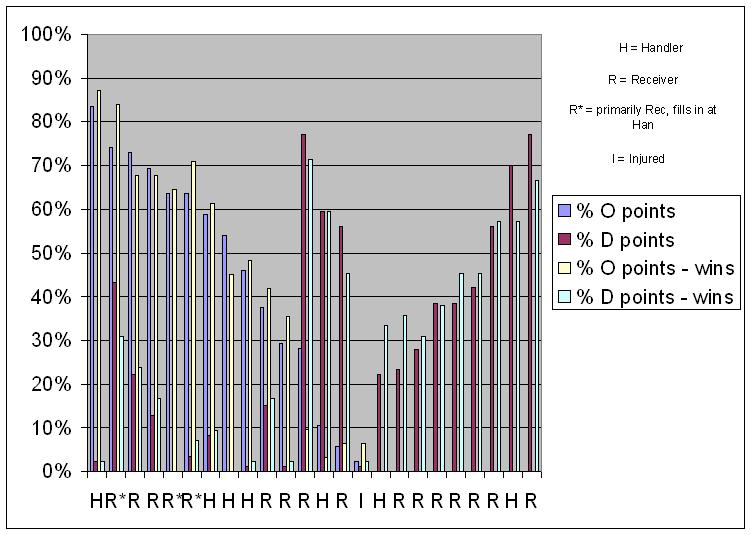
UPDATE: Added graph that showed profile in games DoG won.
REQUEST: If you have subbing sheets for your team at Nationals, please contact me if you'd be willing to share them (after anonymizing).

At Nationals this year, DoG had the flattest playing time profile I’ve ever seen. Only one guy played more than ¾ of the O points, and even he was only at 83% (sitting out about 2 O points per game). In contrast, vintage DoG and practically all the top teams now have several guys who more or less played every O point.

Here’s the graph. Although not necessary for the purposes of this discussion, players are categorized as Handlers, Receivers, or Receivers who played handler if necessary.


Some points:
  1. Lots of guys didn’t play any O; only me and Al didn’t play any D.
  2. The top 7 O played only 2/3 of the time, leaving an average of 2+ guys on the line each point who weren’t considered starters.
  3. D % played is less (7th most is less than 50%).
  4. Only 3 or 4 guys got more than a token amount of points on both sides.
  5. Although this is averaged over all games, and you would suspect that the numbers would be different for tough vs easy games, DoG didn’t have any easy games at Nationals last year, and there was no real difference between relatively easy and relatively tough. There were about an equal number of O and D points.


Some of this is obviously do to a flatter talent level, which unfortunately is probably due to us not having the players who would be selected to an All-Nationals team, rather than having every player be that way. I found it hard to sit out so much and then try to take on an important role when in. The flat profile means that there are only a couple real starters (and even they are barely so) and everyone else is a sub. Ego has to be part of an offensive player's package, and being handled as subs destroys that ego. To belabor the point, starters do not merely play more than subs, but they do more when they are in. By telling each player that he is a sub, the team also tells them that they aren't good enough to be the man when he is in the game. Equally importantly, the player has to draw one of the following conclusions, depending on how the subbing is done: either whatever I do has little effect on my playing time, in which case I don’t have to play smart, or I am going to be benched if I make a mistake, in which case I probably should play so conservatively that I’m not going to help the team.

Friday, December 01, 2006

decision-making

I'm going to be doing a presentation at the Ultimate Coaches & Players Conference to be held in a suburb of Boston on January 27 of next year. As George mentioned, registration is now live. Mention that you saw it on this blog and you can register for only $40 through January 7. I think the organizers also mentioned that their meeting space will limit the number of people that can attend, so register early.

Here is the abstract for my presentation:

What separates players with equal physical ability is the mental ability to process information and make decisions on the field. While innate differences exist in this mental ability, it can also be developed through practice. This presentation will examine many areas of ultimate where decision-making comes into play (throwing, cutting, reacting to poaches, defensive positioning) and will touch upon team-level decision-making during games.

Tuesday, November 21, 2006

HnH and SLG revisited

There are really two dimensions to the Huck ‘n’ Hope, and I’ve been ignoring one of them. Let’s consider four teams:
A: Cuts deep relentlessly, hucks it to 50% of those cuts
B: Cuts deep relentlessly, hucks it to 20% of those cuts
C: Cuts deep occasionally, hucks it to 50% of those cuts
D: Cuts deep occasionally, hucks it to 20% of those cuts

A and B might be considered aggressive. D would be labeled by all as conservative, and C probably would be considered conservative. But looking at it another way, the throwers on A and C are the aggressive players, while B and D’s throwers are considered conservative. I’ve only been considering how often teams throw deep, ignoring how often teams throw deep given the number of deep cuts they get.

I think B is probably the best strategy. This is what golf mental game guru Dr. Bob Rotella refers to as “conservative strategy, cocky swing.” The problem with A is related to decision-making. Other things being equal, B is going to have a much better huck percentage than A while still hucking on almost as many possessions (but will make more passes before hucking). A will chuck it any time the receiver has a step and they can get the throw off (think Allen Iverson). B will eschew these marginal choices and will require a little more before deciding that it’s a good choice.

It’s certainly possible to go too far. If you only take 90% chances, then maybe you’ll complete 90% of your hucks, but you’ll be passing up 80% shots when you only need maybe a 50-60% chance to come out ahead.

So, who wants to be the one to say who A, B, C, and D are? And who from those teams wants to refute?

Friday, August 18, 2006

Training, ECC preview

The four stages of training in a stud's career:
  1. Training? I don't need to train.
  2. Bring it on, beeyotch.
  3. Whenever I try, I win the race.
  4. I have to train for the training.

Bonus training tips:
  • Plan the work, work the plan. Don't cut corners.
  • If you do decide to stop in the middle of a workout, stop at the beginning of a rep, not at the end. That little extra rest between reps can change your mind.

ECC Preview:
DoG has won all of its tournaments so far this year, the first time we have gone this far since 2001, which was also the year of our only previous ECC. We started with 14 on the only hot weekend of the year there, three of whom were on their way back from a grueling week in Japan at the World Games. We lost a couple one-pointers off the bat, played some more, and survived our way to a 2-5 record. Now let us never speak of this again.

Game 1: DoG v Rhino. I don't know these guys, but I presume they're a Huck n Hope offense. DoG's patience should prevail in this one. 13-1.
Game 2: DoG v San Francisco. Huck n Hope merged with Hope n Huck. They got Safdie but have lost all their other Boston imports, but the Boston influence should make this a close game. DoG 13-6.
Game 3: DoG v Condors. They beat us handily last time at this tournament, so that ought to be worth a couple points. I don't know anyone on their team anymore except for Hollywood. He's a top-notch Boggler in his own right, although I'm still the best, so let's say DoG 13-9.
Game 4: DoG v Furious. This is the only team that has a bunch of guys I remember playing against, and we'll be tired and a little overconfident, so it'll come down to the wire. DoG 13-10.
Party: Jim and Al again dominate, although it would be a miracle if Al loses the ro-cham-dirty-dance-with-Mr.-Sensitive-Ponytail-Guy again. However, the absence of our teammates gives the party victory to some chick team, unless the Sockeye guys get really obnoxious and start heckling them for no good reason.
Game 5: DoG v Sockeye. DoG brilliantly picks up Lou Burruss, Luke Smith, and Chris van Holmes for this game and know all the Sockeye calls as well as pointers for telling apart the really big kids. However, we also pick up Brian Cameros, and his infectious attitude keeps it close. DoG 13-11, guaranteeing a finals appearance.
Game 6: DoG v Bravo. A lot of hucking, no hoping. Will Deaver threatens DoG with sanctions for years of roster abuse and Sectional tournament shenanigans. A Little League coach is seen huddling with the DoG team, and suddenly every huck from Bravo is complete. Bravo 13-2.
Round 7: DoG v bye. Grab a beer and a burrito and start diagramming all the hucks to figure out whether it's the 2nd or the 3rd pass.

Seriously, I'm looking forward to the tournament. We don't get to see the West Coast teams except at Nationals. We expect to be behind them right now, but maybe seeing them complete 85% of their 50% hucks against us will clue us in on what we need to do to stop them. Obviously, the answer is to play me on D, but I'm not a machine anymore.

Wednesday, May 24, 2006

junk throws

Bane, or boon? Bad fundamentals, or a nuanced grasp of advanced concepts?

By junk throw, I mean anything that if a rookie threw away, he’d be immediately benched or cut. Depending on your environment, it could be a push pass, lefty backhand, or a thumber, or possibly a scoober, backhand to the forehand side, or hammer. It’s “If you throw that again, you’ll never play in this town again” throws. It’s “What the hell are you thinking?” throws. You get the picture.

(For that matter, it can also be one-handed catches, claw catches, and gratuitous layouts or failure to lay out.)

We all grew up with conventional wisdom about what works and doesn’t work. Someone recently mentioned to me how a younger player was complaining about why they were playing force middle, and this guy said, “A few years ago, we used to call that ‘defense’.” Things change. Sometimes the old strategy was a sound one but new strategies were built to adapt, other times the old strategy was a bad one that just happened to be the best one available at the time, and occasionally the old strategy was the best one but players just wanted to try something different. The point is that the favored strategy becomes “the right way to play” and is never again critically examined to see whether it makes sense.

So it is with some throws, too. I’m seeing more push passes these days, and we had a discussion last fall about lefty backhands. I’m prepared to say that these are acceptable throws, with the followings caveats:
  • Don’t fall in love with the throw.
  • Don’t use it to show off. I’m still ticked at some CU punk on Bravo who went out of his way to throw a thumber huck against us in the finals of Colorado Cup last year when they were up by 4.
  • Don’t throw it because you don’t want to make the effort to try another throw.
  • Be able to justify why you threw it instead of another throw.

The justification will be different in ultimate than it is in goaltimate, where quick decisions and creative throws are more necessary, and the cost of an incompletion is much less.

So, think of the push pass as a sand wedge or as a rescue club. Most of us should consider these as specialty clubs tailor-built for specific situations where our normal clubs might not work well. Just don't use them off the tee.

Thursday, May 18, 2006

more on hucking practice

Last week, I discussed a hucking practice session I planned to do. I set up stakes at 35 and 45 yards away and tried to land a leading pass at the stake, and measured how far the throws missed the target. First, some observations on my success:
  1. 35 yard throws were gimmes
  2. 45 yard throws had unacceptably wide variation (i.e., I shouldn’t be throwing them, if that day’s results are my true level)
  3. Error was attributable both to initial line and to curve
  4. Forehands and backhands were about the same
  5. Variation in range was less than variation in accuracy


But the main conclusion was that this isn’t the way to structure the practice. A huck isn’t a golf shot that has to end up close to the hole, but a 3-D throw where time is just as big of a factor in the catchability. While for every cut there may be an ideal throw, there are a variety of distance/speed/hang time combinations that result in sure completions. Also, the acceptable margin of error is not symmetrical, with more margin long than short. Finally, it doesn’t really matter where the disc lands, it’s where and how long the disc is at a catchable height. Without sophisticated equipment, I don’t think you’d be able to measure that.

So, I’d propose a slightly different setup. The setup is similar, with the thrower attempting to throw a pass that comes down to, say, 6’ high at a set distance. However, instead of measuring how far away the disc lands (a condition that is exacerbated by differences in disc stability), rank each throw on the following scale of 1 to 5:
5: pretty much as I planned
4: not quite as planned, but a sure completion
3: a throw where the receiver has a reasonable chance to come up with the sky or to chase it down if he’s really fast; a 50/50 throw
2: catchable, but not a throw anyone would be expected to come down with
1: uncatchable

For anything except a 5, make a note of how you missed, and see whether any patterns develop. You can also apply the same scale to your long throws in a game, although you also need to consider not just whether the throw did what you wanted but whether it was the right decision.

Thursday, May 11, 2006

hucking practice

So, I have a few frisbees of varying quality lying around my back yard, and sometimes I'll huck a few of them. Usually I'll only get to throw two of them before the boy insists on taking the next. On Friday, weather permitting, I'll try to do a mini-workout with about 10 of them.

I'm wondering how constructive this practice is. Experts get better by deliberate practice, implementing immediate feedback. But because these frisbees are all different, some of them drastically so, I might uncork identical throws back-to-back but get significantly different results. Probably I can limit this by getting rid of the worst discs, but there will still be some effect.

Anyway, what I'm going to do is similar to my wedge workout reported on previously. I have stakes set up at 10 yard intervals, and I'm going to try to huck to the stakes. While I won't have a calibrated swing for each distance, this should help me statistically assess my throws. What I'm expecting is that as distance increases, the error will increase linearly while I'm within my range, then explode when I try to force it (probably enough that I won't be able to measure it because the throws are going into the trees).

PS. Plyo workout last night, I hope I didn't hurt myself. Nothing is too sore today, so that's good.

Monday, April 10, 2006

claw vs pancake

I posted this to rsd the other day in response to someone’s claim that pancaking is the only way to catch:
[quotes from Zaz’s book deleted]
If I had to give a single rule of thumb, I'd say that you'd catch more passes using the pancake if all you're doing is standing and catching with someone, but you'd catch more passes in a game using the rim catch. I'll cite an example from yesterday. In the first point of the Fools semis yesterday, I cut back to the disc with Jay Dono close behind. The pass was about head height. If I was by myself, I could have taken a little hop and pancaked it at chest level, but if I tried that in this situation, Jay would have had the time to get there first. Instead, I ran through it and clawed it, and even then I think he touched it enough that it almost spun out of my hand. Pancake = block (but not a drop), rim catch = chance for a catch. Had I not caught it, someone could have cited this as an example of why the pancake was preferable, but they would have been wrong for this situation.
I liken the pancake catch to a two-handed catch in baseball. It’s how beginners are taught, it’s more secure on your basic catches, but there are plenty of circumstances where it’s not the right catch: a first baseman stretching for a throw, an outfielder diving for a catch, a shortstop going into the hole. And for an experienced, athletic player on a routine catch, it’s just as secure and might help the player get in position to throw.

I know that some good players (even a great one like Paul Greff) swear by the pancake and I’m not going to try to convince them to switch, but the rim catch is a more natural catching motion. We have opposable thumbs for a reason. A rim catch is just two one-handed catches happening at the same time.

The real benefit, though, is that it can be easier to catch in a game. You don’t have to slow down to catch the disc (and you can avoid getting run over by a flailing diver), you can reach a few inches further, and you have better feel (once you get used to it). Additionally, since the disc is already in your fingers, you can quickly take your grip for the next pass (and if the pass is at head height, you don’t have to hop as with a pancake).

If the disc is at chest height, I’ll usually pancake it, especially if it’s windy or if there is no pressure from the defense. But for higher passes or ones where a block is possible, try running through the disc and catching it with your fingers. And take a look at the book for more info.

Monday, December 19, 2005

Relative value of O and D

Here’s a paradox:
  • Offense and defense are equally important in ultimate.
  • Most of the important players are important because of their offense.
  • If you add up the individual values of all the players, the sum of the offensive guys will be more than that of the defensive guys. But see #1.


Is one of these assumptions in error? Which one(s)?

I’m going to go with the first assumption, and here’s why. The advanced view of “value” is “contribution above replacement level.” However, a lot of defense is simply showing up and not screwing up so badly that you hand away goals. A "replacement level" defense is still going to get turns, while a replacement level offense (especially in women's ultimate) is going to do really badly.

Let's just guess that in a decent game between decent teams, offenses score 50% of the time (and defenses get turnovers 50% of the time). In a blowout, say 15-5, the offense will still probably have maybe 10 turnovers, yielding a 60% efficiency against a replacement defense, meaning the other's team's (replacement) offense scores on only about 20% of their possessions. So, the average offense is (50% - 20%) better than a replacement offense, but an average defense is only (60% - 50%) better than a replacement defense.

Maybe this is what people are saying when they say defensive strategy is practically non-existent. Most of the value in playing defense is just being in position.

Part I of an ongoing thread on analysis of ultimate. (I don't really want to call it statisticial analysis because the numbers aren't the important thing, it's the concepts behind the numbers.)

Wednesday, September 28, 2005

Players make plays

1. At some level, it doesn't matter whether you play horizontal stack, German, all-upside-down, or lefty lifts. If you make good passes, you'll score, and if you make bad passes, you'll turn it. All that the system does is to create more or fewer opportunities to make good or bad passes. Leaders are responsible for the system, players are responsible for execution.
2. If two teams are equal in talent, it's the team that makes the plays that will win. Sometimes those plays are just willing yourself to be open at stall 8, or selling a decoy cut to free up a long cut.
3. But more often, those plays are picking up your teammates when they make a sub-optimal play. This doesn't mean that you make hero throws or cut when you're not supposed to, but that you play heads up and balls out.
4. If you throw a pass that's incomplete, it's your fault. If a pass that is thrown to you is incomplete, it's your fault. If you're on the field and your teammate throws a high stall pass that's incomplete, it's your fault. If you're idle on the sidelines and a pass is incomplete because you could have seen something that might have made a difference, it's your fault. Because of all my talk over the years about root causes and team errors and "what's wrong with right here", I am probably most at fault for this attitude being part of the culture. But just make the play and shut up. The way it should have worked was that instead of blaming the guy at the sharp end, everyone involved should have realized that they contributed to the error. It shouldn't be, "Hey, the pass wasn't right at my gut, sorry I couldn't save you."

Thursday, September 22, 2005

Triple Threat redux

In July, I posted Sound Ideas from Crazy Frank, about our old friend Billy Berrou. I met Frank during our debacle at Santa Cruz, then played goaltimate with him afterwards, as described on his web page.

Now, I'm a little hurt that he developed a man-crush on Wiggins but I'm just a single threat like all of ultimate, but I want to give him his airtime. He still gets it wrong in insisting that it's not at all about yardage, but here he is:

"You've missed a lot Jim but I'll just chime in here on what you've written.

1) West Coast teams travel too much. Yes and no. West coast teams travel more than east coast teams but you all travel WAY too much.

I think you're all missing the point here though. The reason I'm determined to fix this flaw in the game is that traveling is a symptom of poor balance. If you're not balanced on your snowboard, you're going to land on your ass and crack your head. If you learn how to play ultimate without any consequences for traveling (being off balance), you're not going to learn very well.

2) Some people hold on to the disc too long.

Wrong.

Everybody holds on to the disc too long. You've played Goalty with me and seen me play. I throw a lot of throws in the 50-100ms range and my target range is to average holding on to the disc around 1000ms. In general, not that I have statistics to back it up, but I would say that the general communitie's average is closer to 4000-5000ms. That's 4-5 times longer than what I think it should be. Playing with a 3 count is a superb idea and something I've also done (except I only make the rule for specific players who don't seem to 'get it').

3) Elite teams cheat on the mark. Hmmm. Elite teams cheat and yes they foul a lot. This has a huge impact on me personally since my stance/game is predicated on balance. Imagine trying to snowboard and having some oaf 'foul' you all the time. It's disgusting. Not fun.


4) You can be a triple threat by throwing the disc for yards, dishing it to someone who then makes a throw for yards, or doing the give and go for yards.

WRONG!

First, take yardage completely out of the equation. It does not belong. Yardage is irrelevent

You can be a triple threat by UNDERSTANDING that your ability to simultaneously be able to penetrate, or dish, or throw for a scrore has a profound effect on how a defense plays you.

5) Sometimes its about position and not yards.

Wrong.

It's always about position.

6) The Swimmy move is the move of the future.

Hardly.

The move of the future is a backhand lift give and go. I didn't get a chance to watch Idris' team at Labor day where I heard they were running some dominator but I didn't see any one with ANY penetration moves and you're talking about the swimmy as the move of the future? You guys need to learn an array of reliable give and go moves. That's the future.

7) Become more ambidextorous. Yes, thank you Idris. This is probably number 1 and Jim left it off his list entirely. As far as your 3 point analogy, hmmm, I hear what you're saying but I wouldn't take it that far. I don't huck much left handed but I do FAKE a lot with it and I find that useful. I'm not sure a left fake on a 3 pointer would be credible my my lefty huck fake sure is.

8) Negative space. Again, right on. This really should be number 1 now that I think about it. Thank you. I only take it 'too far' because of over compensation for an already skewed situation. In a nice balanced attack, I wouldn't be so extreme.
___________________

Other comments:
" Right now, there is a hierarchy in throwing options. You look to throw for yards, then if that's not there, you look to get the disc into better position, and then after that maybe you cut for the give and go. Perhaps it would make for a more efficient offense if throwers looked to dish it as a primary option."

This is entirely upside down. Usually the first thing I do when I catch the disc (and motion hasn't been established) is to establish my balance squarely over my pivot foot and begin to identify where I can break down the defense with a penetration move. I can't understand why nobody else plays this way. To always look first for an upfield throw for yardage is an egotistical, self-centered, selfish, narcisistic style of play. It is unwatchable, borish and dull. This is an easy game, don't make it harder than it needs to be.


"And I don't think you can give Frank and credit for the idea that "elite teams cheat on the mark". People have been complaining about this for at least five years."

I don't want credit for anything. I'd like someday to go watch some ultimate and be intellectually stimulated, which is something that does not happen now.

People have been complaining about elite teams cheating for at least 20 years.

Some of the conceptst that I've borrowed from basketball are over 80 years old. Nothing new.

As for your play at Purdue, Adam, that sounds like a simple back door play if I understand you correctly. It is a good play, don't get me wrong but I take it quite a bit further than that. I run an offense where some players on offense, depending on their roles/positions, are actually cutting, throwing, etc. as if they were attacking the opposite endzone. Nobody does that. Not even my PlinkO boys.

"Does anyone not horrible besides Studarus routinely throw passes with both hands?"

Not anybody I saw at Labor Day (except wiggins but only when he was playing Goalty). What do you mean by routinely? Oh, and by the way, I do take back what I said about wiggings. He is NOT a triple threat. Not only does he lack the understanding of the effect he is having on defense, but he doesn't have much in the way of penetration moves. He is, however, with his upright stance, very good at dictating tempo to the D but seemingly at a loss to know what to do with that edge.

"So, getting back to Frank, he would like throwers and cutters to consider their throws and cuts in terms of offensive flow (the motion offense) rather than as strictly a yardage battle."

sort of. But...there aren't throwers and cutters. There is the thrower (who is THE cutter) and an offensive structure that allows him to cut into spaces, not throw into spaces. Make sense? It's not quite that rigid but the point is in the motion offense that the thrower is also the primary cutter but then this ties in with your remark above about first look down field, then look to disc and then look to penetrate.

"...push passes.."

For 25 years, I rarely threw push passes until very recently. My girlfriend wanted me to teach her how to throw (1 day in GG park) and so I came up with Hippy Hill, a simple drill that's on my website (it's similar to what Idris said about the PlinkO line drill, looks easy but it's harder than you'd think--try throwing 100 throws with a friend at short range, as fast as you reasonably can, always throwing with your catching grip). In any event, the push pass over the past 12 months has become a complete staple in my diet. It's the most compact throw, makes for a great fake and can be outrageous in Goalty with the power skyhook!!

Push passes rule.

"Daryl (KAOS, Jam, Rhino) throws a ton of lefty break mark backhands... and unlike _most_ people, doesn't travel."

WHATTTTTT????? Daryl travels like a MOFO!!! Are we talking about the same guy? Seriously, I like Daryl and everything but he cheats massively. Like I told Daryl directly, he's such a good thrower and hard enough to get a foot/hand block on when he doesn't travel so please give me a fighting chance to make a play by playing fairly by the rules.

Monday, September 19, 2005

"In your head" mistakes

Even if I can't always specify it, I have what I think is a pretty good decision-making algorithm in my head for evaluating throw choices (sometimes I ignore it in the early part of the season in order to improve my throws, but I tone it back as the season progresses, shutting it down if necessary in the end). But I find myself prone to a certain bias that throws it off sometimes. I'll call it the "in your head" bias.

Simply put, you get an idea in your head, and the next time the opportunity arises, you take it. I can go weeks without throwing a scoober, but if I throw one, I have to throw a second, preferably on the same point.

There are at least three variations on this theme:
  • I just completed one, let's try another
  • I just looked off one, I better try this one
  • This is the play call, it's probably a good idea

I just completed one, let's try another. The only remedy I can think of for this is to be aware of it and thus create a bias AGAINST the second throw to cancel the "in your head" bias. The second try might just not be a good idea because the circumstances may have been more favorable on the first try, or the defender might be expecting it (break me with a scoober once, shame on you, etc.).

I just looked off one, I better try this one. I sometimes put extra pressure on myself because I'm one of the guys the team looks to to create offense, and I feel like I should be able to overcome a non-optimal cut. (This happens more often in recreational play, to be sure, but also with my club team.) Solution: again, just don't do it. Just yell, "Sorry, too close" and look for the next option (or, in rec play, accept that it's going to be a non-optimal pass and hope for the best).

This is the play call, it's probably a good idea (or "this is the offense"). We have a certain huck play, and we forced it at least three times this weekend (out of maybe six times it was called) when the thrower probably would not have thrown it had the cut arisen in the course of normal flow offense. Look, the play is NOT "throw it deep"; it's "throw it deep if the cut is there." This starts getting tricky when it happens a lot, because then the play or the basic offense may be flawed because it produces a lot of these questionable choices. Solution: don't throw it and look for the alternative. If the play has no alternative, discuss one with the strategists. Afterwards, think about whether you made the right choice, what the critical variables were in forming your decisions, and what would have been necessary for you to have changed your decision.

PS. #99, with a 15-12 win over Twisted Metal in the finals, x-3 ish in each of the prelims. The finals was a steady building toward a 5 goal lead, then a couple breaks at the end before finishing them off. They're not the DoG Lite that Snapple + begats were, so there is more dramatic tension in the games.

Thursday, September 01, 2005

The Indefensible

I once proposed this defense, partly seriously, but it hasn't been implemented yet. It's just a variation on the offsides trap.

A possible new Defense for the O

Premises, all true to varying degrees
  • The O has trouble getting turnovers against any reasonably skilled team.
  • Even reasonably skilled teams have weak links
  • All passes have some risk to them, and “good” passes have an acceptable rate of return for a given risk.
  • A plan that is good is theory is bad in practice if the players you have can not possibly execute the plan.

THE DEFENSIVE IDEA: Encourage the turnover-prone throwers on the other team to make risky throws. For example, let a bad hucker on the other team get a somewhat open long cutter so he can overthrow him.

RATIONALE: We all have (or should have) developed a set of risk/reward curves for our throws, with a different curve for each opponent or level of difficulty for opponent or game situation. Another way to look at this is that you’ll consider many things when considering whether to throw a particular huck: how good the other team is, how windy it is, how good the deep defender is, how good the receiver is, how open the player is, where on the field you are, what the score of the game is, etc. A situation can change just a little, but the risk changes from “worthwhile” to “unacceptable”. So, if your offense is so good that you will certainly score if you make short passes, then it makes no sense to try a huck that has a 90% chance of completion (disregarding for the moment such factors as fatigue, long-term strategy, practice, confidence, etc.).

I have to say that occasionally, the best chance that the O has at getting a turnover is if the other team misses on a huck. We are banking that the other team fails to realize that the risk/reward curve has changed.

Defensively, we need to make only small adjustments to the faceguard/last back defense.
“Last back” has to delay on the switch so that the pass gets thrown. When you switch/poach, you can either try to prevent the pass by switching as soon as you see it (and so that your teammate can also switch), or you can try for the block by switching as late as possible so the thrower doesn’t realize you’re going until it’s too late. This D would favor waiting. We get burned now by switching too soon and they get a free underneath cut.
We need to have some way to let the team know whether the player with the disc is a good hucker or a bad one. The two ways we could set this up would be either “if players A or B get the disc, we want them to huck” or “if anyone except X or Y gets the disc, we want them to huck.” We would want some guys on Furious to huck, but not Cruickshank. Perhaps the player covering A or B yells “FORCING!” when it is apparent the player is going to catch it (but not when he’s about to catch it, as that’s unsportsmanlike conduct).
We probably will want to force a few players back to the disc. So, perhaps A and B get forced back to the disc, while the others are faceguarded and forced away.

Another variation would be to encourage certain players to try difficult break mark passes.

Monday, August 15, 2005

more from Jim the D guy

Offensive players are such simple creatures of habit, and as a result their individual moves and team structures can be figured out simply by watching them for long enough. And they're selfish, too. And lazy. And they cry when they break a fingernail.

This is most obvious off a called play, especially one where each player's motions are choreographed. If your man isn't a featured cutter, there's an excellent chance that he won't be cutting hard (selfish and lazy). As soon as you see him sorta but not really cut, you know that a set play is going to the place just vacated. And the thrower is afraid of incurring the wrath of the play creator (who is probably the coach or captain who is in charge of subbing), so he's going to throw it because "it's the play". Poach block, give and go for the goal, boo-yah.

Even if there is just a four-man string called, if your guy is cowering on the sideline or just mingling with the other sheep, he's not in the play. If he is alert and separating himself from potential picks, well, at least he's not an idiot, but he's live, so get up there in his face. (Just a secret between us defenders: hack the shit out of him early and often. So what if he calls a foul because you grabbed his arm as he was running by you? It stops the flow, right?) And take note whether he lines up in one part of the stack when he's in the play and another when he's not.

But your savvy and attention to detail will really pay off during the flow. Some self-proclaimed smart guys will claim that they take what you give them, but they are so used to playing against stupid defenders that a smart defender will be able to set them up. (Well, it's not so much we're stupid as we're egotistical. "Ooh, I'm so fast, I'm just going to run by him." But simple physics shows that just a half second head start will usually be too much to overcome. Try this experiment during your next track workout. Take the 2nd fastest and 2nd slowest players and have them race. Give the slow guy a one yard head start, and let him start whenever he wants, with the fast guy reacting. The over/under on when the fast guy will catch him is 40 yards.) Make him think that he can just run straight after a token fake, but you will already be moving in that direction, with your excellent positioning preventing him from going the other direction.

But you don't have to "set up" the cutter in order to play good defense. Just know his habits. So-and-so always fakes for the dump and cuts up the line. Whats-his-name jukes at you and cuts in. blah-blah fakes in and sprints straight deep. It's not a fake if you know what he's doing.

And this applies to marking even more. Learn what he does to break the mark, or if one fake always leads to a particular throw.

No matter how good you are, you're still going to lose 4 out of 5 confrontations. Just try to minimize your losses in those 4 and make that occasional victory a big one.

Wednesday, August 03, 2005

Lessons from an imperfect track workout.

Tried to run 2x200, 3x300, 4x400, 3x300, 2x200. Ran 2x200, 3x300, 2x400, 2x320, 2x200.

What happened?

1. Have goals.
2. Know what to do to meet those goals.
3. Eliminate unnecessary mental hurdles.
4. Listen to your body, but don't be a pussy.

I was trying to get the workout in quickly, so I didn't bother driving to a track (maybe 10 minutes away), and instead just run in my neighborhood, having used a google maps web app to get distances between streets in the hood. Fortunately, there are several "blocks" that are about either 200, 300, or 400 m. Unfortunately, the accuracy of my mouse click is probably no better than 5 or 10 m, so I was never sure if I was running 190 or 210. That by itself isn't a big deal, but I wasn't sure if the split time of 32 s was based on 190 or 210. I used to be very good at pacing, knowing my time within a second without needing to look at a watch. Now, I need to check my 200 split and even my 100 split to know whether I'm going too hard or if I'm just being a pussy for breathing hard.

So, I wasn't sure if that 31 in my first 200 was good or bad. It felt more like a 33. The first "300" was 51 (felt like a 54), followed by true-feeling 56 and 57. The first 400 was a 32/43 split 75, followed by a 33/45 split in the next 400. I improvised and gave myself additional rest as it was hot and I was hotter. The next leg was going to be the first of two more 400s, but I stopped after about 320 (67) as I was slowing down and not feeling very good. Another 68, finished up with 2 more 31-32 200s. Heart beat was still about 120 20 minutes later. I feel okay now, an hour later, after having eaten (one good thing about running in the neighborhood).

Tuesday, July 19, 2005

Mixed strategy

So, a question for the Mixed players out there.

A lot of Mixed teams, some of them good ones, just seem to throw it to their guys. Let's call this the Hang Time strategy. Meanwhile, other teams go out of their way to design plays and offenses to focus on the women. Let's call this the Red Fish Blue Fish strategy.

The Hang Time strategy seems to be used by teams that have exceptionally athletic men or exceptionally unathletic women, while the RFBF strategy is used by teams without exceptionally athletic men or with exceptionally good women frisbee players.

The question is: What strategy would you expect a team with good men and good women or mediocre men and mediocre women to be most successful with?

(There are other questions like: why is the RFBF Strategy considered more strategic, and could each team improve by using a bit more of the other Strategy.)

What did the fantasy stats for the US WG team at Potlatch show? In 2001, the guys had 42 goals thrown, 34 goals scored, and 37 turnovers, versus 10, 19, and 10, respectively, for the ladies. At the 2001 WG, it was 102, 74, 75, vs 12, 38, 28.

George Cooke said that he thought that the women on the 2005 team were going to be the throwers.

And how about a more typical situation where you don't have any dominant players or athletes, just your run-of-the-mill semi-serious Mixed team. What should they do, and what is it that they actually do?

Tuesday, July 12, 2005

sound ideas from crazy Frank

If Frank didn't exist, Idris would have had to invent him.

Our old friend Billy Berrou has actually had some good ideas (i.e., ideas that I agree with) mixed in with his rantings. Let's try to compile a list.

  1. West Coast teams travel too much.
  2. Some people hold on to the disc for too long.
  3. Elite teams cheat on the mark.
  4. You can be a triple threat by throwing the disc for yards, dishing it to someone who then makes a throw for yards, or doing the give and go for yards.
  5. Sometimes it is about position and not yards.
  6. The swimmy swim is the move of the future.


What am I missing?

I'll expound on just two of these for now.
Some people hold on to the disc for too long. We'll sometimes play a "three second O", where we pretend that the stall count is 3 (except it doesn't actually count as a stall if you get to 3). As you might expect, the disc moves quickly, but what you might not expect is that you can still make long cuts and other cuts for yardage. To play this O, you need to be able to anticipate, both as a cutter and as a thrower. Basketball stat geek Dean Oliver, author of Basketball on Paper and a good friend of some West Coast frisbee players, suggested that one good metric for the fluidity of an offense would be how long it takes to release the disc. And who can forget Jam's unstoppable Plinko offense?
The triple threat. Right now, there is a hierarchy in throwing options. You look to throw for yards, then if that's not there, you look to get the disc into better position, and then after that maybe you cut for the give and go. Perhaps it would make for a more efficient offense if throwers looked to dish it as a primary option.

Or, we can just continue to pile on, which is fun.