Word on the street is that Zip decided to renew his contract with DoG for another year. And the rumor mill (which apparently is two steps less reliable than the street) is saying to expect that at least one top player from out-of-town will be wearing the DoG orb this fall. Combine those with the return of old stalwarts Jim and Al, increased confidence and experience for the rest of the boys on the heels of our surprising performance at Nationals last year, and things are looking brighter for DoG than in any year since at least 2002.
Ever the pessimist or possibly realist, I had some discussions with DoG leadership over the winter and suggested that it wouldn’t be unreasonable to think that whichever team that the Pike guys signed with would be the stronger team (and one might almost hope that those guys had enough confidence in their own abilities that they felt that way; I think most gamechangers actually do feel this way, but only the more obnoxious actually say it to others). But not any more. Last year it took me until sometime between the end of Regionals and Day 2 of Nationals to really believe that the team could achieve something big. This year I’m sold already.
Now, back to college seedings.
Saturday, April 22, 2006


Monday, April 10, 2006
claw vs pancake
I posted this to rsd the other day in response to someone’s claim that pancaking is the only way to catch:
[quotes from Zaz’s book deleted]
If I had to give a single rule of thumb, I'd say that you'd catch more passes using the pancake if all you're doing is standing and catching with someone, but you'd catch more passes in a game using the rim catch. I'll cite an example from yesterday. In the first point of the Fools semis yesterday, I cut back to the disc with Jay Dono close behind. The pass was about head height. If I was by myself, I could have taken a little hop and pancaked it at chest level, but if I tried that in this situation, Jay would have had the time to get there first. Instead, I ran through it and clawed it, and even then I think he touched it enough that it almost spun out of my hand. Pancake = block (but not a drop), rim catch = chance for a catch. Had I not caught it, someone could have cited this as an example of why the pancake was preferable, but they would have been wrong for this situation.
I liken the pancake catch to a two-handed catch in baseball. It’s how beginners are taught, it’s more secure on your basic catches, but there are plenty of circumstances where it’s not the right catch: a first baseman stretching for a throw, an outfielder diving for a catch, a shortstop going into the hole. And for an experienced, athletic player on a routine catch, it’s just as secure and might help the player get in position to throw.
I know that some good players (even a great one like Paul Greff) swear by the pancake and I’m not going to try to convince them to switch, but the rim catch is a more natural catching motion. We have opposable thumbs for a reason. A rim catch is just two one-handed catches happening at the same time.
The real benefit, though, is that it can be easier to catch in a game. You don’t have to slow down to catch the disc (and you can avoid getting run over by a flailing diver), you can reach a few inches further, and you have better feel (once you get used to it). Additionally, since the disc is already in your fingers, you can quickly take your grip for the next pass (and if the pass is at head height, you don’t have to hop as with a pancake).
If the disc is at chest height, I’ll usually pancake it, especially if it’s windy or if there is no pressure from the defense. But for higher passes or ones where a block is possible, try running through the disc and catching it with your fingers. And take a look at the book for more info.
[quotes from Zaz’s book deleted]
If I had to give a single rule of thumb, I'd say that you'd catch more passes using the pancake if all you're doing is standing and catching with someone, but you'd catch more passes in a game using the rim catch. I'll cite an example from yesterday. In the first point of the Fools semis yesterday, I cut back to the disc with Jay Dono close behind. The pass was about head height. If I was by myself, I could have taken a little hop and pancaked it at chest level, but if I tried that in this situation, Jay would have had the time to get there first. Instead, I ran through it and clawed it, and even then I think he touched it enough that it almost spun out of my hand. Pancake = block (but not a drop), rim catch = chance for a catch. Had I not caught it, someone could have cited this as an example of why the pancake was preferable, but they would have been wrong for this situation.
I liken the pancake catch to a two-handed catch in baseball. It’s how beginners are taught, it’s more secure on your basic catches, but there are plenty of circumstances where it’s not the right catch: a first baseman stretching for a throw, an outfielder diving for a catch, a shortstop going into the hole. And for an experienced, athletic player on a routine catch, it’s just as secure and might help the player get in position to throw.
I know that some good players (even a great one like Paul Greff) swear by the pancake and I’m not going to try to convince them to switch, but the rim catch is a more natural catching motion. We have opposable thumbs for a reason. A rim catch is just two one-handed catches happening at the same time.
The real benefit, though, is that it can be easier to catch in a game. You don’t have to slow down to catch the disc (and you can avoid getting run over by a flailing diver), you can reach a few inches further, and you have better feel (once you get used to it). Additionally, since the disc is already in your fingers, you can quickly take your grip for the next pass (and if the pass is at head height, you don’t have to hop as with a pancake).
If the disc is at chest height, I’ll usually pancake it, especially if it’s windy or if there is no pressure from the defense. But for higher passes or ones where a block is possible, try running through the disc and catching it with your fingers. And take a look at the book for more info.
Wednesday, April 05, 2006
“This is our year”
The mantra of the ShortFatGuys, mostly jokingly, I think. (It’s hard to tell whether a team with this name could possibly take itself too seriously. But I’m further polluted by the fact that I speak only in clichés (e.g., at double game point, I might say, “This is an important point, guys”) during tournaments like this, except for the rare moments where I completely lose myself in the game.) Borrowing from Groucho Marx, I said more than once that I’m not sure I would want to win any tournament that the ShortFatGuys could win. We’ve all read about the origins of the SF(^O)G over on Billy’s blog, I hope. The team has been around for 20 years now and has never won a tournament. We’ve been in the hunt each of the past three times I’ve been at Fools with the team, but we blew a huge lead against WeSwill in the semis the first time, got outmatched last year in the finals by some offshoot of Pike, and lost a close one to eventual champ BOMB this year.
We’re an old team (on Friday, we could not put out an under-40 line), but almost everyone either still plays club ultimate (although mostly Mixed) in the fall or once played on the DoG O. Most of the older guys are also more handler than receiver. These two things allowed us to play something not completely dissimilar to a motion offense. We certainly didn’t kill the other team with hucks, but still moved the disc around in all directions just fine. We did suffer at times from unforced throwaways, but we can easily attribute that to rust. I also gladly credit goaltimate with one of my throwaways as well as a once-in-a-lifetime beauty of a sharply-bending beach backhand for a goal. Goaltimate encourages quick decisions and throws, and while that is good for speeding up your thought process, it’s bad if your brain already moves quickly. Thus, I found myself a yard from a goal looking for a 2 yard push pass for the score, and instead saw a 15 yard cut. Instead of switching to a forehand grip, I simply lowered my hand and threw the disc how I was holding it.
We started the weekend off slowly with a loss to Middlebury. What killed us was our huck defense. Our strategy appeared to be to encourage them to throw deep (not that they needed any encouragement), then trip over ourselves to give them easy catches. I think it was in this game that I went from baiting the silly long throw after a turnover to giving up pursuit of the long cutter within a second. Next up was the Mennonites, who kept the faith despite having difficulty scoring. 15-6, SFG. They finished in last place, so this may have been their best game of the weekend, but they probably should have scored even more goals against us, making several turns near our end zone. Final game of Friday was a rematch of last year’s final, with similar results.
I felt, well, not exactly tired, but weak that day, as if I was recovering from the flu. I wasn’t wheezing or feeling like my muscles were going to snap, but I felt a bit old again and not particularly excited about another year of playing. But things improved markedly over the next two days as I got my second, third, and nth winds, almost enough for me to become overconfident in what I can still do. Damn kids got nothin’ on me, still. You’re all punks, too. You know who you are.
This left us ranked 11th of 18 after Day 1, with games against the 6th, 8th, and 12th ranked teams on Day 2. The Canadians (winners in 2004) were first, sporting all-white ensembles complete with sporty hats. We jumped out to a big lead, and I started to worry that maybe we’d crush them and demoralize them so much that they’d fold up and do badly the rest of the day, thereby hurting _our_ ranking in the “juggle format”, blatantly and without credit ripped off from the Pittsburgh scramble format. But then they scored a few to close within 1, and we eked out a 3-point win, which did nothing good for our ranking. I noticed that both teams occasionally employed one of my most brilliant defensive innovations, the Indefensible, which leaves a deep cutter open by 10 yards for a 60 yard throw. It turns out that this throw is incomplete a shocking percentage of the time, even for those who consider themselves huckers. Keep an eye out for this. A real key to this is that the throw has to be a really long one that requires the thrower to put everything he has into it. Most guys have big enough of an ego to think, “I got that throw.”
Next up was an Ironman-less Penn reunion team. Things started out bad for them and never improved. We played well, but the 15-5 victory was more indicative of the way they played. My beach throw probably broke their backs, I reckon. On the sideline between games we discussed variations on the theme of calling a player’s girlfriend’s name in order to get him to cut. Best story came from Billy about some anal guy on the West Coast where they called his girlfriend’s name and everyone on both teams as well as on the sidelines cut at once. Also a good “nice ass” story from Marshall.
The wind picked up for our final game against the Plonkers, perennial contenders at this tournament. We managed to score an upwinder against their zone on the first point, added another right after, and soon found ourselves up once again by a bunch. A few giddy points later, we’d rung up another 15-5 pre-cap victory. I was a little fearful of the mighty algorithm still, afraid that our vanquished opponents would be ranked so lowly that our wins wouldn’t count for much, but when the final rankings came out, we found ourselves 5th, just ahead of our old friends WeSwill.
A bunch of really young kids were at the party that night. All weekend long, I would look around the breakfast area at the hotel or across the line and not be able to recognize (let alone name) more than one or two people (and they were on my team). It’s now been 20 years since I first almost made Nationals (losing the game to go with Pittsburgh in the Mid-Atlantic region in 1986 after being up at halftime). If a typical career is 10 years long, I’ve been through two full generations of players, with yet another one bursting onto the scene. UPA ultimate has tripled in that time. More potential customers, I guess.
Quarters began badly, with us reverting to our turnover-laden (no offense, Billy) ways. Luckily for us, the Wilmington team wasn’t so efficient themselves, and we were only down 2 or 3 when we started playing a little more cleanly. Worm finally showed up after his ride was an hour late due to forgetting about daylight savings time. At halftime, continuing our philosophy started the day before, we looked ahead by exactly one game, picturing ourselves down by 4 at half in the semis to BOMB, and reminded ourselves to stay within 2-3 to keep it respectable. Returning to the present, we continued to play well, stretching it out to a 14-11 lead before closing them out 15-13. Overall, despite their hailing from Wilmington and us knowing it all, the game was pleasant and without incident. For the weekend as a whole, the only real contention came from an overeager young Canadian marker who had a few too many legitimate fouls in a row to be forgiven easily.
Repeating a stock line, I asked the captain of our semifinal opponent if he wouldn’t mind getting started since we had another game to play after that. We scored to start the game, but not before a humorous trip over your own feet, bobble it three different ways drop in the endzone by one of our players. We managed to nearly fulfill the prophecy, as we found ourselves down by 3 at half, then gave up the first goal of the second half. I saw my wife, told her that we’re down, they’re better than we are, but we still might win, and it looked like we might, as we clawed back to tie it and even took the lead as the cap went on. But it wasn’t to be, as they scored their next three possessions while we turned our next two, and the ShortFatGuys were able to keep their streak alive.
Our success, such as it was, is a testament to experience and skill, such as they are. We did better in windy conditions, worse when it was just a matchup of athleticism (even on long throws, which are both skill and strength). It does seem amazing that a team with a median age of at least 40 could still do so well in a tournament like Fools, which despite being much less prestigious and competitive than it was a few years ago, is still tough to win. Overall, I sensed a little too much of the West Coast philosophy of huck and hope, while simultaneously being a little envious of the free-wheelin’ fun.
Props to the weather for being warm this year instead of floody, and to the beer truck for being open during our fourth-round bye the first day. They should have provided more chairs right next to the taps, since my back and legs got stiff standing there for an hour. Jeers to the beer truck for not operating on Sunday, and for being too far from my fields on Saturday.
And for those interested in whether I’m playing again, yes, it looks like I am. I felt pretty good running around those last two days, didn’t have any real aches or attitude problems, and got that first tournament out of the way. Guess it’s time to buy another pair of cleats for the year.
We’re an old team (on Friday, we could not put out an under-40 line), but almost everyone either still plays club ultimate (although mostly Mixed) in the fall or once played on the DoG O. Most of the older guys are also more handler than receiver. These two things allowed us to play something not completely dissimilar to a motion offense. We certainly didn’t kill the other team with hucks, but still moved the disc around in all directions just fine. We did suffer at times from unforced throwaways, but we can easily attribute that to rust. I also gladly credit goaltimate with one of my throwaways as well as a once-in-a-lifetime beauty of a sharply-bending beach backhand for a goal. Goaltimate encourages quick decisions and throws, and while that is good for speeding up your thought process, it’s bad if your brain already moves quickly. Thus, I found myself a yard from a goal looking for a 2 yard push pass for the score, and instead saw a 15 yard cut. Instead of switching to a forehand grip, I simply lowered my hand and threw the disc how I was holding it.
We started the weekend off slowly with a loss to Middlebury. What killed us was our huck defense. Our strategy appeared to be to encourage them to throw deep (not that they needed any encouragement), then trip over ourselves to give them easy catches. I think it was in this game that I went from baiting the silly long throw after a turnover to giving up pursuit of the long cutter within a second. Next up was the Mennonites, who kept the faith despite having difficulty scoring. 15-6, SFG. They finished in last place, so this may have been their best game of the weekend, but they probably should have scored even more goals against us, making several turns near our end zone. Final game of Friday was a rematch of last year’s final, with similar results.
I felt, well, not exactly tired, but weak that day, as if I was recovering from the flu. I wasn’t wheezing or feeling like my muscles were going to snap, but I felt a bit old again and not particularly excited about another year of playing. But things improved markedly over the next two days as I got my second, third, and nth winds, almost enough for me to become overconfident in what I can still do. Damn kids got nothin’ on me, still. You’re all punks, too. You know who you are.
This left us ranked 11th of 18 after Day 1, with games against the 6th, 8th, and 12th ranked teams on Day 2. The Canadians (winners in 2004) were first, sporting all-white ensembles complete with sporty hats. We jumped out to a big lead, and I started to worry that maybe we’d crush them and demoralize them so much that they’d fold up and do badly the rest of the day, thereby hurting _our_ ranking in the “juggle format”, blatantly and without credit ripped off from the Pittsburgh scramble format. But then they scored a few to close within 1, and we eked out a 3-point win, which did nothing good for our ranking. I noticed that both teams occasionally employed one of my most brilliant defensive innovations, the Indefensible, which leaves a deep cutter open by 10 yards for a 60 yard throw. It turns out that this throw is incomplete a shocking percentage of the time, even for those who consider themselves huckers. Keep an eye out for this. A real key to this is that the throw has to be a really long one that requires the thrower to put everything he has into it. Most guys have big enough of an ego to think, “I got that throw.”
Next up was an Ironman-less Penn reunion team. Things started out bad for them and never improved. We played well, but the 15-5 victory was more indicative of the way they played. My beach throw probably broke their backs, I reckon. On the sideline between games we discussed variations on the theme of calling a player’s girlfriend’s name in order to get him to cut. Best story came from Billy about some anal guy on the West Coast where they called his girlfriend’s name and everyone on both teams as well as on the sidelines cut at once. Also a good “nice ass” story from Marshall.
The wind picked up for our final game against the Plonkers, perennial contenders at this tournament. We managed to score an upwinder against their zone on the first point, added another right after, and soon found ourselves up once again by a bunch. A few giddy points later, we’d rung up another 15-5 pre-cap victory. I was a little fearful of the mighty algorithm still, afraid that our vanquished opponents would be ranked so lowly that our wins wouldn’t count for much, but when the final rankings came out, we found ourselves 5th, just ahead of our old friends WeSwill.
A bunch of really young kids were at the party that night. All weekend long, I would look around the breakfast area at the hotel or across the line and not be able to recognize (let alone name) more than one or two people (and they were on my team). It’s now been 20 years since I first almost made Nationals (losing the game to go with Pittsburgh in the Mid-Atlantic region in 1986 after being up at halftime). If a typical career is 10 years long, I’ve been through two full generations of players, with yet another one bursting onto the scene. UPA ultimate has tripled in that time. More potential customers, I guess.
Quarters began badly, with us reverting to our turnover-laden (no offense, Billy) ways. Luckily for us, the Wilmington team wasn’t so efficient themselves, and we were only down 2 or 3 when we started playing a little more cleanly. Worm finally showed up after his ride was an hour late due to forgetting about daylight savings time. At halftime, continuing our philosophy started the day before, we looked ahead by exactly one game, picturing ourselves down by 4 at half in the semis to BOMB, and reminded ourselves to stay within 2-3 to keep it respectable. Returning to the present, we continued to play well, stretching it out to a 14-11 lead before closing them out 15-13. Overall, despite their hailing from Wilmington and us knowing it all, the game was pleasant and without incident. For the weekend as a whole, the only real contention came from an overeager young Canadian marker who had a few too many legitimate fouls in a row to be forgiven easily.
Repeating a stock line, I asked the captain of our semifinal opponent if he wouldn’t mind getting started since we had another game to play after that. We scored to start the game, but not before a humorous trip over your own feet, bobble it three different ways drop in the endzone by one of our players. We managed to nearly fulfill the prophecy, as we found ourselves down by 3 at half, then gave up the first goal of the second half. I saw my wife, told her that we’re down, they’re better than we are, but we still might win, and it looked like we might, as we clawed back to tie it and even took the lead as the cap went on. But it wasn’t to be, as they scored their next three possessions while we turned our next two, and the ShortFatGuys were able to keep their streak alive.
Our success, such as it was, is a testament to experience and skill, such as they are. We did better in windy conditions, worse when it was just a matchup of athleticism (even on long throws, which are both skill and strength). It does seem amazing that a team with a median age of at least 40 could still do so well in a tournament like Fools, which despite being much less prestigious and competitive than it was a few years ago, is still tough to win. Overall, I sensed a little too much of the West Coast philosophy of huck and hope, while simultaneously being a little envious of the free-wheelin’ fun.
Props to the weather for being warm this year instead of floody, and to the beer truck for being open during our fourth-round bye the first day. They should have provided more chairs right next to the taps, since my back and legs got stiff standing there for an hour. Jeers to the beer truck for not operating on Sunday, and for being too far from my fields on Saturday.
And for those interested in whether I’m playing again, yes, it looks like I am. I felt pretty good running around those last two days, didn’t have any real aches or attitude problems, and got that first tournament out of the way. Guess it’s time to buy another pair of cleats for the year.
Tuesday, February 21, 2006
rule of thumb for call nerds
If you have to review a video frame by frame to see if a call is correct, then it's not a bad call. It might be incorrect, but it's a justifiable call if it's that close. Exception: if it's a non-contact violation (such as a travel) and you need that degree of granularity to show that the violation actually happened, then it's a pussy call. There is just no way that a player (who is, of course, also attempting to play ultimate besides being a ref) in real time can discern this.
That is all.
That is all.
Thursday, February 16, 2006
Should TDs be paid?
Yes.
In the old days, tournaments were supposed to be run at cost. There was a threatened boycott of Fools in about 1990 because the TDs included their own substantial time as a cost of the tournament (if memory serves). Only gradually did it become even ponderable for TDs to "make money". Even now, though, I would be surprised if any TD got a decent wage (say, more than minimum wage) for his work.
The UPA Series really should be different because the players do not have the option of voting with their cleats and skipping the tournament for something else. The TD really is just the director of the event, not the owner, and so doesn't deserve the entrepreneurial rewards.
So, I'd break down the "profit" into two components:
1. A fair wage for the work going into running the tournament.
2. A fair return on the investment (and risk) of running a tournament.
I think we've reached a point where #1 is permitted (really, 15-20 years ago it was not) and ought to be the standard, although I'm not sure what a fair wage would be, especially since the TDs generally also need volunteers to line fields and man tents, and if the TDs get paid then the volunteers will want to be paid. And maybe we're breaking ground on #2 with the professional services of Cultimate. The NUA couldn't make a go of it.
Then again, in the real world prices are determined by supply and demand, not by the actual costs of producing the product. The actual costs relative to the price then can affect the supply, as producers either rush in to garner profits or else rush out because they can't make a profit. For other participatory sports, it seems that the going rate is about $5-10/hour for short events (1-4 hours) (a four hour round of golf goes for $40, indoor soccer is about $10/hr, my modified fast pitch softball league is about $3/hr, gyms sell one-day passes for $10). By this token, players should be willing to pay about $50 per person for a tournament, but somehow this seems excessive. One of the attractions of ultimate is that it is such a cheap sport to play (just need a pair of cleats, a piece of plastic, and the occasional ACL surgery).
The bottom line is that we've become spoiled (or perhaps we should say, "Ultimate doesn't make people spoiled; it reveals that people are spoiled") and might have to be willing to accept capitalism and all the good things that selfishness does for the world.
In the old days, tournaments were supposed to be run at cost. There was a threatened boycott of Fools in about 1990 because the TDs included their own substantial time as a cost of the tournament (if memory serves). Only gradually did it become even ponderable for TDs to "make money". Even now, though, I would be surprised if any TD got a decent wage (say, more than minimum wage) for his work.
The UPA Series really should be different because the players do not have the option of voting with their cleats and skipping the tournament for something else. The TD really is just the director of the event, not the owner, and so doesn't deserve the entrepreneurial rewards.
So, I'd break down the "profit" into two components:
1. A fair wage for the work going into running the tournament.
2. A fair return on the investment (and risk) of running a tournament.
I think we've reached a point where #1 is permitted (really, 15-20 years ago it was not) and ought to be the standard, although I'm not sure what a fair wage would be, especially since the TDs generally also need volunteers to line fields and man tents, and if the TDs get paid then the volunteers will want to be paid. And maybe we're breaking ground on #2 with the professional services of Cultimate. The NUA couldn't make a go of it.
Then again, in the real world prices are determined by supply and demand, not by the actual costs of producing the product. The actual costs relative to the price then can affect the supply, as producers either rush in to garner profits or else rush out because they can't make a profit. For other participatory sports, it seems that the going rate is about $5-10/hour for short events (1-4 hours) (a four hour round of golf goes for $40, indoor soccer is about $10/hr, my modified fast pitch softball league is about $3/hr, gyms sell one-day passes for $10). By this token, players should be willing to pay about $50 per person for a tournament, but somehow this seems excessive. One of the attractions of ultimate is that it is such a cheap sport to play (just need a pair of cleats, a piece of plastic, and the occasional ACL surgery).
The bottom line is that we've become spoiled (or perhaps we should say, "Ultimate doesn't make people spoiled; it reveals that people are spoiled") and might have to be willing to accept capitalism and all the good things that selfishness does for the world.
Friday, February 03, 2006
Why college ultimate sucks
- The hype
- The blather
- The innocence soon to be lost
- Kids today are soft
- etc.
Nah, I'm kidding, sorta. College ultimate has a lot going for it. In some ways it's a better sport than club ultimate, in that you have a fresh cast of characters each year, the players are less polished and so more prone to exciting greatness or disappointment, and they're not jaded by years and years of having to listen to the latest overpumped superstar who actually isn't that good.
I don't read the college sites (collegeulti and icultimate) too often, if at all, mostly because I'll never see any of these teams play, and I resolved this year to waste my time more productively. But the recent turmoil on rsd due to some critical comments at collegeulti reveals that we still have a way to go before we're really out there. (A similar turmoil ensued when Kenny D criticized the Ultimate History Book and some players.)
We're still an insular community that protects our own, even if they deserve it (rather, even if the criticism is correct) and even if they can protect themselves. Heckling from fans is ok, just as long as it's not too personal or too accurate. It's cruel but not unusual for fans of pro or college teams to make loud requests to remove certain players from the game for bad performance, but such action would (rightfully?) be considered out of line at an ultimate contest. Ultimate reporters rarely point the finger at players or even teams when they don't play well, and when they do name names, they too are regarded as uncool or harsh.
Wednesday, February 01, 2006
kid picture
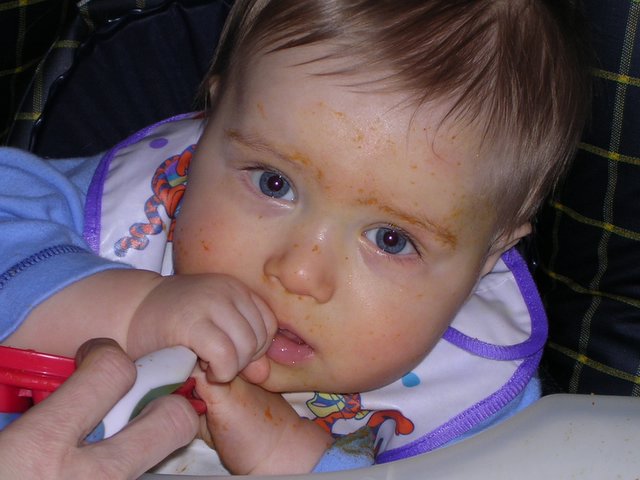 This is one of my favorite pictures of my son, taken when he was about six months old (he's 2 1/2 now) starting to eat solid foods. He does much better now.
Friday, January 20, 2006
what's good about stats
From "CMMI: Guidelines for Process Integration and Product Improvement" by Chrissis, Konrad, and Shrum (btw, I would not recommend to ANYONE that they read this unless they have to):
"The purpose of Measurement and Analysis (MA) is to develop and sustain a measurement capability that is used to support management information needs....
Specifying the objectives of M&A such that they are aligned with identified information needs and objectives...
Providing objective results that can be used in making informed decisions, and taking appropriate corrective actions."
Translation: take measurements of something useful that you can do something about.
The best parts about stats are that they're objective and can be used to aid in decision-making, both individual (making better choices with the disc) and team (allocating playing time or determining strategies).
The easiest way to improve with stats is to identify strong negatives (or to use them to prove their existence to doubters). Player A is 1 for 10 on his hucks. Player B throws away 2 break marks a game. The team has not forced a break when playing zone D all year. These things will stand out on their own without any additional analysis needed. The corrective action will require some analysis, but you know that you have a problem. For Player A, you need to decide whether to improve his throws, tweak his decisions, or get him to stop hucking.
The next thing to do is to establish baselines, which won't be the same for everyone, owing to skill level, role, and reward-level of their throws. 88% completion might be borderline acceptable for an aggressive thrower who racks up a lot of goals and big yards, but cause for action for someone who only dumps it or who takes risky but not useful throws.
Now, at this point I'm not expecting anyone to actually establish numerical baselines. Besides being too much work, there are probably too many other confounders that your limits wouldn't be legitimate. But you can, as a captain or coach or even as an individual, establish goals for each player. Be aware, though, that a player might overcompensate on the risk/reward decision in order to improve that completion percentage. (In the earlier stat entry, gambler asked whether anyone played to the stats by making suboptimal decisions. I commented at the time that stat-padding (going for fantasy league stats instead of smart, solid play) was limited to blowout games, but I neglected the other side of suboptimal play.)
Maybe the largest benefit of stat-keeping as we know it is that it forces introspection. Although a player may deceive himself, he is also the one who is most aware of each of his plays. Stats can force a player to look at each of his miscues and reevaluate whether he made a good decision.
Finally, recognize that a Holy Grail of stats is not going to be available for a long time. There will not be any reliable way to roll up all of a player's offensive contributions into a single number. Accept this, and accept that any stat you keep is going to be just one aspect of production that is linked to the other aspects, and you might just find that you can learn something.
"The purpose of Measurement and Analysis (MA) is to develop and sustain a measurement capability that is used to support management information needs....
Specifying the objectives of M&A such that they are aligned with identified information needs and objectives...
Providing objective results that can be used in making informed decisions, and taking appropriate corrective actions."
Translation: take measurements of something useful that you can do something about.
The best parts about stats are that they're objective and can be used to aid in decision-making, both individual (making better choices with the disc) and team (allocating playing time or determining strategies).
The easiest way to improve with stats is to identify strong negatives (or to use them to prove their existence to doubters). Player A is 1 for 10 on his hucks. Player B throws away 2 break marks a game. The team has not forced a break when playing zone D all year. These things will stand out on their own without any additional analysis needed. The corrective action will require some analysis, but you know that you have a problem. For Player A, you need to decide whether to improve his throws, tweak his decisions, or get him to stop hucking.
The next thing to do is to establish baselines, which won't be the same for everyone, owing to skill level, role, and reward-level of their throws. 88% completion might be borderline acceptable for an aggressive thrower who racks up a lot of goals and big yards, but cause for action for someone who only dumps it or who takes risky but not useful throws.
Now, at this point I'm not expecting anyone to actually establish numerical baselines. Besides being too much work, there are probably too many other confounders that your limits wouldn't be legitimate. But you can, as a captain or coach or even as an individual, establish goals for each player. Be aware, though, that a player might overcompensate on the risk/reward decision in order to improve that completion percentage. (In the earlier stat entry, gambler asked whether anyone played to the stats by making suboptimal decisions. I commented at the time that stat-padding (going for fantasy league stats instead of smart, solid play) was limited to blowout games, but I neglected the other side of suboptimal play.)
Maybe the largest benefit of stat-keeping as we know it is that it forces introspection. Although a player may deceive himself, he is also the one who is most aware of each of his plays. Stats can force a player to look at each of his miscues and reevaluate whether he made a good decision.
Finally, recognize that a Holy Grail of stats is not going to be available for a long time. There will not be any reliable way to roll up all of a player's offensive contributions into a single number. Accept this, and accept that any stat you keep is going to be just one aspect of production that is linked to the other aspects, and you might just find that you can learn something.
Tuesday, January 17, 2006
The outside world
We’re all Joe Durso, to some extent. In a strong contender for “Article of the Year”, Kenny wrote of him (and his ilk) “in the absence of mainstream acceptance, they cling to scraps of fleeting fame, seek out the company and comfort of those who recognize the significance of their accomplishments, and dream of a day when the world at large will recognize their greatness.” This is me, although I’m going to quibble over parts. I know that my accomplishments are possible only because we’re such a small and minor sport that the Div I athletes don’t bother with it, so I’m not looking for the world to acknowledge my greatness, any more than I want them to acknowledge my Div C modified fast pitch softball championship (yeah, Cougars!). But I do want the world to understand that it is an accomplishment worthy of my time and effort.
I enjoy being a minor celebrity (or, as Corey said on the podcast, “add a few more ‘minor’s in front of that”) in the world of ultimate. I appreciate being around people who feel as strongly about the game as I do. And yes, I’m a little bit afraid of the day where ultimate is not part of who I am but simply part of my past (a very special part, perhaps, but still in the past).
And as for clinging to scraps of fleeting fame, well, yes, there is that aspect, but the larger part is the thrill of the chase. You put in all the work in order to have a shot at, well, greatness. But even for those who seek the limelight, what makes for greatness is not the acknowledgment of the outside world, but the acknowledgment of your inner self that what you are doing is important to you. But the thing is that almost all of us need some confirmation of this from the outside world. It is a rare man who doesn’t care in the least what other people think, and kudos to Mr. Dobyns for having that in him and for being able to move on to other important things in life. (Check back with me five or six years after I retire; maybe things will look differently then.)
Also to the point is that “the outside world” is not the 6 billion others who inhabit the planet, but those who we come into contact with, and those close to us. Kenny’s mom would load up her wagon and drive 10 hours to feed Kenny’s teammates, even when Kenny wasn’t there. His older brother played, married a frisbee chick, and still coaches. Do you think he’d be so dismissive of the outside world if this part of the outside world did not acknowledge the importance of the game to him? My parents and my personal outside world have for the most part embraced my commitment, and that has made all the difference.
Here’s a guess that Kenny or Artie can check on sometime: when Joe Durso won his first national championship, his mom probably told him, “I guess this means you can give up that silly game.”
I enjoy being a minor celebrity (or, as Corey said on the podcast, “add a few more ‘minor’s in front of that”) in the world of ultimate. I appreciate being around people who feel as strongly about the game as I do. And yes, I’m a little bit afraid of the day where ultimate is not part of who I am but simply part of my past (a very special part, perhaps, but still in the past).
And as for clinging to scraps of fleeting fame, well, yes, there is that aspect, but the larger part is the thrill of the chase. You put in all the work in order to have a shot at, well, greatness. But even for those who seek the limelight, what makes for greatness is not the acknowledgment of the outside world, but the acknowledgment of your inner self that what you are doing is important to you. But the thing is that almost all of us need some confirmation of this from the outside world. It is a rare man who doesn’t care in the least what other people think, and kudos to Mr. Dobyns for having that in him and for being able to move on to other important things in life. (Check back with me five or six years after I retire; maybe things will look differently then.)
Also to the point is that “the outside world” is not the 6 billion others who inhabit the planet, but those who we come into contact with, and those close to us. Kenny’s mom would load up her wagon and drive 10 hours to feed Kenny’s teammates, even when Kenny wasn’t there. His older brother played, married a frisbee chick, and still coaches. Do you think he’d be so dismissive of the outside world if this part of the outside world did not acknowledge the importance of the game to him? My parents and my personal outside world have for the most part embraced my commitment, and that has made all the difference.
Here’s a guess that Kenny or Artie can check on sometime: when Joe Durso won his first national championship, his mom probably told him, “I guess this means you can give up that silly game.”
Thursday, January 12, 2006
The perils of stats
I love stats, and always have. When I was 5, I would quiz my mom about stats from the backs of baseball cards. I kept track of Little League stats, wrestling records, golf scores, everything. And in ultimate, I have a record of every tournament since 1992 (and the game scores for those first few years, too). Whenever I have a chance, I've taken individual stats from videos, and was part of a team that recorded every pass back in 1991.
But sometimes I wonder what it's all for. There are a few problems with stats that might just overwhelm their usefulness.
1. Small sample sizes.
2. Other things being equal, ....
3. Field position.
4. False normalization.
The first one is a bane for all sports. You'll hear "so and so is 2 for 18 against this pitcher." This has almost no value in predicting the outcome of their next encounter. Even if you have 100 passes, there is still some chance that a 90% passer will outperform a 95% passer. A lot of studies have shown that the "hot hand" is mostly just a figment of the beholder's imagination.
The problem with the second one is that they're usually not. 3 for 3 is better than 2 for 3, if the passes are the same length, but if the first passer completes dumps that put the disc on a trapped line while the second passer attempts upwind hucks, the second one is more useful. Over time, some of these things wash out, but there will still be outstanding differences resulting from usage patterns. The ideal solution is to compartmentalize the stats as much as possible, so that you separate hucks from dumps, O points from D points, zone from man, strong opponents from weak opponents, but then you get back into problem #1.
Field position (and wind) is just a subset. 40% scoring efficiency might be great if you're starting from your own goal line going upwind, but horrible when starting in the red zone.
False normalization results from the zero-sum aspect of the game. Baseball fielding has a similar problem, in that no matter how bad your defense, you still produce 27 outs in a game. You'll get 15 goals if you win no matter how bad your opponent or how bad you play. Sure, you'll have turnovers, just as you have errors or "defensive efficiency" (percentage of batted balls turned into outs) in baseball, but it makes it impossible to compare players on different teams. Having good teammates will actually hurt your raw stats in either ultimate or baseball (for fielding; batting stats will improve) because you'll have fewer opportunities for yourself.
What to do about this? I'm not sure. It's a bit of a problem, since we need to have a large sample from all levels in order to come up with a good model of how the game works, but no one wants to put in all the effort if they won't be able to do any actionable analysis immediately. But if nobody does anything, then all we're left with is conventional wisdom about what the smart move is in a given situation.
I'd like to see more situational analysis, measuring tradeoffs. For instance, if you have a 20% chance at pulling it OB, is it worth the risk of trying to land it within 10 yards of the sideline? How effective are set plays? What's the difference between having the disc on the line vs in the middle of the field? &c.
But sometimes I wonder what it's all for. There are a few problems with stats that might just overwhelm their usefulness.
1. Small sample sizes.
2. Other things being equal, ....
3. Field position.
4. False normalization.
The first one is a bane for all sports. You'll hear "so and so is 2 for 18 against this pitcher." This has almost no value in predicting the outcome of their next encounter. Even if you have 100 passes, there is still some chance that a 90% passer will outperform a 95% passer. A lot of studies have shown that the "hot hand" is mostly just a figment of the beholder's imagination.
The problem with the second one is that they're usually not. 3 for 3 is better than 2 for 3, if the passes are the same length, but if the first passer completes dumps that put the disc on a trapped line while the second passer attempts upwind hucks, the second one is more useful. Over time, some of these things wash out, but there will still be outstanding differences resulting from usage patterns. The ideal solution is to compartmentalize the stats as much as possible, so that you separate hucks from dumps, O points from D points, zone from man, strong opponents from weak opponents, but then you get back into problem #1.
Field position (and wind) is just a subset. 40% scoring efficiency might be great if you're starting from your own goal line going upwind, but horrible when starting in the red zone.
False normalization results from the zero-sum aspect of the game. Baseball fielding has a similar problem, in that no matter how bad your defense, you still produce 27 outs in a game. You'll get 15 goals if you win no matter how bad your opponent or how bad you play. Sure, you'll have turnovers, just as you have errors or "defensive efficiency" (percentage of batted balls turned into outs) in baseball, but it makes it impossible to compare players on different teams. Having good teammates will actually hurt your raw stats in either ultimate or baseball (for fielding; batting stats will improve) because you'll have fewer opportunities for yourself.
What to do about this? I'm not sure. It's a bit of a problem, since we need to have a large sample from all levels in order to come up with a good model of how the game works, but no one wants to put in all the effort if they won't be able to do any actionable analysis immediately. But if nobody does anything, then all we're left with is conventional wisdom about what the smart move is in a given situation.
I'd like to see more situational analysis, measuring tradeoffs. For instance, if you have a 20% chance at pulling it OB, is it worth the risk of trying to land it within 10 yards of the sideline? How effective are set plays? What's the difference between having the disc on the line vs in the middle of the field? &c.
Wednesday, January 04, 2006
More O/D crap
Over at the PuPs, I've been spewing stats about O and D value. Here are a few points I want to make about value:
Oh, yeah. Offense rulez!!!
- Value comes from being better than average or replacement.
- If the difference in a particular skill between good and average (or best and worst) doesn't translate into a substantial difference in points or turnovers or runs, then that skill isn't that valuable to the game.
- However, it may be true that the skill is a threshold skill, where you have to achieve a certain level just to play the game. For instance, weight for an offensive lineman in the NFL is largely uncorrelated to value, but you have to be at least 270 or 300 lbs to be able to play. I guess we could also call this a fundamental skill in which simple competence gets you 95% of the value of mastery.
- We've all been commingling two discussions about value, one being whether an individual offensive player is worth more than an individual defensive player, and the other being whether team offense is more important than team defense. The first issue, I think, is pretty clear for most sports and most players. A top offensive player is involved in a higher percentage of the plays than a top defender. A "shutdown" in ultimate just results in a few seconds wasted (which can of course help create a turnover), while a successful cut clearly increases the odds of scoring. A 20 yard reception from 40 yards out might increase your scoring efficiency from 70% to 80%, but if that cut is shut down by good defense, the efficiency might drop only from 70% to 66.5%. (Here's how I got these numbers. I assume a team is 90% from the goal line and that they lose 5 percentage points every 10 yards. At 20 yards out, they're 80%, and at 40 yards out, they're 70%. For the shutdown, what completion percentage would you expect on a dump where you turn at stall 5? Multiply that by 70% to get your new efficiency. Say it's 95%, then 70% * 95% = 66.5%. You might also need to factor in the yardage loss, pushing it down to maybe 64%.) And you can only cover one player. (Exceptions to this would be a great middle middle in the zone or a great defensive center in basketball who can influence every drive into the lane.)
- This is almost an aside, but while there may be an expectation that the offense should score every time, the reality is that offenses score only about half the time, which is also about the rate of scoring in the NBA (fluctuations in points per game are as much a function of pace (possessions per game) as efficiency). I maintain that even for the top of the game, a large percentage of the turnovers have little to do with what is considered "hot D" but is just a matter of being close enough to remove some of the margin of error.
- While I don't play on the D team anymore and I follow the disc when I'm on the sideline, I still see an awful lot on the field when I'm playing O.
Oh, yeah. Offense rulez!!!
Saturday, December 31, 2005
Last and first
More random thoughts to end and begin the year.
The boy just loved his new train set and didn't play with anything else the whole day. He does seem to be Inertia Boy, where whatever he's currently doing is the thing he wants to be doing next, but this was a whole new level. He also whined incessantly whenever the train went off the track or the two cars became disconnected. kids, whattya gonna do.
Field sense is tough to teach. My wife asked me tonight whether field sense was in the book. At first I said it wasn't, but then decided that it was, just not using that phrase. Much of the Cutting chapter was about when to cut and why, trying to give people guidelines (but not rules, since nothing always applies). But we should have been more explicit in talking about field sense. But I'm still not sure how to drill it into someone's head, other than forcing them to think about it. The stages of field sense are: No clue, will understand when explained to, will recognize right when it's too late, will be able to recognize in time to execute, will do it instictively, then the final stage of recognizing it immediately but being too damn old to do anything about it. Hopefully, you'll have a few years in between those last two stages.
I'll freely admit to reference-counting in the Ultimate History Book. Mooney wins the DoG contest hands-down, so much that he needed to be subindexed ("Mooney, Steve, 62, 68, 113; on Death or Glory, 102, 103a, 115-116; influence of, 47, 86, 94, 130; in Japan, 164; on Philly 8, 114; in Japan, 164; on Rude Boys, 54, 58-59; on Titanic, 67, 76; at Wugc, 162). Seeger was under-referenced, but most others were in fair proportion. It's fun to just look through the index for names, although sometimes I wondered why the hell so-and-so was worth a mention. Didn't make it to see how often Dobyns got mentioned yet.
Speaking of which, he's back. What's the over/under before he appears here to say he would never appear here except to wonder what the hell has happened to the game?
And Mike G, too. He might make an interesting podcast guest, or he could just be Bill O'Reilly. You decide.
Boy those west coast kids just like to chuck that disc. Kids today.
Newsletter arrived today. One bad thing about the UPA getting up to speed is that the articles have already appeared online, so there was nothing new in the stories of Nationals. I had hoped that Shelton had gotten some second- or third-hand reports on the "other" semi that started an hour before the important one and that did not start out 5-0, but no, it was the same old song.
Were there really only 81 turnovers in the women's finals, or did they just not record some of them to be nice? There were 48 in the first 4 points, 26-22, so Riot only had 13 turnovers for their last 11 goals. 63 TOs in the men's final (8 by Cruickshank, surprisingly), 93 in the Mixed final (10 each by Pat Hard and Tim Hertz; 73 by men; 23 of 26 assists by men, 18 goals caught), and only only 29 in a Masters final played on a less windy Saturday.
Continuing my Luke-like review (but with capitalization) of the Newsletter....
No mention of Corey in the Lei-out Beach League article.
American Jews teaching frisbee in Israel, sounds like a great thing for them to do (except I think they spelled the author's name wrong).
Some ads and public service announcements. Ooh, get this, the UPA has the nerve to suggest that people read through the rules first if they have a college eligibility question.
2004 financial statement was in there. UPA added $175K in net assets in 2004, very nice. Got an extra $225K in dues and $75K in nationals fees, 50K in sponsorship and donations. Spent an extra $40K on the Champ Series plus added a new line item for Nationals Teams costing $113K. I think they may have decided to separate the costs and fees for the Nationals tournaments instead of rolling them into "championship series".
Ah, super, Kyle Weisbrod scolds players who behave inappropriately/rudely. Glad to see it, although it's also sad to see things change, in a way. Dobyns alluded to the milk toast (sic) teams today who weren't obnoxious assholes like his team. It was a different day back then, when you could do what you wanted in anonyminity and obscurity (although that wasn't the point he was trying to make).
The pictures are good, but I hope that the ones on the devoted page were not the 10 best, in the UPA's opinion.
Ok, time to watch the New Year ring in.
The boy just loved his new train set and didn't play with anything else the whole day. He does seem to be Inertia Boy, where whatever he's currently doing is the thing he wants to be doing next, but this was a whole new level. He also whined incessantly whenever the train went off the track or the two cars became disconnected. kids, whattya gonna do.
Field sense is tough to teach. My wife asked me tonight whether field sense was in the book. At first I said it wasn't, but then decided that it was, just not using that phrase. Much of the Cutting chapter was about when to cut and why, trying to give people guidelines (but not rules, since nothing always applies). But we should have been more explicit in talking about field sense. But I'm still not sure how to drill it into someone's head, other than forcing them to think about it. The stages of field sense are: No clue, will understand when explained to, will recognize right when it's too late, will be able to recognize in time to execute, will do it instictively, then the final stage of recognizing it immediately but being too damn old to do anything about it. Hopefully, you'll have a few years in between those last two stages.
I'll freely admit to reference-counting in the Ultimate History Book. Mooney wins the DoG contest hands-down, so much that he needed to be subindexed ("Mooney, Steve, 62, 68, 113; on Death or Glory, 102, 103a, 115-116; influence of, 47, 86, 94, 130; in Japan, 164; on Philly 8, 114; in Japan, 164; on Rude Boys, 54, 58-59; on Titanic, 67, 76; at Wugc, 162). Seeger was under-referenced, but most others were in fair proportion. It's fun to just look through the index for names, although sometimes I wondered why the hell so-and-so was worth a mention. Didn't make it to see how often Dobyns got mentioned yet.
Speaking of which, he's back. What's the over/under before he appears here to say he would never appear here except to wonder what the hell has happened to the game?
And Mike G, too. He might make an interesting podcast guest, or he could just be Bill O'Reilly. You decide.
Boy those west coast kids just like to chuck that disc. Kids today.
Newsletter arrived today. One bad thing about the UPA getting up to speed is that the articles have already appeared online, so there was nothing new in the stories of Nationals. I had hoped that Shelton had gotten some second- or third-hand reports on the "other" semi that started an hour before the important one and that did not start out 5-0, but no, it was the same old song.
Were there really only 81 turnovers in the women's finals, or did they just not record some of them to be nice? There were 48 in the first 4 points, 26-22, so Riot only had 13 turnovers for their last 11 goals. 63 TOs in the men's final (8 by Cruickshank, surprisingly), 93 in the Mixed final (10 each by Pat Hard and Tim Hertz; 73 by men; 23 of 26 assists by men, 18 goals caught), and only only 29 in a Masters final played on a less windy Saturday.
Continuing my Luke-like review (but with capitalization) of the Newsletter....
No mention of Corey in the Lei-out Beach League article.
American Jews teaching frisbee in Israel, sounds like a great thing for them to do (except I think they spelled the author's name wrong).
Some ads and public service announcements. Ooh, get this, the UPA has the nerve to suggest that people read through the rules first if they have a college eligibility question.
2004 financial statement was in there. UPA added $175K in net assets in 2004, very nice. Got an extra $225K in dues and $75K in nationals fees, 50K in sponsorship and donations. Spent an extra $40K on the Champ Series plus added a new line item for Nationals Teams costing $113K. I think they may have decided to separate the costs and fees for the Nationals tournaments instead of rolling them into "championship series".
Ah, super, Kyle Weisbrod scolds players who behave inappropriately/rudely. Glad to see it, although it's also sad to see things change, in a way. Dobyns alluded to the milk toast (sic) teams today who weren't obnoxious assholes like his team. It was a different day back then, when you could do what you wanted in anonyminity and obscurity (although that wasn't the point he was trying to make).
The pictures are good, but I hope that the ones on the devoted page were not the 10 best, in the UPA's opinion.
Ok, time to watch the New Year ring in.
Thursday, December 29, 2005
More on the Hall of Fame
On the other HoF thread, someone asked who will be the first DoG player enshrined. I said it was Mooney, if for no other reason than he's so much older than the rest of us.
But he will be one of the "inner-circle" members of the Hall. Bill James, the baseball stat guy/writer/Red Sox employee, has studied baseball's Hall of Fame a lot, and we've drawn from his insights in crafting ultimate's Hall (disclaimer: I'm currently on the HoF Committee). One of the ideas concerns "peak" and "career" value.
Sandy Koufax is the classic example of a "peak" HoFer, someone with a short career (just 12 years in the majors, only six of them as above-average) but at such a brilliant high that you can't ignore him. Eddie Murray is a good example of "career", as he almost never led the league in anything but was pretty damn good for a pretty damn long time.
Well, Mooney is one of the tops in ultimate for both peak and career. His career value easily outdistances the rest of the field, even Kenny Dobyns, the only other player in the discussion when you combine your "peak" and "career" top 10 lists into "best player ever." (I write this only because I know neither of them will ever read this.)
It will be interesting to see how DoG and NYNY populate the Hall over the years. It will be a few more years until most of the core of those teams become eligible. As a rough guess, each team will probably have about five HoFers and another five guys who belong in the Hall of Very Good, guys who were either one of the very best for a short time or guys who were consistently excellent but never one of the elite of the elite. But these numbers really depend on how the Hall plays out.
A maximum of 5 players and contributors can be elected per year. There is currently a backlog of Hall-worthy players, so you'd expect that there'd be five new inductees each year, but it's possible that qualified candidates will split the vote and thus only three or four will be inducted. (There is a multi-step process to make sure that this isn't too much of a problem.) I'll guess without calculating that it will take 10-15 years for the Hall to be really current, such that the leading candidates in any given year will be those who just hit the minimum age (48 for men/45 for women this year, moving down to 43/40 by 2010).
It's an unfortunate reality that some of the early greats will probably not make it because of the dense field.
But he will be one of the "inner-circle" members of the Hall. Bill James, the baseball stat guy/writer/Red Sox employee, has studied baseball's Hall of Fame a lot, and we've drawn from his insights in crafting ultimate's Hall (disclaimer: I'm currently on the HoF Committee). One of the ideas concerns "peak" and "career" value.
Sandy Koufax is the classic example of a "peak" HoFer, someone with a short career (just 12 years in the majors, only six of them as above-average) but at such a brilliant high that you can't ignore him. Eddie Murray is a good example of "career", as he almost never led the league in anything but was pretty damn good for a pretty damn long time.
Well, Mooney is one of the tops in ultimate for both peak and career. His career value easily outdistances the rest of the field, even Kenny Dobyns, the only other player in the discussion when you combine your "peak" and "career" top 10 lists into "best player ever." (I write this only because I know neither of them will ever read this.)
It will be interesting to see how DoG and NYNY populate the Hall over the years. It will be a few more years until most of the core of those teams become eligible. As a rough guess, each team will probably have about five HoFers and another five guys who belong in the Hall of Very Good, guys who were either one of the very best for a short time or guys who were consistently excellent but never one of the elite of the elite. But these numbers really depend on how the Hall plays out.
A maximum of 5 players and contributors can be elected per year. There is currently a backlog of Hall-worthy players, so you'd expect that there'd be five new inductees each year, but it's possible that qualified candidates will split the vote and thus only three or four will be inducted. (There is a multi-step process to make sure that this isn't too much of a problem.) I'll guess without calculating that it will take 10-15 years for the Hall to be really current, such that the leading candidates in any given year will be those who just hit the minimum age (48 for men/45 for women this year, moving down to 43/40 by 2010).
It's an unfortunate reality that some of the early greats will probably not make it because of the dense field.
Wednesday, December 21, 2005
New Hall of Fame inductees announced
Monday, December 19, 2005
Relative value of O and D
Here’s a paradox:
Is one of these assumptions in error? Which one(s)?
I’m going to go with the first assumption, and here’s why. The advanced view of “value” is “contribution above replacement level.” However, a lot of defense is simply showing up and not screwing up so badly that you hand away goals. A "replacement level" defense is still going to get turns, while a replacement level offense (especially in women's ultimate) is going to do really badly.
Let's just guess that in a decent game between decent teams, offenses score 50% of the time (and defenses get turnovers 50% of the time). In a blowout, say 15-5, the offense will still probably have maybe 10 turnovers, yielding a 60% efficiency against a replacement defense, meaning the other's team's (replacement) offense scores on only about 20% of their possessions. So, the average offense is (50% - 20%) better than a replacement offense, but an average defense is only (60% - 50%) better than a replacement defense.
Maybe this is what people are saying when they say defensive strategy is practically non-existent. Most of the value in playing defense is just being in position.
Part I of an ongoing thread on analysis of ultimate. (I don't really want to call it statisticial analysis because the numbers aren't the important thing, it's the concepts behind the numbers.)
- Offense and defense are equally important in ultimate.
- Most of the important players are important because of their offense.
- If you add up the individual values of all the players, the sum of the offensive guys will be more than that of the defensive guys. But see #1.
Is one of these assumptions in error? Which one(s)?
I’m going to go with the first assumption, and here’s why. The advanced view of “value” is “contribution above replacement level.” However, a lot of defense is simply showing up and not screwing up so badly that you hand away goals. A "replacement level" defense is still going to get turns, while a replacement level offense (especially in women's ultimate) is going to do really badly.
Let's just guess that in a decent game between decent teams, offenses score 50% of the time (and defenses get turnovers 50% of the time). In a blowout, say 15-5, the offense will still probably have maybe 10 turnovers, yielding a 60% efficiency against a replacement defense, meaning the other's team's (replacement) offense scores on only about 20% of their possessions. So, the average offense is (50% - 20%) better than a replacement offense, but an average defense is only (60% - 50%) better than a replacement defense.
Maybe this is what people are saying when they say defensive strategy is practically non-existent. Most of the value in playing defense is just being in position.
Part I of an ongoing thread on analysis of ultimate. (I don't really want to call it statisticial analysis because the numbers aren't the important thing, it's the concepts behind the numbers.)
Tuesday, December 13, 2005
close games and semis
I'm not sure why, but I feel the urge to talk about the evolution of strategy. No reason in particular that it's on my mind, really.
Kidding, I'm kidding. Sheesh, I can't keep up with all the new blog entries coming out. What's amazing about the frisbee blog acceleration is that blogging is like so three years ago. You'd think that with a sport that prides itself on being so high tech and college-y that blogging would have hit bigtime awhile ago.
I thought I'd go over Corey's Dangerfieldesque comment about how Jim/DoG gives no respect. I'm really not sure how this post will turn out and whether he'll be right or I'll be vindicated, but that's the beauty of live Internet.
DoG in the winning years had its fair share of close games, some of them elimination games. But we won 52 games in a row over 7 years before being knocked out in the semis in 2000, something that surely passes even the most anal statistician's significance test.
With a little help from google, which has a neat Advanced Search by date function for the news groups, here are the close games year by year. I am writing this as dispassionately as can be done, and the guy writing this tonight has disassociated himself from the guy who played in those games:
1994: pool 19-16 over Boulder, 18-13 over Rhino. The Rhino game seemed closer. The Boulder game had a lot of offense on both sides, as 20 of the 35 points had no turnovers. DoG got broken 6 of 14 times by Rhino, however, at a time in the tournament when no one had any idea that Rhino would go 0-5. Looking back, and contemplating the Loser's Lament, I'll say that we had almost no chance at losing the Boulder game and a 10% chance in the Rhino game. Semis: 19-17 over Cojones in a game that merits consideration for the Best Game Ever. It was a great battle that either team could have won, even though we had handled them easily all year (6-1, counting games against the springtime We Smoke Weed). Finals 21-11 over Double Happiness. After the previous day's catharsis, Sunday victory was a foregone conclusion.
1995: pool 18-15 over Double, 19-16 over San Diego. Double game was close to a tossup. San Diego game was one of those where it shouldn't have been that close and they didn't belong with us yada yada no respect. Semis was another possible Best Game Ever win over Cojones, 21-17. Slightly higher quality than the year before because of the win, but it wasn't as historic because it was a repeat. Finals was 21-10 over Sockeye in what might be the Best Played Game Ever (3 turnovers).
Scorecard so far: 2 "no respect" close wins, 1 "just a little", 3 "great games", and 2 "we are so great" not-close games.
1996: pool 15-14 over Saucy Jack after being down 11-4. Start the excuse wagon, it's going to be a long ride. We had a first-round bye and didn't get into the game quickly, they were on a roll having scored 6 in a row to come back against Randall's Island, the game was unlikely to have any implications on where we would finish, we got some bad breaks/plays in the first half, and we were still chuckling to ourselves about Mooney getting stalled on what should have been the very first pass of the tournament. I'm not ready to call this a "no respect" win, but I can't help but think of it as a fluke, so I'm not sure how to categorize it. Semis 19-9 over Z. Finals 19-16 over Sockeye. Never tied after 2-2, although Sockeye had it to tie at 6 and 8. As close as 14-12 in the 2nd half, but then 17-12 and 19-16. Didn't really feel all that close. This could have been DoG's strongest team ever, just because we won so easily without playing our A game.
1997: pool 17-5, 17-10, 17-9 (over semifinalist Z), 15-12, 17-9, 17-6. The close game was against Double, which had failed to qualify for Nationals but got to go after Oregon's Pack of Lies decided to stay home. I think that this is probably where Idris got the term "nicest cheaters", since there were some calls of ours that they disagreed with (although I can't remember what any of them might have been or even whether I thought they were bad/ok/good calls). Not a great game, but could have gone either way. Hard to classify it, though. There is some respect for the game because of the history of having close games against Double, but everything else about the game points to it as one of those which Corey would have accused us of not having respect. (Hey, also check out this thread. Faust was thought (incorrectly, as discovered after Nationals) to have been left off the team's roster at a Sectionals he didn't attend and so there was a big brouhaha about whether he should be allowed to play. That was close to the end of the Golden Days of RSD, by the way.) Semis 17-15 against Ring, after being down 10-4. Some superficial similarities to the Saucy game before, but Ring was just playing phenomenally to earn their lead. Finals 16-10 over Sockeye. 7-0, 7-5, 16-10. Sockeye's first goal in the finals came on a Full Haskell.
1998: Pool play had that one point win over the Condors, a blowout over a Furious team that had taken it to us at Worlds and Tuneup, and some other not close games. Semis over NY (Corey played in this one so must have felt personally aggrieved). Gewirtz wrote of it: "NY gave DoG a good fight. DoG went ahead by 2 upwind goals. WSL was resilient, though, and equalized toward the end of the first half. DoG took a 1 goal lead to the intermission. DoG regained their cushion and NY fought back, but, fell short." I wrote simply, "Semis was uneventful win against NY." Leonardo wrote that it was 6-2, 8-8, 13-8, 14-12 (of this rally, he commented "WSL finally got on track (or Boston eased up in anticipation of closing the game big. It’s remarkable how much these guys really can turn it on and off)."), 17-12. Chalk one up for Corey. Perhaps part of this was that virtually everyone from the NY years and even almost all the key players from the Cojones team of 1995 were no longer with the team, and so we probably felt that any close game against them (the Regional finals were 18-16, and probably felt about the same) was just from us playing badly or uninspired. Finals was 17-15 over Condors, down 6-4 (hmm, don't remember that part), up 14-10 (_That's_ what I remember), tied 14-14 going into a strong wind, 16-14, 17-15. The Condors games were tight contests, no doubt. Way too much wind to be considered great games, though.
1999: Tight Day 2 games against Jam and Ring, both probably games with "too little respect." The offense was great that tournament, not struggling in even a single game, so perhaps that's a common thread. (The other common thread I've identified is that a close game against a team where there's a history of close wins or defeats is much more likely to be considered a good game than a close game against a team that had never beaten us in an important or semi-important game.) But to be fair, a 15-12 game with only 2 breaks isn't really as close as a 15-12 with a lot of breaks, since in the first game the losers would have had to more than double the number of breaks in order to win. Quarters may have been as close as 7-7 before finishing 15-8. Semis was a nail-biter over Furious, finals a 17-12 masterpiece over the Condors (only one break and four turnovers in that game).
2000: wow, rsd says that our first round pool play game against Sockeye was 12-12. Also beat Jam by 2, according to my web page, but all I wrote about Nationals was "Errr. DoG has now won 52 of our last 53 games at Nationals?" No recollection right now of either of those close games. Funny how that memory thing works.
Well, that's it. As I said at the start of this, I wrote this as dispassionately and as disassociated as I could, like I was peering into someone else's head for a documentary, and it's not always pretty. But I said I'd write it and see how it goes, and that's how it went. Tough luck, I guess.
But to go back to the original question, I think I answered it in the 1999 comments. Respect doesn't come from one close game, but from a history of them.
Kidding, I'm kidding. Sheesh, I can't keep up with all the new blog entries coming out. What's amazing about the frisbee blog acceleration is that blogging is like so three years ago. You'd think that with a sport that prides itself on being so high tech and college-y that blogging would have hit bigtime awhile ago.
I thought I'd go over Corey's Dangerfieldesque comment about how Jim/DoG gives no respect. I'm really not sure how this post will turn out and whether he'll be right or I'll be vindicated, but that's the beauty of live Internet.
DoG in the winning years had its fair share of close games, some of them elimination games. But we won 52 games in a row over 7 years before being knocked out in the semis in 2000, something that surely passes even the most anal statistician's significance test.
With a little help from google, which has a neat Advanced Search by date function for the news groups, here are the close games year by year. I am writing this as dispassionately as can be done, and the guy writing this tonight has disassociated himself from the guy who played in those games:
1994: pool 19-16 over Boulder, 18-13 over Rhino. The Rhino game seemed closer. The Boulder game had a lot of offense on both sides, as 20 of the 35 points had no turnovers. DoG got broken 6 of 14 times by Rhino, however, at a time in the tournament when no one had any idea that Rhino would go 0-5. Looking back, and contemplating the Loser's Lament, I'll say that we had almost no chance at losing the Boulder game and a 10% chance in the Rhino game. Semis: 19-17 over Cojones in a game that merits consideration for the Best Game Ever. It was a great battle that either team could have won, even though we had handled them easily all year (6-1, counting games against the springtime We Smoke Weed). Finals 21-11 over Double Happiness. After the previous day's catharsis, Sunday victory was a foregone conclusion.
1995: pool 18-15 over Double, 19-16 over San Diego. Double game was close to a tossup. San Diego game was one of those where it shouldn't have been that close and they didn't belong with us yada yada no respect. Semis was another possible Best Game Ever win over Cojones, 21-17. Slightly higher quality than the year before because of the win, but it wasn't as historic because it was a repeat. Finals was 21-10 over Sockeye in what might be the Best Played Game Ever (3 turnovers).
Scorecard so far: 2 "no respect" close wins, 1 "just a little", 3 "great games", and 2 "we are so great" not-close games.
1996: pool 15-14 over Saucy Jack after being down 11-4. Start the excuse wagon, it's going to be a long ride. We had a first-round bye and didn't get into the game quickly, they were on a roll having scored 6 in a row to come back against Randall's Island, the game was unlikely to have any implications on where we would finish, we got some bad breaks/plays in the first half, and we were still chuckling to ourselves about Mooney getting stalled on what should have been the very first pass of the tournament. I'm not ready to call this a "no respect" win, but I can't help but think of it as a fluke, so I'm not sure how to categorize it. Semis 19-9 over Z. Finals 19-16 over Sockeye. Never tied after 2-2, although Sockeye had it to tie at 6 and 8. As close as 14-12 in the 2nd half, but then 17-12 and 19-16. Didn't really feel all that close. This could have been DoG's strongest team ever, just because we won so easily without playing our A game.
1997: pool 17-5, 17-10, 17-9 (over semifinalist Z), 15-12, 17-9, 17-6. The close game was against Double, which had failed to qualify for Nationals but got to go after Oregon's Pack of Lies decided to stay home. I think that this is probably where Idris got the term "nicest cheaters", since there were some calls of ours that they disagreed with (although I can't remember what any of them might have been or even whether I thought they were bad/ok/good calls). Not a great game, but could have gone either way. Hard to classify it, though. There is some respect for the game because of the history of having close games against Double, but everything else about the game points to it as one of those which Corey would have accused us of not having respect. (Hey, also check out this thread. Faust was thought (incorrectly, as discovered after Nationals) to have been left off the team's roster at a Sectionals he didn't attend and so there was a big brouhaha about whether he should be allowed to play. That was close to the end of the Golden Days of RSD, by the way.) Semis 17-15 against Ring, after being down 10-4. Some superficial similarities to the Saucy game before, but Ring was just playing phenomenally to earn their lead. Finals 16-10 over Sockeye. 7-0, 7-5, 16-10. Sockeye's first goal in the finals came on a Full Haskell.
1998: Pool play had that one point win over the Condors, a blowout over a Furious team that had taken it to us at Worlds and Tuneup, and some other not close games. Semis over NY (Corey played in this one so must have felt personally aggrieved). Gewirtz wrote of it: "NY gave DoG a good fight. DoG went ahead by 2 upwind goals. WSL was resilient, though, and equalized toward the end of the first half. DoG took a 1 goal lead to the intermission. DoG regained their cushion and NY fought back, but, fell short." I wrote simply, "Semis was uneventful win against NY." Leonardo wrote that it was 6-2, 8-8, 13-8, 14-12 (of this rally, he commented "WSL finally got on track (or Boston eased up in anticipation of closing the game big. It’s remarkable how much these guys really can turn it on and off)."), 17-12. Chalk one up for Corey. Perhaps part of this was that virtually everyone from the NY years and even almost all the key players from the Cojones team of 1995 were no longer with the team, and so we probably felt that any close game against them (the Regional finals were 18-16, and probably felt about the same) was just from us playing badly or uninspired. Finals was 17-15 over Condors, down 6-4 (hmm, don't remember that part), up 14-10 (_That's_ what I remember), tied 14-14 going into a strong wind, 16-14, 17-15. The Condors games were tight contests, no doubt. Way too much wind to be considered great games, though.
1999: Tight Day 2 games against Jam and Ring, both probably games with "too little respect." The offense was great that tournament, not struggling in even a single game, so perhaps that's a common thread. (The other common thread I've identified is that a close game against a team where there's a history of close wins or defeats is much more likely to be considered a good game than a close game against a team that had never beaten us in an important or semi-important game.) But to be fair, a 15-12 game with only 2 breaks isn't really as close as a 15-12 with a lot of breaks, since in the first game the losers would have had to more than double the number of breaks in order to win. Quarters may have been as close as 7-7 before finishing 15-8. Semis was a nail-biter over Furious, finals a 17-12 masterpiece over the Condors (only one break and four turnovers in that game).
2000: wow, rsd says that our first round pool play game against Sockeye was 12-12. Also beat Jam by 2, according to my web page, but all I wrote about Nationals was "Errr. DoG has now won 52 of our last 53 games at Nationals?" No recollection right now of either of those close games. Funny how that memory thing works.
Well, that's it. As I said at the start of this, I wrote this as dispassionately and as disassociated as I could, like I was peering into someone else's head for a documentary, and it's not always pretty. But I said I'd write it and see how it goes, and that's how it went. Tough luck, I guess.
But to go back to the original question, I think I answered it in the 1999 comments. Respect doesn't come from one close game, but from a history of them.
Sunday, December 11, 2005
A history of Boston ultimate
I'm not sure why this is on my mind now, but I wrote a piece back in 1994 about the history of Boston ultimate. The short story is that two equal teams in an area will not exist. There will be a top team, a second team will form and may stay together for awhile but eventually its top players will join up with the top team. The second team then has a few lean years before it all starts over again.
From 1992-1995, the 2nd team fell upon hard times, not making Nationals with the 3rd spot. 1996 saw the emergence of Snapple, which morphed into Dark Horse and RoQ the next couple years (but they'll always be Snapple to me). In those years, DoG had relatively few additions to the roster, most of them being players who had moved from other cities (Cameros, Greff) or unretirements (Seeger, Axon). Zaz was one of the few who worked his way up the ladder, having played with Boston Kremes before.
DoG absorbed the top players (and Lyn) from Snapple in 1999 after a triumphant Worlds championship that summer, leaving a skeleton crew to form into Blackjack, which missed Nationals that fall before making it the following year. BJ missed again in 2001, causing another reforming into Boss Hogg. BH lasted until its top players and DoG simultaneously decided they had had enough and formed a new team (called DoG) in 2004. Twisted Metal formed, not out of the remnants, but out of something completely different. The BH guys who didn't play on DoG mostly played Coed that year. Had BH not dissolved, probably some of the TM guys would have played with them and maybe one or two would have made DoG, but the absence of a clear 2nd team paved the way for their existence.
1999 signalled a change to a youth movement which has never stopped. While such dinosaurs as Al and myself have stayed around, we slowly lost the rest of the old guard. Nepotist Wicks brought in a bunch of Brown players and recent alumni. The team might still be old compared to other teams (Jam's oldest is 32, Sockeye's 33) but has continued to get younger.
(By the way, I should note that other than some split squad losses to Twisted at WMO this year and a scrimmage loss or two to Snapple/Hogg, the 2nd team hasn't beaten the 1st team since 1991. We've lost to a whole bunch of teams, but not Boston B.)
Is there really animosity towards DoG from TM? If so, then I wouldn't have exhorted Jeff Graham to cut in a pivotal point against Condors when he was just standing around. I don't really talk to those guys, though, so who knows whether to believe a couple rumor-mongers who have already stated that they deliberately exaggerate to get hits.
Anyway, I've always felt that DoG has respected the sovereignty of the 2nd Boston team, even during the years with massive defections.
From 1992-1995, the 2nd team fell upon hard times, not making Nationals with the 3rd spot. 1996 saw the emergence of Snapple, which morphed into Dark Horse and RoQ the next couple years (but they'll always be Snapple to me). In those years, DoG had relatively few additions to the roster, most of them being players who had moved from other cities (Cameros, Greff) or unretirements (Seeger, Axon). Zaz was one of the few who worked his way up the ladder, having played with Boston Kremes before.
DoG absorbed the top players (and Lyn) from Snapple in 1999 after a triumphant Worlds championship that summer, leaving a skeleton crew to form into Blackjack, which missed Nationals that fall before making it the following year. BJ missed again in 2001, causing another reforming into Boss Hogg. BH lasted until its top players and DoG simultaneously decided they had had enough and formed a new team (called DoG) in 2004. Twisted Metal formed, not out of the remnants, but out of something completely different. The BH guys who didn't play on DoG mostly played Coed that year. Had BH not dissolved, probably some of the TM guys would have played with them and maybe one or two would have made DoG, but the absence of a clear 2nd team paved the way for their existence.
1999 signalled a change to a youth movement which has never stopped. While such dinosaurs as Al and myself have stayed around, we slowly lost the rest of the old guard. Nepotist Wicks brought in a bunch of Brown players and recent alumni. The team might still be old compared to other teams (Jam's oldest is 32, Sockeye's 33) but has continued to get younger.
(By the way, I should note that other than some split squad losses to Twisted at WMO this year and a scrimmage loss or two to Snapple/Hogg, the 2nd team hasn't beaten the 1st team since 1991. We've lost to a whole bunch of teams, but not Boston B.)
Is there really animosity towards DoG from TM? If so, then I wouldn't have exhorted Jeff Graham to cut in a pivotal point against Condors when he was just standing around. I don't really talk to those guys, though, so who knows whether to believe a couple rumor-mongers who have already stated that they deliberately exaggerate to get hits.
Anyway, I've always felt that DoG has respected the sovereignty of the 2nd Boston team, even during the years with massive defections.
Monday, December 05, 2005
Random thoughts...
Columnists often do a “Nobody asked me but…” column whenever they run out of ideas. Over the last week, I’ve been commenting on other guys’ blogs but haven’t produced anything myself, so here goes.
I’m pissed that Arrested Development has been cancelled. Best show on TV.
The odometer on my car somehow is off by about 3%. I noticed this on a recent 100 mile trip when the miles-to-go according to the highway signs differed from what my odometer would have indicated. Do I need to worry about this?
I’m always trapped between hating rules lawyers and wanting to be one. On the first point of a recent game, the marker in a zone would begin the stall with “One” while still about six yards away. Could I call a foul right then since that is two fast count violations at once? Should I just let it go?
A women’s sport (or a coed sport) has arrived when spectators don’t say “Great play” when a woman makes a play that a man would be expected to make. Do you see anyone saying “Wow” when a WNBA player makes a three-pointer or does a crossover dribble (or would you see that if anyone watched the WNBA)? This is the soft bigotry of low expectations that some politicians talk about.
It’s hard not to feel that a whole team is a bunch of cheaters when one player makes what may be a bad call on a pivotal point. This weekend, I went undercover to sample the Mixed game, and in the semis, one of our opponents caught a disc which appeared to bounce first. After the usual ridiculous arguments, the disc went back, and they scored. We scored six in a row after that, though, and I said, “Justice!” after each one. (Incidentally, that was the third game in a row in which a disc appears to have bounced before the catch.)
“Back to the thrower” is often not an equitable solution. Consider a contested catch in the end zone. If it was really up, it should be a goal, and if it was really down, it should be a turnover, and there are odds associated with each. You are theoretically able to calculate what a fair compromise is such that the odds of scoring haven’t changed, and those odds don’t depend on where the throw came from. Thus, if it’s a 2 yard pass that’s contested, the offense comes out way ahead if it’s really a 50/50 call (because they haven’t lost any yardage and they keep possession). Only if the likelihood that the disc was up was equal to the odds of scoring the point (somewhere in the 90-95% range probably) is the most fair solution to send it back to the thrower. Perhaps a better solution on these validly contested calls would be to give the offense the disc 20 or 30 yards back from the call (but no deeper than their own goal line, or half the distance to an X-rules offsides mark (something like 10 yards deep in the endzone)). Or maybe those clowns who want to give close calls to the D because they’re the D had it right for the wrong reason.
Hmm, should an Observer in that situation use this calculus? With most calls, you’re going to be more than 90% certain of a call, but what about the ones with less certainty? Suppose you think it’s 60% likely that the catch was up. Is that enough to rule it up?
There was a lot of dead time during the tournament this weekend. Pulls out the back of the endzone were the worst, taking at least a minute to retrieve. Solution to that: have a “corner disc” available and let someone else chase the errant disc. It’s already in the rules somewhere, isn’t it?
And what the hell’s up with George? Stop posting so much, dammit!
And has anyone seen AJ or Alex?
I’m pissed that Arrested Development has been cancelled. Best show on TV.
The odometer on my car somehow is off by about 3%. I noticed this on a recent 100 mile trip when the miles-to-go according to the highway signs differed from what my odometer would have indicated. Do I need to worry about this?
I’m always trapped between hating rules lawyers and wanting to be one. On the first point of a recent game, the marker in a zone would begin the stall with “One” while still about six yards away. Could I call a foul right then since that is two fast count violations at once? Should I just let it go?
A women’s sport (or a coed sport) has arrived when spectators don’t say “Great play” when a woman makes a play that a man would be expected to make. Do you see anyone saying “Wow” when a WNBA player makes a three-pointer or does a crossover dribble (or would you see that if anyone watched the WNBA)? This is the soft bigotry of low expectations that some politicians talk about.
It’s hard not to feel that a whole team is a bunch of cheaters when one player makes what may be a bad call on a pivotal point. This weekend, I went undercover to sample the Mixed game, and in the semis, one of our opponents caught a disc which appeared to bounce first. After the usual ridiculous arguments, the disc went back, and they scored. We scored six in a row after that, though, and I said, “Justice!” after each one. (Incidentally, that was the third game in a row in which a disc appears to have bounced before the catch.)
“Back to the thrower” is often not an equitable solution. Consider a contested catch in the end zone. If it was really up, it should be a goal, and if it was really down, it should be a turnover, and there are odds associated with each. You are theoretically able to calculate what a fair compromise is such that the odds of scoring haven’t changed, and those odds don’t depend on where the throw came from. Thus, if it’s a 2 yard pass that’s contested, the offense comes out way ahead if it’s really a 50/50 call (because they haven’t lost any yardage and they keep possession). Only if the likelihood that the disc was up was equal to the odds of scoring the point (somewhere in the 90-95% range probably) is the most fair solution to send it back to the thrower. Perhaps a better solution on these validly contested calls would be to give the offense the disc 20 or 30 yards back from the call (but no deeper than their own goal line, or half the distance to an X-rules offsides mark (something like 10 yards deep in the endzone)). Or maybe those clowns who want to give close calls to the D because they’re the D had it right for the wrong reason.
Hmm, should an Observer in that situation use this calculus? With most calls, you’re going to be more than 90% certain of a call, but what about the ones with less certainty? Suppose you think it’s 60% likely that the catch was up. Is that enough to rule it up?
There was a lot of dead time during the tournament this weekend. Pulls out the back of the endzone were the worst, taking at least a minute to retrieve. Solution to that: have a “corner disc” available and let someone else chase the errant disc. It’s already in the rules somewhere, isn’t it?
And what the hell’s up with George? Stop posting so much, dammit!
And has anyone seen AJ or Alex?
Monday, November 28, 2005
gender ratios in Coed
The official ratio is 4/3, offense decides. This ought to suggest that teams have a 1M:1W ratio, oughtn't it? But a quick look at a few Nationals rosters suggests more of a 1.4M:1W ratio. Even if every team chose to play 4M:3W, that'd still only be a 1.33M:1W ratio.
Boston has summer leagues for 4M/3W and 5M/2W, and my impression is that most teams have a lot more guys per spot than women. Someone can let me know whether the leagues that are limited to a certain number of players have to turn away a higher %age of male or female applicants.
On the other hand, guys in coed generally have a disproportionate share of the touches, so maybe the average number of passes for each person is the same for each gender.
So my question is whether anyone even cares about this. Should the UPA or league organizers care about gender equality or gender equity? If so, how much should they lead and how much should they follow? If it turns out that after 10 years of a Mixed series that only 35% of Mixed players are females, should they tinker with the 4/3 ratio? And should they care if males throw 80% of the goals?
Boston has summer leagues for 4M/3W and 5M/2W, and my impression is that most teams have a lot more guys per spot than women. Someone can let me know whether the leagues that are limited to a certain number of players have to turn away a higher %age of male or female applicants.
On the other hand, guys in coed generally have a disproportionate share of the touches, so maybe the average number of passes for each person is the same for each gender.
So my question is whether anyone even cares about this. Should the UPA or league organizers care about gender equality or gender equity? If so, how much should they lead and how much should they follow? If it turns out that after 10 years of a Mixed series that only 35% of Mixed players are females, should they tinker with the 4/3 ratio? And should they care if males throw 80% of the goals?
Tuesday, November 22, 2005
A shout-out for science
My buddy Dennis McCarthy just had a paper come out in Journal of Biogeography, and he's working on some videos that he'll soon be putting up on his website, www.4threvolt.com. Don't miss the revolution this time around.
Subscribe to:
Posts (Atom)