I worked at GE when I first moved to Boston, and they had a pretty sweet boondoggle they took part in. It was a Corporate Track Meet, and they would fly in their employees from all over the country to run relay races against other big corporations. I ran some 200s and 400s for them, and decided to run some track meets on my own.
For one of them, I ran a 400m at full speed (probably about a 53 then). A fast, all-out 400 can wreck you for the rest of the day, and no more than 10 minutes later, I had to run a trial in the 200m. I walked over on wobbly legs, started to get down into the blocks, then had to walk over to the side of the track and throw up. (I ran anyway and didn't qualify.)
Until today, that was the only athletic-related vomiting I'd experienced.
This week's scheduled workout: 2x200, 3x400, 6x200, 2x400, 2x200.
Played corporate on Tuesday, so I ran the workout this morning, a vacation day. (if you're not interested in a luke-type description of my day, skip ahead.) The boy got up a little early today and my wife had to leave for work early, so we hung out for a little bit. Wednesday's breakfast is cereal (also M+F; Tues is pancakes, Thurs is bagel+cc, Sat/Sun are usually pancakes or waffles fresh (Tues' pancakes are reheats)). He likes his cereal, so much that on the non-cereal days, if you try to eat cereal while he's downing a bagel, he'll stop eating the bagel and say "own bowl cereal". So, when feeding him on those days, I make my coffee, empty the dishwasher, pack my snacks, look through my mail, whatever. But today was cereal day, so none of that is important. But I still made my coffee, and finished my second cup along with a banana pretty close to 9 when the nanny started work. I then took off to the nearby Wayland track.
There was some future soccer mom pushing a stroller along with her friend walking laps, some girls field hockey team practicing on an adjacent field, and some tennis camp going on behind the stands, but otherwise I was alone. It's always tougher running alone. This time I did have the benefit of being confident about the distances I was running (although it was skimpily marked; I eventually figured out that what I thought was the 300 m mark was not). Jogged a couple laps, but which time the moms had taken off. Did the "active warmup" thing for 5 minutes, and started off. I told myself to run 33/34 for these 200s, and did. Next up were 3 400s. I paid attention to my 100m splits, and tried to make sure that I got 10 good strides in at the beginning of each 100m segment, a little mental trick that I've found to be helpful in maintaining pace. Uneventful, really, running 76-78-78, way off my peak workout times of 68-70, and even the 71-74 times of recent years, but a steady pace. After a break came the 6 200s, which I ran remarkably consistently, all of them between 34.0 and 35.0. My pulse was generally around 160 about 30 seconds after I finished a rep. I talked myself into keeping on target for the 400, and had a very nice set of splits en route to another 78, although I had to work extra to keep my stride going for that last 100. I panted hands on knees, and a few seconds later the coffee and the banana and the growing heat and the age and the early wakeup and everything made me nauseous, so I stumbled to the side of the track and had a little puke come up into my mouth. If I had already been at the edge of the track I would have puked full-blown, but I held it up out of courtesy and managed to avoid the full puke. Workout done. I've had track workouts in the past where I had worked so hard that it actually hurt me to open my eyes, but I had never thrown up. Sad.
Followed it up with 18 holes of golf. I had a nice seven-hole stretch where I was even par, but hit a lot of truly bad shots (several bladed irons, two sand shots I couldn't put on the green, pitch shots chunked or overshot) and so stumbled to a 90. One of my playing partners took about five mulligans, gave himself 3-6 footers, improved a lie when he really shouldn't have, and may have even shaved a stroke or two off his score. I don't play by the strict Rules of Golf (I'll take practice shots sometimes, I'll take 1 footers occasionally, I'll treat in-bounds lost balls as lateral water hazards, if I nudge my ball during address I won't take a penalty, and if I'm frustrated I'll move my ball out of a fairway divot, but I view all those as practical common-sense non-tournament adjustments), but I didn't like this too much. But otoh, I wasn't playing against this guy, he just happened to be in my foursome, so what do I care? I guess I don't, except he almost "beat" me. I was almost hoping that one of his par-3 mulligans would go into the hole, so he would have squandered his once-in-a-lifetime hole-in-one.
Anyway, wanted to make a too-detailed, rambling post. Next up: an inning-by-inning recap of Monday night's men's modified fast pitch softball C division playoff game.
Summary: For a variety of reasons, I had a minor throw-up that ended today's track workout, but I'm ok.
Wednesday, August 17, 2005


Monday, August 15, 2005
more from Jim the D guy
Offensive players are such simple creatures of habit, and as a result their individual moves and team structures can be figured out simply by watching them for long enough. And they're selfish, too. And lazy. And they cry when they break a fingernail.
This is most obvious off a called play, especially one where each player's motions are choreographed. If your man isn't a featured cutter, there's an excellent chance that he won't be cutting hard (selfish and lazy). As soon as you see him sorta but not really cut, you know that a set play is going to the place just vacated. And the thrower is afraid of incurring the wrath of the play creator (who is probably the coach or captain who is in charge of subbing), so he's going to throw it because "it's the play". Poach block, give and go for the goal, boo-yah.
Even if there is just a four-man string called, if your guy is cowering on the sideline or just mingling with the other sheep, he's not in the play. If he is alert and separating himself from potential picks, well, at least he's not an idiot, but he's live, so get up there in his face. (Just a secret between us defenders: hack the shit out of him early and often. So what if he calls a foul because you grabbed his arm as he was running by you? It stops the flow, right?) And take note whether he lines up in one part of the stack when he's in the play and another when he's not.
But your savvy and attention to detail will really pay off during the flow. Some self-proclaimed smart guys will claim that they take what you give them, but they are so used to playing against stupid defenders that a smart defender will be able to set them up. (Well, it's not so much we're stupid as we're egotistical. "Ooh, I'm so fast, I'm just going to run by him." But simple physics shows that just a half second head start will usually be too much to overcome. Try this experiment during your next track workout. Take the 2nd fastest and 2nd slowest players and have them race. Give the slow guy a one yard head start, and let him start whenever he wants, with the fast guy reacting. The over/under on when the fast guy will catch him is 40 yards.) Make him think that he can just run straight after a token fake, but you will already be moving in that direction, with your excellent positioning preventing him from going the other direction.
But you don't have to "set up" the cutter in order to play good defense. Just know his habits. So-and-so always fakes for the dump and cuts up the line. Whats-his-name jukes at you and cuts in. blah-blah fakes in and sprints straight deep. It's not a fake if you know what he's doing.
And this applies to marking even more. Learn what he does to break the mark, or if one fake always leads to a particular throw.
No matter how good you are, you're still going to lose 4 out of 5 confrontations. Just try to minimize your losses in those 4 and make that occasional victory a big one.
Friday, August 12, 2005
Alternate universe: Jim as a D player
Over the next few weeks, I might try to explore some alternate timelines just for fun. What if I hadn't moved to Boston? What if I had joined up with Titanic in 1990 instead of waiting for 1992? What if Mooney had thrown a simple backhand instead of that hammer?
But those all have easy branching points, and it doesn't seem that hard to follow an alternate path. What if, instead, I had been a D player?
Oh, I know what you're saying. "Jim, would you really want to have half of your brain sucked out? And you've always seemed too honest to be willing to resort to thuggery."
So, I don't know whether to make this a not-so-subtle jab at D players or whether to write this honestly. Hmmm.
It would be easy to make a little list, like:
Eh, this'll have to do for now.
But those all have easy branching points, and it doesn't seem that hard to follow an alternate path. What if, instead, I had been a D player?
Oh, I know what you're saying. "Jim, would you really want to have half of your brain sucked out? And you've always seemed too honest to be willing to resort to thuggery."
So, I don't know whether to make this a not-so-subtle jab at D players or whether to write this honestly. Hmmm.
It would be easy to make a little list, like:
- O guys never have to layout, so they're pussies.
- O guys don't have to be in shape since they only play one point at a time, and if they are any good, they'll be off the field in 10 seconds.
- Did I mention O guys are pussies?
- Re #1 and #3, they call any little contact. "Ooh, excessive breathing, that's a foul!"
- The rules were clearly written by an O player who needs help to avoid being completely shut down everywhere on the field.
- Throwing is so overrated.
- Offenses should score every time, and no, not because we defenders suck.
Eh, this'll have to do for now.
Monday, August 08, 2005
Okay, maybe not "suck"
We played way above/at/way below expectations this weekend in finishing 2nd at the Colorado Cup. Team highlights were a 15-7 spanking of Doublewide and yet another one point victory over Sub-Zero in the de facto semifinal, and lowlights were two losses to Bravo and a two-point win over Sack Lunch and a two-point loss to Kaos after we had clinched our finals berth.
It seems ludicrous and highly inconsistent to claim that we were short-handed by having only 18 or 19 players, but we were missing five guys who probably expect to play a bunch of O points, and as a result we had a very tight O rotation. (I believe that the D also had some sort of rotation, as I think I recognized a few of the guys going in and out at various times, but don't quote me on that.) I suspect that my team will always have either too many or too few players.
I had one of my 10* best Callahans this weekend, too. It was 10-10 in a game to 12 against Sub-Zero, we had just turned it over in their end zone, and I was covering some tall, skinny kid. After a few swing passes, they had it on their goal line on the backhand side, and my guy comes running in at a high count for the dump, but I uncharacteristically play good defense on him, and the turnover is pretty much a done deal by the time the pass is thrown, but I'm close to enough to slide/trip/dive to catch it for the goal.
After a turnover in the Doublewide game, they were in a spread stack and so my man and I were near the sideline. "He's three times your age," one of them quipped. I corrected him by holding up two fingers. To verify, I asked him his age, and he was indeed half of my 40 years. Kids. I'm much more fixated on ages this year than I was last year. It seems much more remarkable in ultimate than in other sports for a person to be able to say "I was playing before you were born." Heck, I was playing wiffeball when I was 5, but it would be really strange if I tried to invoke that if I was playing some 34 year old.
I commented while hobbling to the cars that it has been a long time since I felt satisfied with a second-place finish. This, despite the O never really having a great game and having some pretty crappy stretches, and the D having its own struggles. But we played well enough to make the finals, the endzone O looked nice a few times, no one got seriously hurt (ignoring the one pass in the Sub-Zero game that sent two of our guys off the field in unrelated incidents), and we had plenty of training opportunities. So, ok.
* - Positions 2-10 are currently blank, unless you count that one I had at practice that one time.
Friday, August 05, 2005
Why does everyone on rsd think we suck?
Theodore Hex authored a preview of the Colorado Cup on rsd.
He wouldn't be surprised if we lost to Sack Lunch, and thinks that Kaos "could beat" us. (Wags will note that Kaos had the disc twice on double-game point against us last year at Labor Day.) And without Moses and Zip (who has played one tournament for DoG in the last two years) this weekend, what are we to do?
Kick T. Hex's ass, that's what. Damn kids today got no respect.
grumble, grumble.
Wednesday, August 03, 2005
Lessons from an imperfect track workout.
Tried to run 2x200, 3x300, 4x400, 3x300, 2x200. Ran 2x200, 3x300, 2x400, 2x320, 2x200.
What happened?
1. Have goals.
2. Know what to do to meet those goals.
3. Eliminate unnecessary mental hurdles.
4. Listen to your body, but don't be a pussy.
I was trying to get the workout in quickly, so I didn't bother driving to a track (maybe 10 minutes away), and instead just run in my neighborhood, having used a google maps web app to get distances between streets in the hood. Fortunately, there are several "blocks" that are about either 200, 300, or 400 m. Unfortunately, the accuracy of my mouse click is probably no better than 5 or 10 m, so I was never sure if I was running 190 or 210. That by itself isn't a big deal, but I wasn't sure if the split time of 32 s was based on 190 or 210. I used to be very good at pacing, knowing my time within a second without needing to look at a watch. Now, I need to check my 200 split and even my 100 split to know whether I'm going too hard or if I'm just being a pussy for breathing hard.
So, I wasn't sure if that 31 in my first 200 was good or bad. It felt more like a 33. The first "300" was 51 (felt like a 54), followed by true-feeling 56 and 57. The first 400 was a 32/43 split 75, followed by a 33/45 split in the next 400. I improvised and gave myself additional rest as it was hot and I was hotter. The next leg was going to be the first of two more 400s, but I stopped after about 320 (67) as I was slowing down and not feeling very good. Another 68, finished up with 2 more 31-32 200s. Heart beat was still about 120 20 minutes later. I feel okay now, an hour later, after having eaten (one good thing about running in the neighborhood).
Friday, July 29, 2005
picking a US All Star team
There have been a lot of comments in the previous post about the World Club teams, one of them a question from Mick asking whether the US is going to send an all-star team one of these Worlds.
Here are some questions:
1. Would an all-star team be our best team?
1a. Of the top 20 players in the game, how many of them would commit to this team and the whole tryout process?
2. Does the Champies champ deserve to go regardless of whether they're the best team that the US could send?
3. Is this just too logistically difficult?
4. What about Mixed and Masters?
Would an all-star team be our best team?
Yes, for sure, given even a couple weekends of practice together. Schemes aren't that complicated, and enough of the top players will have played together on club teams that familiarity won't be too big of a problem.
Of the top 20 players in the game, how many of them would commit to this team and the whole tryout process?
And would be selected by the selection committee, I should add. Idris seemed to think that a lot of the best players weren't on the team, while of course acknowledging that the ones selected were pretty damn good. Perhaps with the team being coed, some of them were less excited about the idea, or maybe they were passed over because they wouldn't be good coed players, or perhaps they just couldn't find the time for the whole tryout and practice camps. Anyway, this is an issue. With the Champs going, virtually all of them go.
Does the Champies champ deserve to go regardless of whether they're the best team that the US could send?
Maybe. I know some of my teammates back in the day felt strongly about this one. And there is something to be said about familiarity, and being able to practice and train together frequently.
Is this just too logistically difficult?
This has been why the US has never seriously contemplated it before (there was a point/counterpoint editorial and questionnaire about 15 years ago in the newsletter, I'm sure you all remember). The US is just so damn big and the top players are spread out among enough teams that it would be really hard to pick the team and have them play together enough. Australia may be of comparable size, but their top players are mostly on two or three teams.
What about Mixed and Masters?
Would these teams be restricted to players who played in those divisions in the fall series? Could you apply or try out for both Open and Masters? I say that if you're holding tryouts and want the best, you take the best. This would probably infuriate the "true" Mixed and Masters players, however.
Tuesday, July 26, 2005
picking teams for 2006 World Clubs
The timing (November 2006) and location (Perth, Australia, on the west coast, 11 618 miles from Boston) of World Clubs next year will undoubtedly lead to a weak field. How many of the US teams who attend Nationals will also attend Worlds in near-full force? I think the UPA might have to make some changes to the eligibility rules in order to get competitive teams.
Below are some ideas to improve the quality of the US teams that do attend.
But first, here are the simplified eligibility rules for rosters:
Problems:
Ideas (UPA would have to get WFDF approval on these):
Below are some ideas to improve the quality of the US teams that do attend.
But first, here are the simplified eligibility rules for rosters:
- Teams are selected in descending order of finish at Nationals, extending to Regionals somehow if not enough teams from Nationals choose to go (happened as recently as 1995, when there were about a dozen US teams at Worlds). (Oh, and if your team is a bunch of dicks, you might not get picked either.)
- Anyone on the team in the qualifying year or the playing year is eligible.
- Anyone not on another roster in the playing year is eligible.
- An additional 3 or 5 players can be added to the roster.
Problems:
- Teams that do go will probably be short-handed by a lot.
- There might not be enough Nationals teams that choose to go, forcing Regionals-level teams to go. (And how do you determine whether NW#5 should go over S#4?) And since WFDF uses Worlds rankings to help determine bid allocations for the next Worlds, this could affect the US in 2010 as well.
- The qualifying tournament is more than a year before the event.
Ideas (UPA would have to get WFDF approval on these):
- Significantly expand the number of ringers allowed.
- Allow teams in the same region to combine.
- Allocate, say, half of the spots to Nationals qualifiers, and hold a separate qualifying tournament for the remaining spots. Set an early deadline (May 15) for Nationals teams to commit, then hold the qualifying tournament in June. Put strict requirements on the rosters for these qualifying tournaments, e.g., all players must either play with that team in the fall series or they must attend Worlds. The situation you want to avoid is having a group of ringers qualify the team but then not attend Worlds.
Monday, July 25, 2005
U-S-A! U-S-A!
The US brought home the gold at the World Games. I'd be interested to hear analyses of the games, insights into what made certain teams more successful, how the males and females played together, who hooked up at the parties, etc.
The US spread out their goals thrown and caught pretty well, compared to the Aussies, who seemed to rely on Tom Rogacki (4 GC, 22 GT) and Matt Dowle (17 GC, 9 GT).
That is all.
The US spread out their goals thrown and caught pretty well, compared to the Aussies, who seemed to rely on Tom Rogacki (4 GC, 22 GT) and Matt Dowle (17 GC, 9 GT).
That is all.
Friday, July 22, 2005
World Games stats
Source: Rosters at http://ressourcen.wige-data.de/infosystem/?lang=en&sport_id=16. Germany and Finland list women first. Japan and Canada list men first. US and Australia integrate.
Scores and goal scoring at http://www.wfdf.org/wg2005/scores.htm.
Day 1 completed: Men 1188 goals caught, 156 goals thrown. Women 69 goals caught, 30 goals thrown. (Note: I think this is a 4M/3W game, as rosters are 6M/5F.)
US is about average, with 28% of GC and 18% of GT done by women. Japan is worst, with only 5 GC and 3 GT by women. Totals (please scroll down):
| Team | M-GC | M-GT | W-GC | W-GT | Total | %W-GC | %W-GT |
| US | 28 | 32 | 11 | 7 | 23% | 28% | 18% |
| Canada | 17 | 28 | 16 | 4 | 31% | 48% | 13% |
| Austr | 25 | 32 | 12 | 7 | 25% | 32% | 18% |
| Japan | 21 | 23 | 5 | 3 | 15% | 19% | 12% |
| Finland | 14 | 18 | 11 | 7 | 36% | 44% | 28% |
| Germany | 13 | 23 | 14 | 2 | 31% | 52% | 8% |
| Totals | 118 | 156 | 69 | 30 | 27% | 37% | 16% |
Tuesday, July 19, 2005
Mixed strategy
So, a question for the Mixed players out there.
A lot of Mixed teams, some of them good ones, just seem to throw it to their guys. Let's call this the Hang Time strategy. Meanwhile, other teams go out of their way to design plays and offenses to focus on the women. Let's call this the Red Fish Blue Fish strategy.
The Hang Time strategy seems to be used by teams that have exceptionally athletic men or exceptionally unathletic women, while the RFBF strategy is used by teams without exceptionally athletic men or with exceptionally good women frisbee players.
The question is: What strategy would you expect a team with good men and good women or mediocre men and mediocre women to be most successful with?
(There are other questions like: why is the RFBF Strategy considered more strategic, and could each team improve by using a bit more of the other Strategy.)
What did the fantasy stats for the US WG team at Potlatch show? In 2001, the guys had 42 goals thrown, 34 goals scored, and 37 turnovers, versus 10, 19, and 10, respectively, for the ladies. At the 2001 WG, it was 102, 74, 75, vs 12, 38, 28.
George Cooke said that he thought that the women on the 2005 team were going to be the throwers.
And how about a more typical situation where you don't have any dominant players or athletes, just your run-of-the-mill semi-serious Mixed team. What should they do, and what is it that they actually do?
Monday, July 18, 2005
more on drills
I didn't mean to be so negative last time about drills. I was mostly commenting on drills for advanced club teams, not for beginning teams that need to work on basics like catching and 20 yard passes that don't turn over. If that's your team, then it'd be very inefficient to spend much valuable practice time on subtle skills (maybe a little just to get players thinking and to make it fun).
My wife is putting together a women's team and I sat in on their practices this weekend. They had low numbers, so had to do drills and just drills. They ran a nice combination of break-mark throws and cutting to the break mark, with plenty of time for each group of O and D to discuss what went right and wrong and how to improve.
They also did Idris' cutting drill (make a move within 3 steps, decide within 1 or 2 steps whether to continue, and if not go the other way), which went well but suffered a little because the D wasn't that good. (Even when I was running through on D as 3/4 speed, I was still making plenty of mistakes, but I don't think they read the mistakes at all, and instead went through their planned motions. I had read them my new "five rules" of cutting, and they seemed responsive, although I don't know how much they were able to incorporate.
Anyway, I thought of a couple things you could do by yourself with 6-10 discs.
1. Throw long passes to an exact point, or to a small marked-off area (say, 5 yards by 10 yards).
2. Throw successively longer passes. Begin by throwing at a target 30 yards away. Your next throw has to be longer than your first. Continue until you fail. Long passes often fail because you're just throwing to throw them too hard. Most golf shots are not hit at 100%, because they aren't nearly as controllable.
3. Discathon. Set up a course, or go through a sparsely-wooded area. Two discs. Throw one, run after it, throw the second just before you pick up the first.
With two people:
1. Throw and run, pretending you're making specific cuts.
2. Throw in a crowded area with restricted passing lanes, say, a street with a bunch of parked cars, or again, in a sparsely-wooded area, or around the house. This forces you to contemplate the throwing lanes, and will help you figure out how to deal with poachers and cloggers.
3. Throw standing still, pretending you have a marker who occasionally fouls you.
Thursday, July 14, 2005
drills, good and bad
In general, I don't like drills, because they usually seem stupid to me. They take too much time while doing little, they teach bad habits, or they're too basic.
Drills I like:
Drills I hate:
Good drills: get lots of reps, offer a chance to reflect on whether you did the right thing or not, require decision-making, fatigue you, mimic some aspect of ultimate.
Bad drills: have lots of down time, have poorly-designed incentives, have an easy way to get around the purpose of the drill, simulate something artificial.
Maybe it's just the way that my mind works, but I can instantly see the flaws in and ways to get around a drill that someone else designs.
Drills I like:
- 3 on 3 on a mini-field. Lots of touches, cutting, and high stall count passes, no chance to hide.
- Seegerball or any of its variants. Any game involving two teams, a field, and multiple balls/discs. Teaches fast break offense, O and D with man advantages, and evaluating risky strategies. And fun, too, especially if there is violence involved.
- Some version of the cutting drill. This is the only conventional drill on the list, where you have lines of people doing about the same thing. I like it because it focuses on a technique that includes decision-making rather than just mechanics.
Drills I hate:
- The endzone drill. Dump, swing, loonnng cut from the back, repeat. Especially bothersome when you add defense or require x completions in a row. ALTERNATIVE: split up into two teams, flip the disc 10 yards out, one team is on O and the other is on D.
- The endzone drill. I hate it that much, it deserves two places.
- The comeback drill. Two lines, one player cuts, throw the disc. Zook! Thwack! It's only mildly better when you cut at an angle. Barely tolerable when a marker is added. ALTERNATIVE: poke your eye with a needle.
- Any drill where you add an incentive (an extra minute on an Indian run for everyone on the team, say) that changes the way people do the drill. For instance, take the drill where one player runs back and forth for 90 seconds and the other throws him leading passes. Without that incentive, I try to work on useful but difficult passes, say, pretending the mark is all over me and I have to stretch out to get the pass off. But with that incentive, I'm much more likely to take the "100%" pass that I don't need to work on. ALTERNATIVE: reduce the penalty, or eliminate it while stressing the mental images that make the drill good.
Good drills: get lots of reps, offer a chance to reflect on whether you did the right thing or not, require decision-making, fatigue you, mimic some aspect of ultimate.
Bad drills: have lots of down time, have poorly-designed incentives, have an easy way to get around the purpose of the drill, simulate something artificial.
Maybe it's just the way that my mind works, but I can instantly see the flaws in and ways to get around a drill that someone else designs.
Tuesday, July 12, 2005
sound ideas from crazy Frank
If Frank didn't exist, Idris would have had to invent him.
Our old friend Billy Berrou has actually had some good ideas (i.e., ideas that I agree with) mixed in with his rantings. Let's try to compile a list.
What am I missing?
I'll expound on just two of these for now.
Some people hold on to the disc for too long. We'll sometimes play a "three second O", where we pretend that the stall count is 3 (except it doesn't actually count as a stall if you get to 3). As you might expect, the disc moves quickly, but what you might not expect is that you can still make long cuts and other cuts for yardage. To play this O, you need to be able to anticipate, both as a cutter and as a thrower. Basketball stat geek Dean Oliver, author of Basketball on Paper and a good friend of some West Coast frisbee players, suggested that one good metric for the fluidity of an offense would be how long it takes to release the disc. And who can forget Jam's unstoppable Plinko offense?
The triple threat. Right now, there is a hierarchy in throwing options. You look to throw for yards, then if that's not there, you look to get the disc into better position, and then after that maybe you cut for the give and go. Perhaps it would make for a more efficient offense if throwers looked to dish it as a primary option.
Or, we can just continue to pile on, which is fun.
Our old friend Billy Berrou has actually had some good ideas (i.e., ideas that I agree with) mixed in with his rantings. Let's try to compile a list.
- West Coast teams travel too much.
- Some people hold on to the disc for too long.
- Elite teams cheat on the mark.
- You can be a triple threat by throwing the disc for yards, dishing it to someone who then makes a throw for yards, or doing the give and go for yards.
- Sometimes it is about position and not yards.
- The swimmy swim is the move of the future.
What am I missing?
I'll expound on just two of these for now.
Some people hold on to the disc for too long. We'll sometimes play a "three second O", where we pretend that the stall count is 3 (except it doesn't actually count as a stall if you get to 3). As you might expect, the disc moves quickly, but what you might not expect is that you can still make long cuts and other cuts for yardage. To play this O, you need to be able to anticipate, both as a cutter and as a thrower. Basketball stat geek Dean Oliver, author of Basketball on Paper and a good friend of some West Coast frisbee players, suggested that one good metric for the fluidity of an offense would be how long it takes to release the disc. And who can forget Jam's unstoppable Plinko offense?
The triple threat. Right now, there is a hierarchy in throwing options. You look to throw for yards, then if that's not there, you look to get the disc into better position, and then after that maybe you cut for the give and go. Perhaps it would make for a more efficient offense if throwers looked to dish it as a primary option.
Or, we can just continue to pile on, which is fun.
Thursday, July 07, 2005
sudden death
I was pondering the flip the other day, and whether you could avoid giving the flip winner an advantage in a capped game. One way would be to play to time, or perhaps the first half is to a fixed, even number of goals. Then the Atlantans were talking about it on their blog, and I remembered a suggestion from TMQ.
Make all games win by 2, and if it's tied at the cap, you play an extra point of sudden death, but with a twist. Have another flip. The flip loser determines where on the field the disc is to be put into play and in which direction, and the flip winner gets to pick whether to play O or D. Presumably the loser will pick a point where they think their chances of scoring are 50:50. If there's no wind, that point would probably be deep in the endzone and near a sideline. If it's a moderate wind, that point might be at the 30 yard line going upwind.
Further, you could make the whole game this way to change the O/D balance. Do away with the pull, which is boring anyway and which my team is no good at, start off each point with the disc at a predetermined point (midfield for lower skills, 10 yards deep in the endzone for high skills), and then let them go. In this scenario, you would give the scored-upon team the disc all the time. Teams can still sub between points, and maybe you can have a five- or ten-second period before the disc is live where the teams are allowed to run around to set up. On windy days, you could specify that upwind points start at midfield while downwind points are in the endzone, to make every point close to 50/50.
What do you think? Where is your neutral point?
Rules for cutting
Rules for cutting
1. Cut sharp.
2. Cut hard.
3. Cut decisively
4. Think, but only before or after the cut.
5. Know when to just run.
Cut sharp. Don’t round your cuts. Plant on one foot, push off hard, and go. The longer it takes you to change direction, the less separation you will get from your defender.
Cut hard. Don’t jog out there when you are actively cutting. One place where this is especially important is at the start of a deep cut. For your first 3-6 steps, go all out without looking up or back, until you’re near top speed and have some separation and can check back to see whether the throw is up and where it’s going. Further, cut hard when you’re the decoy in a called play, or else an astute defender will know that it’s a fake.
Cut decisively. As Idris said, “Oh, you had ‘em.” You really only have time for one or two efforts before you become a clog. Commit to something, if that doesn’t work, quickly try something else, and if you don’t think you’re open in the first three steps, get the hell out of the way.
Think, but only before or after the cut. During the setup phase of the cut, you might have a chance to think about what you’re going to do, and can try to manipulate the defender into giving you a straight path to the disc. But once you are in motion, you can only react. You need to internalize all the small details (defender body position, field space, playing conditions)
that let you know whether you’re open or not without having to think about it. After the cut, you can think about what it was that made it work or not so that you build up your experience, until eventually it will become more of an instinct.
Know when to just run. You need to learn when you can just sprint in a straight line and be open. Fortunat calls these “opportunity cuts.” These arise when you know that the disc has changed positions but the defender does not, because you have kept him busy enough that he can’t check in. But this also arises in the middle of a faking sequence, when you can recognize the exact moment that the defender has committed himself to another direction and you can cut behind him.
Tuesday, July 05, 2005
learning the game
A loyal reader writes:
who have been the major influences in your ultimate career? from whom did you learn? were they players you emulated? opponents that forced you to get better? teammates who actively taught and coached you?
or is your style all your own, sprouting from your head like athena from zeus?
The short answer is, no one taught me nuthin', though I have learned from people, and that's why I am how I am, for better or worse.
One of the frisbee accomplishments that I'm most proud of is that I feel that I helped to create an open, almost academic atmosphere of knowledge sharing. Although some teams still guard their "ideas" and playbooks, you'll now find a lot of high-level players freely (or for $19.95 from Human Kinetics!) passing down whatever they know about the game to whoever wants to listen.
You kids today don't know how lucky you have it. I can't remember a single piece of direct instruction or advice from the first 10 years of my career. (Of course, there have been times in my life when you couldn't tell me anything.) There was always some general team-level strategy, but it never translated into "you need to do this or that, which you can do by implementing the following."
The two things that did help me were playing with and against some top players, and hanging out with Dennis and Alex (or maybe that's four things, depending on how you count it).
Playing with top players allows you to see repeatedly the things they do and the decisions they make, in a way that getting schooled 15-2 twice a year at tournaments does not. It also helps you get over your fear of them, and lets you think, "Hey, I can do that." You're also able to separate the truly top players from those who are simply good complements who would not stand out in weaker surroundings. One such standout that sticks in my mind as I write this is Jeremy Seeger, who was fundamentally perfect.
Playing and hanging out with the Tea Party in the years 1989-1994 was also important, as these were really my formative years in my understanding of the game. We talked about frisbee, we figured things out, we were able to try out the ideas on a good team. Even if we were just rehashing things others already knew (but were keeping secret!), it felt like we were on the cutting edge of technology, and it was exciting.
And I guess there is a third (or fifth) thing that made me me, and that is the writing. Having to describe what it was that I did forced me to think about it more, and to learn from it. You really need feedback in order to improve, and if it doesn't come from a teammate or opponent, you have to do it yourself.
Having said all that, I think some of the drills we've been using the last few years (but not that one you all know I hate) are good at teaching.
Thursday, June 30, 2005
efficiency curves
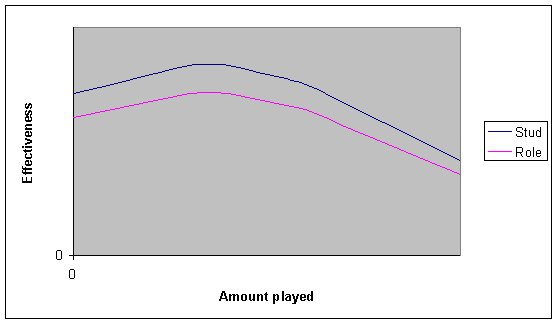

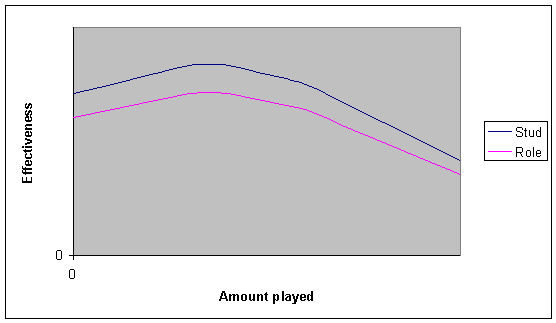
There are two “efficiency curves” that are relevant to playing time and role. One of them is how a player’s performance varies based on how much he’s put in. The other is how his performance varies based on how much he’s asked to do.
At the one extreme, it’s hard to be effective playing every 10th point. At the other, too much play leads to fatigue or pacing and a similar decrease in effectiveness. You want your team to be at a sweet spot where your stars play as much as they can without losing effectiveness while getting your role players enough time to be effective, while maintaining the flexibility to ride one or the other a little more due to a hot or cold hand or an injury.
The first graph shows what I’m guessing a typical curve is for a stud and a role player, and a replacement player. (You can think of the x axis as either “readiness” or “points played”.) I think the shape of the curve is about the same for everyone, with the exception that well-conditioned athletes won’t drop off as quickly with lots of play.
So, the question for subbers is, can you incorporate this model into your subbing scheme? How much does a player have to play in order to be near his peak effectiveness? How much is too much before you start to see fatigue-related errors? Have you experimented with designating some role players to “on” one game (maybe they’ll play 8 points) and “off” the next (0-2 points) instead of being half-on (5 points) for both? Do players rebel against this?
The other curve shows how a player can bear a load when he’s in. On offense, if a player’s full job was to cut for goals, he’d be more effective than if he also had to work the disc. On defense, a player might be able to prevent the third handler from doing a lot, but would be toasted by the star cutter.
A good role player will actually be better than the stud at the subordinate tasks like filling or clearing or reacting to the poach, but the reason that the stud is the stud is that he will be effective when it’s his job to be the first cutter or to break the mark or to cover the top cutter.
Anyway, I’m not really sure what you’re supposed to do with this, but I’ve been thinking about it and wanted to write it up, so there.
Monday, June 27, 2005
#98
This weekend was the estimated 98th tournament victory of my career, as DoG outlasted everyone (including the fans) to win the Boston Invitational (ne Easterns).
I heard one of the tryouts say excitedly to a friend that this was his first tournament victory. I often don't remember how few teams actually win tournaments, even those teams that do well. In the three years I played with Earth Atomizer, years in which we made Nationals twice (once going 3-2) and the semis at Worlds, we won exactly one tournament, the Clambake in 1990, which oddly enough was the one tournament that Earth went to that NYNY and Titanic did not.
I started writing down my tournament results in 1992, the year some Earth friends got bought out by Titanic, and after which I've been averaging half a dozen wins a year (full results below). Prior to that, I think I won 16 tournaments in my first 10 years:
1989-1991: Clambake 1990, Mars 1991 (with Pittsburgh)
1983-1988 in Cleveland: We won Sectionals in 1988, 1987, (I didn't play in 1986), 1985. Probably a couple OMITs.
1983-1989 in Pittsburgh: Fall Sectionals in 1986. There were spring Sectionals back then, too, and I was probably on the winning team 3 times then. There were 3 summer league titles. I think I had two other Mars titles in addition to 1991.
Victories by year from 1992-present: 6, 5, 9, 6, 8, 8, 11, 5, 6, 6, 5, 3, 4, 1. In 1998, I was on the winning team at Hawaii, Fools, Hingham, Corporate League, and Get Ho Ho Ho!, along with DoG victories at Turkey Swamp, Mothers Day, Easterns, Sectionals, Regionals, and Nationals. Funny, though, when I look at the little black stat book for that year, the two items that jump out are a 2nd place finish at Poultry Days and a 13th-16th place finish at Tuneup. The Poultry Days loss really should have made my list of worst losses, but it slipped my mind. We were a little short-handed that tournament (playing with Red Fish Blue Fish), and had maybe 9 or 10 for the finals. We seemingly had the game in control, though, going up 7-2. I only remember two details of the demise: Steve Finn made a layout bid on what would have been the winning goal (or it may have been earlier) and just got a finger on it (unfortunately, the pass was intended to a woman standing open behind him), and Marky Mark caught the game-winner but Matt Greff got the credit in the newsletter. Oh, and I missed my flight anyway because I hung around the fields for too long. For Tuneup, I had written on my web page "Interesting schedule, but too much for a hot day. 6 games on Saturday, all of them close. Went 2-1 in the first pool, advanced to the top half. Then went 1-2 in that pool, beating eventual champion Ring by 1, but losing to NY by 1 after being up late and to Sockeye by a few, and so we were sent to the B pool. We went down 7-2 to Red Tide, then have a spirited comeback to tie it at 10-10, next point wins. But they completed another huck to win it and send us drinking. Small squad again."
Anyway, we won this weekend. There was one point in the quarters with at least five turnovers per team. Later, Lyn was trying to ingratiate himself with Alex and me, and noted, "Well, the important thing is that the three of us weren't in that point." "No," I corrected him, "the important thing is that Alex and I weren't in that point. It's ironic that you weren't in that point." Al and I chuckled like schoolgirls about that one.
Thursday, June 23, 2005
Roster limits of 15
Suppose the UPA institutes a roster limit of 15 players for the fall series. What effect will this have?
80% of teams will be worse in absolute terms. The overall level of play will probably decline. There will be more parity.
How will various teams be affected?
All teams will be hurt a little because practices will be harder to do.
The best teams from big cities will be hurt a little because of this.
Conglomerate teams will be hurt significantly as practices become much more difficult to field 7s, and players decide to stay locally.
Second teams from big cities will be significantly better. There might even be enough interest in a third competitive team.
Small-market teams that currently do not lose players to conglomerate teams will be hurt a little because of the practice effect. Small-market teams that currently lose players will be helped a lot.
Why will play decline?
With this few tournament players, the level of play will have to decrease because players won’t be able to maintain that intensity and quality playing 50% more. (Roster of 21: play 1/3 of the time. Roster of 14, play ½ of the time. ½ is 50% more than 1/3.)
Practices will have no subs and won’t be intense. Many practices won’t even have 7 on 7, which means no zone or junk D practice, funny offensive lines (2 handlers, 2 middles, 1 deep?), and unrealistic spacing.
Some good players will retire/play coed rather than compete on a lesser men’s or women’s team.
Some decent players will want to play but won’t make it on any roster, and unless there is a critical mass of them and at least one or two are organizers, they’ll be out of luck.
On the other hand,
Players will have to condition better, so maybe that will raise the play.
Second-string elite teamers will now be playing bigger roles on lesser teams, bumping down those players to a lower level.
And another thing:
There will be more tournaments, as teams decide that they can’t get that much out of 6 on 6 practices and so will decide to go a relatively weak tournament. Having more tournaments that are competitive is definitely a good thing, but what is the cost? Perhaps it is that teams won’t practice much. Maybe this would lead to a rise in conglomerate teams who get together at tournaments every weekend.
And one more thing: I’ve been discussing this from a team level, but of course it is individuals who play. I listed a few types who would be hurt by this, but who is going to be helped?
Players who would prefer to be a big fish in a small pond but all the other fish prefer a big pond. (Ok, let’s be a little kinder to them: perhaps they think that it will be better for their career if they spend a year or two playing full-time at AAA instead of practicing with and riding the pine on a big league team, and without roster limits there would be no AAA team for them.)
Players on a team whose natural roster limit is 15. They actually won’t get any better or get to play more, but their best opponents will be a little worse. (Otoh, maybe their chances at making Nationals are lessened. Red Tide might have been good enough to beat Dark Horse twice when it counted, but they probably weren’t good enough to beat Dark Horse reinforced with a few of the extra players from DoG.)
Discuss.
Subscribe to:
Posts (Atom)