Well, I guess we need to buy shirts, shorts, and numbers.
First, the streaks. 12 Regional titles in a row (and 15 of 16), covering about 50 games (can't be bothered to look it up right now). 16 Nationals appearances in a row (and 18 of 19). 14th in a row with a team called "DoG". 24th straight Regionals appearance, 25th straight UPA series appearance.
The tournament went better than expected. As I mentioned on rsd, no one had bought his ticket to Sarasota prior to the tournament. There were three teams of roughly equal caliber (plus two teams that weren't as competitive) and two spots to Nationals. the format was full round robin on Saturday and modified clipped elimination on Sunday (1 plays 2 for 1st, 3 plays 4 to be eliminated, loser and winner play for 2nd spot to Nationals). It's version 5.1.2.A.chi, I think, in the handbook.
First round is at 8:30. We have 38 names on our mailing list, about 35 on the roster, and somewhere between 25 and 30 who are actually playing. We hadn't had anything close to a full team in our prior five tournaments, and as is typical of a Masters team, introductions were done at the beginning of Regionals. People are still strolling in at 8:30, or 9 for that matter (one player was at the Sox game the night before which didn't end until 1), but we still have plenty. We roll over Mt. Crushmore 15-4.
Next up is Tombstone, the #2 seed. They could easily have been the #1 seed, or the #3 seed. They are purported to be a merger of Tombstone, which won Canadian Nationals a couple months ago, and GLUM, which finished 2nd at CanNats and won the NE Region last year, finishing 5th at Nationals, but word is that they are bringing a small squad because of Canadian Thanksgiving. I develop an immediate dislike on the first point for one of their players who mauls me a couple times (not violently, just hackingly) while playing poor defense, then tapping the disc back in quickly and silently. The game is close through the first half, but we pull away. Mooney convinces Alex to withdraw a foul call, thus leading to a discussion after the game of the many, many, many times that Steve has handed the disc to the other team. (Most notable was in pool play at 1996 Worlds, where a pick call on double game point just prior to a huck was somehow overruled by Moons, and we lost right then and there. I know one player who is still livid about that. But this led directly to another story of a double game point call. At pool play at Nationals in 1998, a Condor caught a scoober very close to the line in the end zone. (Two videotapes from cameras right next to each other provided conclusive but contradictory evidence on whether he was in.) Discussion ensued, I saw Mooney saunter over to hand the game away, and I say to him, "Steve, don't say another word." He backs away, the disc eventually goes back, same pass is thrown and is OB, we move it upwind for the win. With the wind as strong as it was and the disc where it was after it was sent back, I'd have to guess that the Condors would still expect to win in excess of 95% of the time.) We stretch it out to a 5 goal win, which gives us a lot of breathing room in the event of a 3 way tie.
Next up is Above and Beyond, the other team that could have been seeded anywhere from 1-3 (their biggest claim is that they made semis at Nats last year and are the only of the three teams who played in the series last year as the same team). It's our second tough game in a row, but at least one of the three had to play back-to-back (given that none of the tough games were in the first round), and even though we were the top seed and thus in line for the favorable schedule, it wasn't really an earned first seed so we sucked it up. Similar pattern to the first game, close for the first half, then we pulled away, this time winning 15-11. A&B may have realized that point differential wasn't going to come into play if they lost, and even if they won, they would still need to win or keep it close against Tombstone in order to finish top two, so perhaps they conceded at some point. I noticed that Arnold and I were rarely on the field at the same time, which was a surprise since he so often covers me. I've come to really enjoy playing against him because it's always a battle, and though it was easier with others on me, I was disappointed.
We then had a bye, followed by a final game against Not Dead Yet, a team which plays in the local club league. I played one point only and was on the field for only about 15 seconds, which was enough for me to make the Man cut and huck the goal.
I had only two turnovers on the day, a drop on a stupid hammer and a breakmark flick to the middle of the field. (The hammer should have been the fourth straight O point goal for us that came off a hammer or blade to me, only two of them from Alex.) I went up well twice. I was embarrassingly bad at jump balls last year and possibly the year before. In my defense, it always seemed that I had to wait an excruciatingly long time for those and thus had to jump flat-footed against a young defender coming in at full speed. I once again found myself playing almost exclusively O points after playing both ways all year. But it seems like we have a fairly deep (though less star-laden, even if the names are the same) roster this year, and the tournaments are long, so I can deal. I think I will play some D points as needed at Nationals, but generally will stick to O.
So, we were set up for two shots at making Nationals. Finals are at 10:45, though we tell everyone 10:30 (but still people saunter in; having a local tournament is great and was definitely an advantage, but players try to maintain a semblance of normal life and so are more likely to skip out on parts of the weekend). And what a difference for the weather. Saturday was hot, probably in the 80s and with a lot of sun, but it's in the 50s with some wetness and more wind than the day before. We pull to start the game and are up 4-2 with several chances to add another. There is an injury after one of their turnovers, and I am called in for O. I expect to be the first cutter, but someone else goes first, unsuccessfully. I fill but the pass is behind me and it goes through my hands. A few passes later, the mark is broken and my guy catches the continuation for the goal. Well, that was an excellent 30 seconds of ultimate. Next point, I throw an open side pass several yards behind the receiver, and we are broken for the tie. I take myself out. At 7-5, receiving for the half, we become embroiled in a hell point. I have one turnover that point, a pass similar to the potential game-ender that Goat would later have in the Open finals, and another pass that was not caught (I think it was mostly a drop, but it wasn't a perfect throw), but I continue to work hard, cutting deep at least twice, and am about to cut to the end zone a third timebut see Mooney streaking that way, so I do a highly effective stand still and act like I'm about to cut, and the thrower hits Steve for the goal.
Somewhere in the first half, I have one of my trademark triple-bobble catches. The field had a lot of bare spots in the middle, and as I cut for a simple dump, I trip. I get a hand on it to keep it alive, maybe the defender hits it once or twice, but by the third or fourth contact I have in under control even though I am still on the ground, and snag it.
At halftime, especially with us receiving, they apparently decide to open up the bench in order to prep for the backdoor game. They score only twice more and we can begin our (dry, unfortunately) celebration.
It was terrific and even a little bit emotional to win with this crew. We have about a dozen of the old DoG plus several others who have been around the block, but also several players for whom this will be their first trip to Nationals, and I'm happy for them, more than I was happy for my 23 year old teammates in previous years (nothing against them personally, just that 23 year olds generally haven't been around the game long enough to truly appreciate it). And though we didn't win by less than 4, I never had the feeling that playing the games was just a formality, as was so often the case in recent years, where our typical chances of making Nationals were well over 99%.
So, one $450 plane ticket later, I am on my way to Sarasota. At some point, Alex and I realized we have to contact Joe Seidler so he can update his Hall of Records. Yeah, addendum!
Tuesday, October 09, 2007


Open seedings
Well, you gotta rank Boston ahead of Sockeye since Boston is 1-0 head-to-head.
Of course, I don't mean that. A team will play 30-50 games over the course of a year (more when you count the split squad teams they send to some spring tournaments), but some just want to take the results of 3, 2, or even 1 of all those games as the primary determinant of which of two teams deserves a higher seed. It's particularly silly in this example because it was a one-point pool play defeat in a tournament that Sockeye won (while Boston lost in quarters), a tournament that had 9 of the Nationals qualifiers plus Revolver and the Buzz Bullets.
Anyway, as promised, here are my seedings. I wrote a post last year about the method. The only change this year was to give bonus points also for making the semis at a top tournament like ECC or Boston Invite.
The method is to take a team's tournament RRI as shows up in the Score Reporter, give bonus points for finishing high, take a weighted average (with bigger tournaments counting as more), add bonus points for last year, and regress them to a low-Nationals-team level if they don't have enough tournaments this year.
One big problem I can't figure out is how much credit to give Jam for last year. Qualitatively, a team gets credit for both how they did and for how their Regional equivalent did, so Jam would get some credit since they won the Regional and the top finisher from the NW won Nationals, plus they're from the NW, which always seems to be worth extra points. They have the second highest rating prior to the bonus points, but three teams would jump ahead of them if they got no points.
So, without further ado, here are the results:
Team w/2006 No 2006 RRI
Sockeye 1 1 1
Bravo 2 4 4
Furious 3 11 7
SubZero 4 3 3
Jam 5 2 2
Ring 6 5 5
Boston 7 7 9
Condors 8 6 6
Chain 9 10 10
GOAT 10 9 8
Rhino 11 12 12
DWide 12 8 11
TStop 13 13 13
Machine 14 14 14
VBB 15 15 15
Pike 16 16 16
Comments:
1. Furious is an interesting case. RRI by itself has them 7th, but they drop to 11th because they didn't do well in elimination games (other than Can Nats; they lost in Sectionals and came in 3rd in region). But then the bonus for last year lets them leapfrog all those teams.
2. Otherwise, there is a disappointing lack of difference from straight RRI, whose main flaw in seeding is that it overvalues close losses. It's a predictive algorithm, so it is more accurate looking forward, but doesn't properly give credit for wins and losses. I may have discussed this already, but compare Boston and GOAT at CUT and Boston Invite. GOAT has a higher RRI at CUT than Boston, even though Boston beat GOAT twice and won the tournament. Similarly, GOAT won Boston Invite and beat Boston but had only a small advantage in RRI. In both cases, the tournament winner happened to have some close games along the way while the other team had bigger victories in the other games. I think this is probably where the algorithm is most off from how I would seed teams (and it was designed to mimic that method). Two of the Regional runnerups (Chain and Condors) had higher RRIs than the champ.
3. Most teams were pretty consistent, even comparing tournaments like Sectionals and ECC. "Inconsistent" Boston actually had the 4th lowest variance, but perhaps their inconsistency is manifested within a tournament rather than from tournament to tournament. The VBB had the second highest variance, but that is due to one significantly higher performance. That touranemnt? Nope, it was Sectionals, which was more than 200 points (equivalent to a 15-11 win) higher than any other tournament.
4. Sub Zero was surprisingly high. They were helped out a lot by their dominance at Regionals, which was the highest RRI for any team at any tournament this year (2954 including the 40 point bonus for winning).
I guess what I might want to do instead is to somehow figure out a strength of field for a tournament, allocate points based on final placement, then adjust for wins and losses during the tournament (so someone who wins while going undefeated would do better than one who wins while losing twice in pool play). Sounds doable.
The remaining issue I haven't addressed yet is how to handle inconsistencies. Sockeye emerges as #1 but lost their Region. They are so far ahead of Bravo that my solution is to bring Jam in front of them for the overall #1 and leave the others in the same order. DW and Chain are also inconsistent, but in this case, their average score is right in the middle of some other teams, so the final seedings by this algorithm are:
Jam
Sockeye
Johnny Bravo
Furious George
Sub Zero
Ring of Fire
Boston Ultimate
Condors
Doublewide
Chain Lightning
GOAT
Rhino
Truck Stop
Machine
The Van Buren Boys
Pike
Well, even I don't believe it, but once the method was set, there is no subjectivism. GOAT and Rhino seem low, but what higher team deserves the 11 and 12 seed?
Of course, I don't mean that. A team will play 30-50 games over the course of a year (more when you count the split squad teams they send to some spring tournaments), but some just want to take the results of 3, 2, or even 1 of all those games as the primary determinant of which of two teams deserves a higher seed. It's particularly silly in this example because it was a one-point pool play defeat in a tournament that Sockeye won (while Boston lost in quarters), a tournament that had 9 of the Nationals qualifiers plus Revolver and the Buzz Bullets.
Anyway, as promised, here are my seedings. I wrote a post last year about the method. The only change this year was to give bonus points also for making the semis at a top tournament like ECC or Boston Invite.
The method is to take a team's tournament RRI as shows up in the Score Reporter, give bonus points for finishing high, take a weighted average (with bigger tournaments counting as more), add bonus points for last year, and regress them to a low-Nationals-team level if they don't have enough tournaments this year.
One big problem I can't figure out is how much credit to give Jam for last year. Qualitatively, a team gets credit for both how they did and for how their Regional equivalent did, so Jam would get some credit since they won the Regional and the top finisher from the NW won Nationals, plus they're from the NW, which always seems to be worth extra points. They have the second highest rating prior to the bonus points, but three teams would jump ahead of them if they got no points.
So, without further ado, here are the results:
Team w/2006 No 2006 RRI
Sockeye 1 1 1
Bravo 2 4 4
Furious 3 11 7
SubZero 4 3 3
Jam 5 2 2
Ring 6 5 5
Boston 7 7 9
Condors 8 6 6
Chain 9 10 10
GOAT 10 9 8
Rhino 11 12 12
DWide 12 8 11
TStop 13 13 13
Machine 14 14 14
VBB 15 15 15
Pike 16 16 16
Comments:
1. Furious is an interesting case. RRI by itself has them 7th, but they drop to 11th because they didn't do well in elimination games (other than Can Nats; they lost in Sectionals and came in 3rd in region). But then the bonus for last year lets them leapfrog all those teams.
2. Otherwise, there is a disappointing lack of difference from straight RRI, whose main flaw in seeding is that it overvalues close losses. It's a predictive algorithm, so it is more accurate looking forward, but doesn't properly give credit for wins and losses. I may have discussed this already, but compare Boston and GOAT at CUT and Boston Invite. GOAT has a higher RRI at CUT than Boston, even though Boston beat GOAT twice and won the tournament. Similarly, GOAT won Boston Invite and beat Boston but had only a small advantage in RRI. In both cases, the tournament winner happened to have some close games along the way while the other team had bigger victories in the other games. I think this is probably where the algorithm is most off from how I would seed teams (and it was designed to mimic that method). Two of the Regional runnerups (Chain and Condors) had higher RRIs than the champ.
3. Most teams were pretty consistent, even comparing tournaments like Sectionals and ECC. "Inconsistent" Boston actually had the 4th lowest variance, but perhaps their inconsistency is manifested within a tournament rather than from tournament to tournament. The VBB had the second highest variance, but that is due to one significantly higher performance. That touranemnt? Nope, it was Sectionals, which was more than 200 points (equivalent to a 15-11 win) higher than any other tournament.
4. Sub Zero was surprisingly high. They were helped out a lot by their dominance at Regionals, which was the highest RRI for any team at any tournament this year (2954 including the 40 point bonus for winning).
I guess what I might want to do instead is to somehow figure out a strength of field for a tournament, allocate points based on final placement, then adjust for wins and losses during the tournament (so someone who wins while going undefeated would do better than one who wins while losing twice in pool play). Sounds doable.
The remaining issue I haven't addressed yet is how to handle inconsistencies. Sockeye emerges as #1 but lost their Region. They are so far ahead of Bravo that my solution is to bring Jam in front of them for the overall #1 and leave the others in the same order. DW and Chain are also inconsistent, but in this case, their average score is right in the middle of some other teams, so the final seedings by this algorithm are:
Jam
Sockeye
Johnny Bravo
Furious George
Sub Zero
Ring of Fire
Boston Ultimate
Condors
Doublewide
Chain Lightning
GOAT
Rhino
Truck Stop
Machine
The Van Buren Boys
Pike
Well, even I don't believe it, but once the method was set, there is no subjectivism. GOAT and Rhino seem low, but what higher team deserves the 11 and 12 seed?
Friday, October 05, 2007
formats
I was just checking out the other regions that had pools of 5 to see their schedules. Three of the Divs at South Regionals had 10 teams (5 per pool), and each had a different schedule. The one in the format manual is the one we used at Sectionals. Here it is:
4 v 5 2 v 3
1 v 3 2 v 4
1 v 5 3 v 4
1 v 4 2 v 5
1 v 2 3 v 5
Kinda sucks to be 3 in this format, opening with 2 and then 1. What is especially interesting is that finishing 2nd in the pool instead of 3rd can be quite beneficial, more than the difference between 1st and 2nd or 3rd and 4th. In a 5 team Masters Regionals, 1 and 2 play off for the 1st spot to Nationals while 3 plays 4, then there is a second game to go. Thus, if 1-3 are equal, the teams that finish top two have a 75% chance of advancing, while 3rd has a 50% chance. So, what might be the most pivotal game of the pool is played in the first round, then the next most pivotal games are in the 2nd round (not only 1v3 but also conceivably 2v4 if 4 is underseeded).
Speaking of opening with 2 and 1, I'm still a little ticked about the seeding and format at 1990 Nationals. We (Earth Atomizer, the little engine that could) had made Nats in 1989 ahead of Graffiti, had split with them during the year (and neither had won anything since NYNY and Boston #1 (let's see, they must have been First Time Gary that year, but let's just call them Titanic) were winning everything in the area), but they won the final game, and somehow they finagled the 3rd seed (or maybe it was because our seeding representative, Bruce Jacobson, was too nice). We were bummed because we wanted a shot at Titanic in the semis instead of NYNY, who always handled us. (As an aside, we played Titanic closer than Graffiti did, while they played NYNY closer than we did.) Anyhoo, it all went to seed until we dismantled Graffiti 19-9 in the game to go, but it was too late to play the 2/3 game, so we played it the following week and won, 21-17, to earn the #2 seed from the mighty NE. Titanic had lost by 1 in the semis at Nats in 1989, and were in year 4 of a 17 year streak of making semis. So, out of 12 teams, they seeded us....
9th. Just ahead of Titanic at 10th.
And our schedule had us playing the top seed LA in the first round, then 2nd seed (3rd overall) Windy City in the second (and final) round of the first day. Didn't seem fair. We got smoked by LA, 19-7 (this was the first year pool play games were to only 19 instead of 21), then lost a two-pointer to Windy City to end our tournament. We won our last three games after that so we could play the what-if game. We definitely would have benefitted from a different first day, but then again, maybe the next games wouldn't have gone the same way had we played them early. The Condors game in particular probably would have had a different tone. We got them on the last day after they had fallen apart. They went in seeded 3rd in the pool but played and acted badly, and actually kicked off one of their players (a captain, maybe? I hardly knew who anyone was back then, being only slightly older (25) than most of you reading this blog, and rsd did not exist yet).
Then again, it worked out ok for Titanic (better, actually). They opened with NYNY (and lost), but then got #2 seed Tsunami, who IIRC didn't have everyone there the first day because they knew they were just going to have two games they would win. Titanic won that won and made it to the finals.
Anyway, go DoG.
4 v 5 2 v 3
1 v 3 2 v 4
1 v 5 3 v 4
1 v 4 2 v 5
1 v 2 3 v 5
Kinda sucks to be 3 in this format, opening with 2 and then 1. What is especially interesting is that finishing 2nd in the pool instead of 3rd can be quite beneficial, more than the difference between 1st and 2nd or 3rd and 4th. In a 5 team Masters Regionals, 1 and 2 play off for the 1st spot to Nationals while 3 plays 4, then there is a second game to go. Thus, if 1-3 are equal, the teams that finish top two have a 75% chance of advancing, while 3rd has a 50% chance. So, what might be the most pivotal game of the pool is played in the first round, then the next most pivotal games are in the 2nd round (not only 1v3 but also conceivably 2v4 if 4 is underseeded).
Speaking of opening with 2 and 1, I'm still a little ticked about the seeding and format at 1990 Nationals. We (Earth Atomizer, the little engine that could) had made Nats in 1989 ahead of Graffiti, had split with them during the year (and neither had won anything since NYNY and Boston #1 (let's see, they must have been First Time Gary that year, but let's just call them Titanic) were winning everything in the area), but they won the final game, and somehow they finagled the 3rd seed (or maybe it was because our seeding representative, Bruce Jacobson, was too nice). We were bummed because we wanted a shot at Titanic in the semis instead of NYNY, who always handled us. (As an aside, we played Titanic closer than Graffiti did, while they played NYNY closer than we did.) Anyhoo, it all went to seed until we dismantled Graffiti 19-9 in the game to go, but it was too late to play the 2/3 game, so we played it the following week and won, 21-17, to earn the #2 seed from the mighty NE. Titanic had lost by 1 in the semis at Nats in 1989, and were in year 4 of a 17 year streak of making semis. So, out of 12 teams, they seeded us....
9th. Just ahead of Titanic at 10th.
And our schedule had us playing the top seed LA in the first round, then 2nd seed (3rd overall) Windy City in the second (and final) round of the first day. Didn't seem fair. We got smoked by LA, 19-7 (this was the first year pool play games were to only 19 instead of 21), then lost a two-pointer to Windy City to end our tournament. We won our last three games after that so we could play the what-if game. We definitely would have benefitted from a different first day, but then again, maybe the next games wouldn't have gone the same way had we played them early. The Condors game in particular probably would have had a different tone. We got them on the last day after they had fallen apart. They went in seeded 3rd in the pool but played and acted badly, and actually kicked off one of their players (a captain, maybe? I hardly knew who anyone was back then, being only slightly older (25) than most of you reading this blog, and rsd did not exist yet).
Then again, it worked out ok for Titanic (better, actually). They opened with NYNY (and lost), but then got #2 seed Tsunami, who IIRC didn't have everyone there the first day because they knew they were just going to have two games they would win. Titanic won that won and made it to the finals.
Anyway, go DoG.
What happens at Clambake...
Gets blogged about here. But I won’t name any names.
Helluva party. I got there at 9:30 to a raging multi-pronged scene, left a little before 1, figuring that no good could possibly come from me staying any longer, and it was still raging. Favorite moments:
Mullets for charity. Pay $20 (to go to Special Olympics, the targeted beneficiary of the event), get a mullet by a drunk female. The best one was when the haircutter stabbed the haircuttee (the first one, I believe) in the ear and he began bleeding. It brought back the memories of my last head wound, seeing all that blood spurt out. Pretty cool.
Breast shots:
Some woman with a cleavagy shirt nestled a shot of tequila (or some other fine liquor) in her bosom and some willing payer got to drink it. Not sure how much overeagerness was allowed before the shot was ended. This of course led to body shots, and perhaps some other type of shots that can’t be blogged about.
Music:
There was a house band off in another room, plus a DJ that had lots of people on the floor.
Frisbee games:
As I drove in, I could see several sets of illuminated sticks for Cups, which seems to be the game of choice these days. A guy at work described a Frisbee game recently and wondered if it was ultimate. Nope, it was Cups.
Food and beer:
Lots of it, everywhere.
So, the breadth and depth of the party was like nothing I’ve seen at a Frisbee party. No matter where you wandered to, there was something going on, not just a bunch of dudes hanging around a keg swapping stories (although there was that, too).
So, definitely a worthwhile experience. The one eerie part was that it was really far away from everything. While I was driving up, it reminded me of an old movie called "Race with the Devil", where some campers in an RV in the middle of nowhere witness a Satanic human sacrifice, then spend the rest of the movie trying to flee.
So, the ultimate. Saturday was a bit slow. We appeared sluggish all day (or maybe I'm just projecting), and we took all of our games, each a litttle closer than it should have been. We tried working on some of our defenses, but nothing seemed to work especially well. With a full squad (and more of the veterans), perhaps some of our zones and transitions will be a bit more effective.
Sunday had a late start. First round for anyone was at 10, but as people strolled in at 10, there wasn't even a full setup at Frisbee Central. My wife's dumb old team didn't have a program and weren't sure what fields they were supposed to be on, nor was anyone else. So they just sort of wandered over to where they thought they might be and set up, but it looked like it might have been a too-narrow sliver between two other fields (it was 31 yards wide). So they moved to some other field and got started sometime around 11, about the same time as everyone else. The TD had warned that they needed to start on time as games in teh past had been capped at 4, but they just decided to push the whole schedule back, meaning that were we to make the finals, we probably wouldn't get out before dusk. Well, it was a nice day out, so I guess that's ok.
The boy and I then went inside and played some in the gym. They had an indoor track there, and the day before we had done some 55m sprints. He had a pretty good surge every time at the end, I was proud to see. This morning, we went into the batting cage and played some foot baseball and running the bases. He loves to hit the ball in our yard and run around the bases, and seems to understand the basic rules about getting tagged out and having to be on the base and foul balls. Here's a video of him about 3 months ago. His swing has continued to improve. At the beginning of the summer, I would basically have to hit his bat with the pitch in order for him to hit it, but now he does pretty well no matter where the pitch is. I haven't instilled plate discipline yet, which is not something his old man is famous for, either, but if he wants to make it to the pros, he has to learn it.
So, we played against the Pitts brothers in our first round, former teammate Darden and his much older brother James, whom we used to play against 10-15 years ago. They were nice enough to play zone against us the first point and we never looked back.
Our semis were against Harvard, who apparently hadn't entered the fall series. I recognized a few of their guys from Sectionals the previous weekend, but damned if I could tell you which team they were on. Well, I'm guessing either New Noise or Gunslingers, but I wouldn't wager a lot of money either way. So, of course, we immediately get broken to start the game, then again, then again. We finally score to make it 3-1, then come down in zone. From their end zone, they throw a looping forehand to my side. I drift back, leap for my third competitive Callahan goal, and have it bounce out of my hand and get caught. They proceed to score without turning. We continue to trade, clawing back one or two here and there, and eventually tie it at 10 and 11. But we couldn't score again, and couldn't force a turnover, and those Harvard kids get the thrill of their young frisbee lives, second only to making Nationals probably. Well, in our bid, we did promise to "provide plenty of opportunities for opponents to school one-time greats of the game who still delusionally think they're awesome."
In retrospect, we should have done something about getting beat deep so often other than trying harder or hoping it would stop. Afterwards, I mentioned how defenders need to "orbit" around the cutter as soon as he turns upfield after a comeback cut, rather than continuing to chase after and hoping to catch up if it's thrown. But perhaps after the thir or fourth huck would have been more timely. I suppose that's where Dick Brown comes in handy, to throw his handy, storm off the fields, simmer for a few minutes, and eventually tell everyone how to play better.
Of the three "I can't believe I lost to this team"
games this year, this one was the most that the other
team did to earn. Against Gunslingers at Sectionals,
it was equal part us playing badly and them playing
well, and against Colt .45 at WMO, it was mostly about
us plus one of their guys having the game of his life.
At the end of last blog entry, I discussed individual
game RRIs, but misinterpreted their meaning. A game
RRI is a sample, but of both teams. So, if we have a
single game score typical of an Open Nats team, in
reality maybe half of the difference is due to the
other team playing worse than usual. Additionally,
the winner is typically luckier (for instance, a
Harvard guy yesterday bobbled the disc twice into the
end zone and fell down and had the disc land on him
for a goal, oh, and I dropped a Callahan that ended up
being caught and they scored without turning it), so
even if the teams played identically, a second
sampling would probably result in the loser being
closer. So maybe only 1/3 of the difference in RRI
between a team's overall RRI and an individual game
RRI should be attributed to the team.
So, onto Regionals tomorrow. Three go in, two come out. (Plus two other teams.) Big games at 10:30 and 12:30 should reveal where we are. We've played the last two weekends, but against faster but less experienced players, so it will be different against Masters. Paradoxically, it might be more difficult in certain situations to get open, as simple setups just won't work as well.
Ok, gotta run. Good luck to all.
Helluva party. I got there at 9:30 to a raging multi-pronged scene, left a little before 1, figuring that no good could possibly come from me staying any longer, and it was still raging. Favorite moments:
Mullets for charity. Pay $20 (to go to Special Olympics, the targeted beneficiary of the event), get a mullet by a drunk female. The best one was when the haircutter stabbed the haircuttee (the first one, I believe) in the ear and he began bleeding. It brought back the memories of my last head wound, seeing all that blood spurt out. Pretty cool.
Breast shots:
Some woman with a cleavagy shirt nestled a shot of tequila (or some other fine liquor) in her bosom and some willing payer got to drink it. Not sure how much overeagerness was allowed before the shot was ended. This of course led to body shots, and perhaps some other type of shots that can’t be blogged about.
Music:
There was a house band off in another room, plus a DJ that had lots of people on the floor.
Frisbee games:
As I drove in, I could see several sets of illuminated sticks for Cups, which seems to be the game of choice these days. A guy at work described a Frisbee game recently and wondered if it was ultimate. Nope, it was Cups.
Food and beer:
Lots of it, everywhere.
So, the breadth and depth of the party was like nothing I’ve seen at a Frisbee party. No matter where you wandered to, there was something going on, not just a bunch of dudes hanging around a keg swapping stories (although there was that, too).
So, definitely a worthwhile experience. The one eerie part was that it was really far away from everything. While I was driving up, it reminded me of an old movie called "Race with the Devil", where some campers in an RV in the middle of nowhere witness a Satanic human sacrifice, then spend the rest of the movie trying to flee.
So, the ultimate. Saturday was a bit slow. We appeared sluggish all day (or maybe I'm just projecting), and we took all of our games, each a litttle closer than it should have been. We tried working on some of our defenses, but nothing seemed to work especially well. With a full squad (and more of the veterans), perhaps some of our zones and transitions will be a bit more effective.
Sunday had a late start. First round for anyone was at 10, but as people strolled in at 10, there wasn't even a full setup at Frisbee Central. My wife's dumb old team didn't have a program and weren't sure what fields they were supposed to be on, nor was anyone else. So they just sort of wandered over to where they thought they might be and set up, but it looked like it might have been a too-narrow sliver between two other fields (it was 31 yards wide). So they moved to some other field and got started sometime around 11, about the same time as everyone else. The TD had warned that they needed to start on time as games in teh past had been capped at 4, but they just decided to push the whole schedule back, meaning that were we to make the finals, we probably wouldn't get out before dusk. Well, it was a nice day out, so I guess that's ok.
The boy and I then went inside and played some in the gym. They had an indoor track there, and the day before we had done some 55m sprints. He had a pretty good surge every time at the end, I was proud to see. This morning, we went into the batting cage and played some foot baseball and running the bases. He loves to hit the ball in our yard and run around the bases, and seems to understand the basic rules about getting tagged out and having to be on the base and foul balls. Here's a video of him about 3 months ago. His swing has continued to improve. At the beginning of the summer, I would basically have to hit his bat with the pitch in order for him to hit it, but now he does pretty well no matter where the pitch is. I haven't instilled plate discipline yet, which is not something his old man is famous for, either, but if he wants to make it to the pros, he has to learn it.
So, we played against the Pitts brothers in our first round, former teammate Darden and his much older brother James, whom we used to play against 10-15 years ago. They were nice enough to play zone against us the first point and we never looked back.
Our semis were against Harvard, who apparently hadn't entered the fall series. I recognized a few of their guys from Sectionals the previous weekend, but damned if I could tell you which team they were on. Well, I'm guessing either New Noise or Gunslingers, but I wouldn't wager a lot of money either way. So, of course, we immediately get broken to start the game, then again, then again. We finally score to make it 3-1, then come down in zone. From their end zone, they throw a looping forehand to my side. I drift back, leap for my third competitive Callahan goal, and have it bounce out of my hand and get caught. They proceed to score without turning. We continue to trade, clawing back one or two here and there, and eventually tie it at 10 and 11. But we couldn't score again, and couldn't force a turnover, and those Harvard kids get the thrill of their young frisbee lives, second only to making Nationals probably. Well, in our bid, we did promise to "provide plenty of opportunities for opponents to school one-time greats of the game who still delusionally think they're awesome."
In retrospect, we should have done something about getting beat deep so often other than trying harder or hoping it would stop. Afterwards, I mentioned how defenders need to "orbit" around the cutter as soon as he turns upfield after a comeback cut, rather than continuing to chase after and hoping to catch up if it's thrown. But perhaps after the thir or fourth huck would have been more timely. I suppose that's where Dick Brown comes in handy, to throw his handy, storm off the fields, simmer for a few minutes, and eventually tell everyone how to play better.
Of the three "I can't believe I lost to this team"
games this year, this one was the most that the other
team did to earn. Against Gunslingers at Sectionals,
it was equal part us playing badly and them playing
well, and against Colt .45 at WMO, it was mostly about
us plus one of their guys having the game of his life.
At the end of last blog entry, I discussed individual
game RRIs, but misinterpreted their meaning. A game
RRI is a sample, but of both teams. So, if we have a
single game score typical of an Open Nats team, in
reality maybe half of the difference is due to the
other team playing worse than usual. Additionally,
the winner is typically luckier (for instance, a
Harvard guy yesterday bobbled the disc twice into the
end zone and fell down and had the disc land on him
for a goal, oh, and I dropped a Callahan that ended up
being caught and they scored without turning it), so
even if the teams played identically, a second
sampling would probably result in the loser being
closer. So maybe only 1/3 of the difference in RRI
between a team's overall RRI and an individual game
RRI should be attributed to the team.
So, onto Regionals tomorrow. Three go in, two come out. (Plus two other teams.) Big games at 10:30 and 12:30 should reveal where we are. We've played the last two weekends, but against faster but less experienced players, so it will be different against Masters. Paradoxically, it might be more difficult in certain situations to get open, as simple setups just won't work as well.
Ok, gotta run. Good luck to all.
Wednesday, September 26, 2007
Sectionals 2007
Alex recounted the details of the tournament pretty well over on his blog, so I’ll just recap them here and give more impressions, which is really what all of you want to read.
We started out terribly, losing a grudge match against the Gunslingers, 13-9. There were numerous rookie mistakes that game on all parts, people just a little too anxious to impress and make plays, and not enough of the seamless efficiency we were famous for. As with the rest of the weekend, we played a basic offense with a four-person play and fills. We stayed with man-to-man defense for too long that game when it wasn’t working that well. I didn’t leave that game with a good feeling about things.
Game 2 was similarly unimpressive. We got broken twice (out of four points) against a college zone D in the first half, the lowest point of the weekend and possibly my career.
I missed the third game to attend the Bolton Fair with my wife, son, and parents for about 20 minutes. There was horrible traffic management there. Coming from the east, fairgoers were forced to wait for 30-45 minutes just to park. There were three huge parking lots, but all the cars from the east (which had 75% of the cars) were shunted to the first lot. However, the parking lot traffic directors were inefficient. They would frequently stop traffic to allow a few cars from the other direction to come through, and occasionally stopped traffic for no apparent reason. There were a few cones in the lot intended to direct foot traffic, but no one enforced it and so car access to the lot was frequently restricted as a result. Only once in the 20 or so minutes I stood watching did they do something proactive, waiving about 20 cars ahead to one of the other under-utilized lots. I am reasonably confident that I could have gotten cars parked twice as fast with no more than one accident. So, instead of spending an hour there, I had just enough time to pay admission, stand in line for tickets for my son to go on rides, and watch him ride one thing. The rides were a ripoff, too, generally $3 per person for a typical carnival ride. They did have a lot of other county-fair type activities (including a Frisbee-catching dog!).
Back to the fields for a brief warmup prior to the Red Tide game. In another low point of my career, I did the math incorrectly in evaluating the tiebreak possibilities, at least twice. (It was easy enough to do that as soon as the game ended, I thought about it for two seconds and said, “Hold on, that’s not right” without even running the numbers.) We started out with a gift turnover and break, expanded our lead, and won convincingly to take 1st place in the pool.
Semis on Saturday was another grudge match, this time for us. If you remember correctly, this was the team that sent me to the hospital when we played them at Boston Invite. The offender was pointed out and acknowledged me but never bothered to mutter even a simple “sorry about that”. I know it wasn’t intentional, and I am obviously ok now, but it was a bit reckless, and I did need stitches. I think I made a joke about being entitled to kick him in the groin at some point. Again, we had our chances this game, and it would have been nice to win to get a chance against my old mates and the new kids.
So, impressions. First off, it remains weird playing in a tournament I don’t think I have a chance to win (although some part of me thought it _could_ happen). This was especially so because it was Sectionals, where I hadn’t lost a game since 1991. That was also approximately the last time where I was actually looking forward to Sectionals. That was an interesting year, by the way. I had a foot injury that fall and so didn’t practice or play much. I sat out most of Sectionals except for the game against Titanic. Our team may have beaten Harvard by just 1 goal, in fact, but we made it to the finals. I was warming up by playing football with our opponents, and Gary Lippman felt it necessary to point out how bad we were that year, and that just really pissed me off. In a game to 13, I threw three goals and caught five more. On the bad side, though, I had a critical late turnover on their goal line and we lost by 1. Rats. There were two more scares for the #1 Boston team since then. In maybe 1995, we were close late in the game against Snapple, but they gakked it away as they were wont to do. And we beat Dos Manos by only 1 in 1998 as we were working on our split stack offense the entire game. (Late in the first half, I asked an opponent the score, was told we were losing, and didn’t believe him.) So, Boston #1 continues to have the longest streak of Sectional titles in the country.
It is also weird to take pride in finishing 3rd in the Section and in losing a close game to a team that will not make Nationals (but no pride in losing badly to a team not expected to make the second day of Regionals). But it’s action, isn’t it?
I think I had four blocks on the weekend, five if you count the one where I called a foul on myself, completely surprising the offensive player. The block itself was clean but I was pretty sure I went through his body to get there. He wouldn’t have called anything, either. All but one of these were on handler cuts, and I left my feet on two of them. I was only overmatched once all weekend, by a little squirrelly guy. I had been told he was squirrelly and volunteered to take him, but I thought he was a squirrelly handler. He was instead a squirrelly receiver, so he combined actual running with his squirreling and so had me spinning. Oh, I also took out a pivoter. The lanky opponent had caught a disc near the line and I thought he may have been out, so was thinking about that a little as I jogged downfield with my guy. I think I followed in my guy’s steps, a foot or two outside the pivot foot (but six feet from the thrower’s body), only to be surprised by a rapid pivot back to the forehand side, and I bowled him over. Whoops. I should have been more alert and known that was a possibility. I apologized to the guy on the other team who yelled at me about it, to the thrower, and again later to the thrower, and now to the unwashed masses.
As typical of the past couple years, I felt better later in the weekend than at first. I played basketball last Monday but then nothing again until Saturday, which explains it a bit. I would like to get in one speed workout per week the rest of the season, and will try to break a sweat the day before Regionals. (Goals must be achievable, you know.)
Overall I felt really good, though. I was able to move quickly, went up nicely the one time I had to, got open pretty easily both downfield and near the disc. With another tournament (Clambake) this weekend, I expect to be rarin’ to go at Regionals.
I don’t think I changed my opinion of Sectionals, though, as a result of being “one of those teams we have to play because the UPA says so.” While it would have been nice to play a game against “Boston #1” where they were trying hard, not playing them didn’t significantly alter my Sectionals experience (other than it meant we lost a game we wanted to win). Boston Ultimate blanked the first two teams they played, and even shut out New Noise in the first half on Saturday, I heard. In a Section that has a handful of teams, perhaps it is necessary to the UPA for a team like Boston Ultimate to play, but here, where there were 25 teams total, there were still plenty of opportunities to play good games even without them (and for lower level teams to play someone significantly better). I guess I still don’t see the point of playing a 15-2 game, for either team.
I’m a little disappointed that we don’t have an Open RRI, just a Masters RRI. Oh, heck, let me just figure out an estimate. I looked at all of our games, pro-rated it to a game to 15, and took the RRI of the team that expected to finish with that score against that opponent. For instance, first game was a 13-4 loss to Boston Ultimate. Translate that to 15-4.6. I went to the Score Predictor for BUY and saw that the middle team that would lose 15-4.6 had an RRI of 1974. Repeat for the entire schedule. Average the scores.
Result: Average 2331. Best game was 15-7 against Phoenix at Boston Invite (2656), then 13-12 over Bro White at WMO (2598) and 13-7 over Red Tide at Sectionals (also 2598). A typical low-level Nationals team has an RRI of about that, but I don’t buy that on our best day we would be on an equal footing with them. There is, of course, the problem that each of those games is just a sample and likely not indicative of our true “best” game. Our average is right around the teams that will probably go into Regionals in the 5-9 range. Our worst performances were against Gunslingers at Sectionals (1958) and Boston Ultimate Y at WMO (1974), which puts us at the “didn’t qualify for Regionals” level. It would be kind of interesting to repeat this best-and-worst for other teams, but nah.
Workout this week: did a sprint workout in front of my house tonight. 4x100, 6x50, 8x30, 6x(backpedal fast for 5 seconds and sprint back). Started each rep on the minute, 5 minutes between sets.
We started out terribly, losing a grudge match against the Gunslingers, 13-9. There were numerous rookie mistakes that game on all parts, people just a little too anxious to impress and make plays, and not enough of the seamless efficiency we were famous for. As with the rest of the weekend, we played a basic offense with a four-person play and fills. We stayed with man-to-man defense for too long that game when it wasn’t working that well. I didn’t leave that game with a good feeling about things.
Game 2 was similarly unimpressive. We got broken twice (out of four points) against a college zone D in the first half, the lowest point of the weekend and possibly my career.
I missed the third game to attend the Bolton Fair with my wife, son, and parents for about 20 minutes. There was horrible traffic management there. Coming from the east, fairgoers were forced to wait for 30-45 minutes just to park. There were three huge parking lots, but all the cars from the east (which had 75% of the cars) were shunted to the first lot. However, the parking lot traffic directors were inefficient. They would frequently stop traffic to allow a few cars from the other direction to come through, and occasionally stopped traffic for no apparent reason. There were a few cones in the lot intended to direct foot traffic, but no one enforced it and so car access to the lot was frequently restricted as a result. Only once in the 20 or so minutes I stood watching did they do something proactive, waiving about 20 cars ahead to one of the other under-utilized lots. I am reasonably confident that I could have gotten cars parked twice as fast with no more than one accident. So, instead of spending an hour there, I had just enough time to pay admission, stand in line for tickets for my son to go on rides, and watch him ride one thing. The rides were a ripoff, too, generally $3 per person for a typical carnival ride. They did have a lot of other county-fair type activities (including a Frisbee-catching dog!).
Back to the fields for a brief warmup prior to the Red Tide game. In another low point of my career, I did the math incorrectly in evaluating the tiebreak possibilities, at least twice. (It was easy enough to do that as soon as the game ended, I thought about it for two seconds and said, “Hold on, that’s not right” without even running the numbers.) We started out with a gift turnover and break, expanded our lead, and won convincingly to take 1st place in the pool.
Semis on Saturday was another grudge match, this time for us. If you remember correctly, this was the team that sent me to the hospital when we played them at Boston Invite. The offender was pointed out and acknowledged me but never bothered to mutter even a simple “sorry about that”. I know it wasn’t intentional, and I am obviously ok now, but it was a bit reckless, and I did need stitches. I think I made a joke about being entitled to kick him in the groin at some point. Again, we had our chances this game, and it would have been nice to win to get a chance against my old mates and the new kids.
So, impressions. First off, it remains weird playing in a tournament I don’t think I have a chance to win (although some part of me thought it _could_ happen). This was especially so because it was Sectionals, where I hadn’t lost a game since 1991. That was also approximately the last time where I was actually looking forward to Sectionals. That was an interesting year, by the way. I had a foot injury that fall and so didn’t practice or play much. I sat out most of Sectionals except for the game against Titanic. Our team may have beaten Harvard by just 1 goal, in fact, but we made it to the finals. I was warming up by playing football with our opponents, and Gary Lippman felt it necessary to point out how bad we were that year, and that just really pissed me off. In a game to 13, I threw three goals and caught five more. On the bad side, though, I had a critical late turnover on their goal line and we lost by 1. Rats. There were two more scares for the #1 Boston team since then. In maybe 1995, we were close late in the game against Snapple, but they gakked it away as they were wont to do. And we beat Dos Manos by only 1 in 1998 as we were working on our split stack offense the entire game. (Late in the first half, I asked an opponent the score, was told we were losing, and didn’t believe him.) So, Boston #1 continues to have the longest streak of Sectional titles in the country.
It is also weird to take pride in finishing 3rd in the Section and in losing a close game to a team that will not make Nationals (but no pride in losing badly to a team not expected to make the second day of Regionals). But it’s action, isn’t it?
I think I had four blocks on the weekend, five if you count the one where I called a foul on myself, completely surprising the offensive player. The block itself was clean but I was pretty sure I went through his body to get there. He wouldn’t have called anything, either. All but one of these were on handler cuts, and I left my feet on two of them. I was only overmatched once all weekend, by a little squirrelly guy. I had been told he was squirrelly and volunteered to take him, but I thought he was a squirrelly handler. He was instead a squirrelly receiver, so he combined actual running with his squirreling and so had me spinning. Oh, I also took out a pivoter. The lanky opponent had caught a disc near the line and I thought he may have been out, so was thinking about that a little as I jogged downfield with my guy. I think I followed in my guy’s steps, a foot or two outside the pivot foot (but six feet from the thrower’s body), only to be surprised by a rapid pivot back to the forehand side, and I bowled him over. Whoops. I should have been more alert and known that was a possibility. I apologized to the guy on the other team who yelled at me about it, to the thrower, and again later to the thrower, and now to the unwashed masses.
As typical of the past couple years, I felt better later in the weekend than at first. I played basketball last Monday but then nothing again until Saturday, which explains it a bit. I would like to get in one speed workout per week the rest of the season, and will try to break a sweat the day before Regionals. (Goals must be achievable, you know.)
Overall I felt really good, though. I was able to move quickly, went up nicely the one time I had to, got open pretty easily both downfield and near the disc. With another tournament (Clambake) this weekend, I expect to be rarin’ to go at Regionals.
I don’t think I changed my opinion of Sectionals, though, as a result of being “one of those teams we have to play because the UPA says so.” While it would have been nice to play a game against “Boston #1” where they were trying hard, not playing them didn’t significantly alter my Sectionals experience (other than it meant we lost a game we wanted to win). Boston Ultimate blanked the first two teams they played, and even shut out New Noise in the first half on Saturday, I heard. In a Section that has a handful of teams, perhaps it is necessary to the UPA for a team like Boston Ultimate to play, but here, where there were 25 teams total, there were still plenty of opportunities to play good games even without them (and for lower level teams to play someone significantly better). I guess I still don’t see the point of playing a 15-2 game, for either team.
I’m a little disappointed that we don’t have an Open RRI, just a Masters RRI. Oh, heck, let me just figure out an estimate. I looked at all of our games, pro-rated it to a game to 15, and took the RRI of the team that expected to finish with that score against that opponent. For instance, first game was a 13-4 loss to Boston Ultimate. Translate that to 15-4.6. I went to the Score Predictor for BUY and saw that the middle team that would lose 15-4.6 had an RRI of 1974. Repeat for the entire schedule. Average the scores.
Result: Average 2331. Best game was 15-7 against Phoenix at Boston Invite (2656), then 13-12 over Bro White at WMO (2598) and 13-7 over Red Tide at Sectionals (also 2598). A typical low-level Nationals team has an RRI of about that, but I don’t buy that on our best day we would be on an equal footing with them. There is, of course, the problem that each of those games is just a sample and likely not indicative of our true “best” game. Our average is right around the teams that will probably go into Regionals in the 5-9 range. Our worst performances were against Gunslingers at Sectionals (1958) and Boston Ultimate Y at WMO (1974), which puts us at the “didn’t qualify for Regionals” level. It would be kind of interesting to repeat this best-and-worst for other teams, but nah.
Workout this week: did a sprint workout in front of my house tonight. 4x100, 6x50, 8x30, 6x(backpedal fast for 5 seconds and sprint back). Started each rep on the minute, 5 minutes between sets.
Thursday, September 20, 2007
The game is afoot
Big Ego Ultimate/DoG plays its first tournament since June this weekend, entering Sectionals as the #4 seed. We open with a pivotal game against the Gunslingers, who we beat by 1 at Boston Invite, and close with Red Tide, playing a couple college teams in between, then the usual format machinations on Sunday to guarantee that if the 1st, 2nd, 3rd, and 5th best teams are in one pool and all teams play consistently, the game to determine the antepenultimate spot to Regionals is fair, or something like that.
Ok, I was kidding. They don't care about the antepenultimate spot.
We're in the Score Reporter as Big Ego, but I submitted our roster as simply "DoG", although whether it stands for "Death or Glory" or "Delusions of Grandeur" has yet to be determined. As usual, our shirts our nowhere to be seen. During our heyday, I don't ever remember having team shirts at Regionals (other than the year where we didn't get new shirts and just used the ones from the year before), and at least once they showed up at Nationals (and one year at Worlds, they didn't even show up, and we played with only a light shirt). Now, we need freakin' numbers on the shorts. Is there a chance this rule is going to be revoked? Anyway, we gotta get working on that.
So how does the team look? It's hard to say. We'll have something like 20 of our 30+ at the tournament, I think, although not everyone has bothered responding to the poll. We've averaged about 10-12 of us (plus some outsiders sometimes) at the four practices we've had the last three weekends. Since we've had so few and needed to play so much, we haven't really talked a lot about what our strategy is. We will probably use our bye this weekend to do some walkthroughs and even chalktalk about things like defense against the ho stack.
We will treat this weekend as a learning experience, and also a bit of a reunion. It will be less about subbing to win than about getting familiar with each other and having some good times (although the prohibition against alcohol will inhibit that).
If we keep winning (or if we finish 2nd on Saturday), we'll get to play Boston Ultimate. Perhaps we'll ask them to play zone D in order for them to practice and us to score. Or maybe we'll just pull off the Best Win Ever and take them down.
The Masters race is wide open in the Northeast this year. There are three teams competing for two spots (plus two other teams, as well as five Grand Masters teams), and it's anyone's guess who will make it. Two Canadian Masters teams which finished 1 and 2 at their Nationals (one of which won NE Regionals last year) combined, but apparently they will be bringing a reduced team to Regionals because of Canadian Thanksgiving. Above & Beyond has made Nats three years running, losing in semis last year and finals in 2005 (although we did steal Mooney back from them). We beat A&B twice this year at Masters Easterns, but that was early June. A&B lost to Wesleyan (!) at Sectionals last weekend, but they probably had only half of their players. Of course we think that we're the best team (hence the name Big Ego Ultimate (hmm, Delusions of Grandeur also applies)), but we also know it's up for grabs.
We are also going to Clambake. I think this is only the 2nd time I've played there, and I'm really looking forward to it. From what I remember and all I hear, they throw a really good event (it's a Clambake theme). It's a bit of a shame this year that it falls on the only weekend between Sectionals and Regionals, or else it might attract more top teams from the area, but it has in the past and there is no reason that it can't again with a little bit of effort (vintage DoG went once, recent DoG went once). Great chance to bond as a team. More to come about this when it's time.
Workout this week: played basketball Monday night. I avoided covering that one guy who cheats most of the night, but in the last game he matched up against me, then did a couple pushoffs, so I worked him hard and didn't let him get away with his lowering the shoulder or hand to the stomach when cutting. I'm sure we'll match up again. It's kinda fun in a way, and as I get better from playing, I'm sure I'll own him, but I could also just blow my top. We'll see.
Ok, I was kidding. They don't care about the antepenultimate spot.
We're in the Score Reporter as Big Ego, but I submitted our roster as simply "DoG", although whether it stands for "Death or Glory" or "Delusions of Grandeur" has yet to be determined. As usual, our shirts our nowhere to be seen. During our heyday, I don't ever remember having team shirts at Regionals (other than the year where we didn't get new shirts and just used the ones from the year before), and at least once they showed up at Nationals (and one year at Worlds, they didn't even show up, and we played with only a light shirt). Now, we need freakin' numbers on the shorts. Is there a chance this rule is going to be revoked? Anyway, we gotta get working on that.
So how does the team look? It's hard to say. We'll have something like 20 of our 30+ at the tournament, I think, although not everyone has bothered responding to the poll. We've averaged about 10-12 of us (plus some outsiders sometimes) at the four practices we've had the last three weekends. Since we've had so few and needed to play so much, we haven't really talked a lot about what our strategy is. We will probably use our bye this weekend to do some walkthroughs and even chalktalk about things like defense against the ho stack.
We will treat this weekend as a learning experience, and also a bit of a reunion. It will be less about subbing to win than about getting familiar with each other and having some good times (although the prohibition against alcohol will inhibit that).
If we keep winning (or if we finish 2nd on Saturday), we'll get to play Boston Ultimate. Perhaps we'll ask them to play zone D in order for them to practice and us to score. Or maybe we'll just pull off the Best Win Ever and take them down.
The Masters race is wide open in the Northeast this year. There are three teams competing for two spots (plus two other teams, as well as five Grand Masters teams), and it's anyone's guess who will make it. Two Canadian Masters teams which finished 1 and 2 at their Nationals (one of which won NE Regionals last year) combined, but apparently they will be bringing a reduced team to Regionals because of Canadian Thanksgiving. Above & Beyond has made Nats three years running, losing in semis last year and finals in 2005 (although we did steal Mooney back from them). We beat A&B twice this year at Masters Easterns, but that was early June. A&B lost to Wesleyan (!) at Sectionals last weekend, but they probably had only half of their players. Of course we think that we're the best team (hence the name Big Ego Ultimate (hmm, Delusions of Grandeur also applies)), but we also know it's up for grabs.
We are also going to Clambake. I think this is only the 2nd time I've played there, and I'm really looking forward to it. From what I remember and all I hear, they throw a really good event (it's a Clambake theme). It's a bit of a shame this year that it falls on the only weekend between Sectionals and Regionals, or else it might attract more top teams from the area, but it has in the past and there is no reason that it can't again with a little bit of effort (vintage DoG went once, recent DoG went once). Great chance to bond as a team. More to come about this when it's time.
Workout this week: played basketball Monday night. I avoided covering that one guy who cheats most of the night, but in the last game he matched up against me, then did a couple pushoffs, so I worked him hard and didn't let him get away with his lowering the shoulder or hand to the stomach when cutting. I'm sure we'll match up again. It's kinda fun in a way, and as I get better from playing, I'm sure I'll own him, but I could also just blow my top. We'll see.
Sunday, September 16, 2007
goaltimate strategy
We played some goaltimate at the start of practice last weekend and actually had to stop in between games to explain some basic strategies. Although I was surprised that we had to, I guess I shouldn’t have, as most hadn’t played before. The two key ones were:
Now, the first of these may be partially or mostly dependent on the style of offense and defense that we play, which is largely unchanged since we won $2500 at the Inaugural Goaltimate tournament in San Diego in 1999. Atlanta had great success against us at the Goaltimate Grand tournament by setting up 5-10 yards outside the goal and extending the defense, but otherwise we’ve not really gone with any setup much different from “get it in front”, and the defense is generally “clog the front”. But perhaps this is due to offensive success at the fast break, quickly taking advantage of any defense that extends all the way out to the clear line (and fails to get the turnover). Hmm, another factor is that probably half of all goaltimate games played in the Boston area in the last 10 years have been in the snow, which acts as a great impediment to wanting to run a lot. Whatever the reason, we tend to play half-court.
For defensive positioning, we face-guard a lot when we play ultimate but that is deadly in goaltimate. Even when the defender does more triangulation, the basic position is between the thrower and the receiver. In goaltimate, the default has to be between the receiver and the point beneath the center of the arch, facing the clear line with body turned to the outside. But some were initially playing even with or in front of the receiver, allowing the receiver a clear path to the goal for a leading pass.
There was also a little bit of unawareness of feet, with at least two uncontested, not that difficult catches coming with a receiver just beyond the goal.
We played again today and though it was better, there was still a little more faceguarding than is good. We also got plenty of good experience at dealing with bad calls from the other team, and one of our games ended up with both teams declaring themselves the winner.
I suggested once or twice that we ought to play a full game (or even a point) completing following the rules, but then I thought, "what's the point?" other than to prove a point. Notable violations would include miniscule travels, saying "stall" or just "one" instead of "stalling", invasion of body space, and offsides by both teams if playing ultimate. I vacillate between being a rules lawyer and a hippie. Most of the time, I end up following the rules myself, noting others violations, and doing nothing about them other than an occasional snide remark.
Got off one good zing as a teammate was misintepreting the rules on a few occasions, as he does with the golf rulebook. "A little knowledge is a dangerous thing, Jordan." Alex laughed, as did I, and that's all that matters.
Anyway, any comments on goaltimate strategy?
- Get the disc to a power position just in front of the goal.
- Position yourself on defense like you’re playing basketball, not ultimate.
Now, the first of these may be partially or mostly dependent on the style of offense and defense that we play, which is largely unchanged since we won $2500 at the Inaugural Goaltimate tournament in San Diego in 1999. Atlanta had great success against us at the Goaltimate Grand tournament by setting up 5-10 yards outside the goal and extending the defense, but otherwise we’ve not really gone with any setup much different from “get it in front”, and the defense is generally “clog the front”. But perhaps this is due to offensive success at the fast break, quickly taking advantage of any defense that extends all the way out to the clear line (and fails to get the turnover). Hmm, another factor is that probably half of all goaltimate games played in the Boston area in the last 10 years have been in the snow, which acts as a great impediment to wanting to run a lot. Whatever the reason, we tend to play half-court.
For defensive positioning, we face-guard a lot when we play ultimate but that is deadly in goaltimate. Even when the defender does more triangulation, the basic position is between the thrower and the receiver. In goaltimate, the default has to be between the receiver and the point beneath the center of the arch, facing the clear line with body turned to the outside. But some were initially playing even with or in front of the receiver, allowing the receiver a clear path to the goal for a leading pass.
There was also a little bit of unawareness of feet, with at least two uncontested, not that difficult catches coming with a receiver just beyond the goal.
We played again today and though it was better, there was still a little more faceguarding than is good. We also got plenty of good experience at dealing with bad calls from the other team, and one of our games ended up with both teams declaring themselves the winner.
I suggested once or twice that we ought to play a full game (or even a point) completing following the rules, but then I thought, "what's the point?" other than to prove a point. Notable violations would include miniscule travels, saying "stall" or just "one" instead of "stalling", invasion of body space, and offsides by both teams if playing ultimate. I vacillate between being a rules lawyer and a hippie. Most of the time, I end up following the rules myself, noting others violations, and doing nothing about them other than an occasional snide remark.
Got off one good zing as a teammate was misintepreting the rules on a few occasions, as he does with the golf rulebook. "A little knowledge is a dangerous thing, Jordan." Alex laughed, as did I, and that's all that matters.
Anyway, any comments on goaltimate strategy?
Thursday, September 06, 2007
Another year, another title
The Cougars rallied to win the B Division playoffs in the Sudbury Men’s Modified Fast-Pitch Softball League. We lost the first game in the series 18-14, then in the second game hung on for a 9-8 victory as the potential game-winning run took a called third strike, setting the stage for our heroics. Copying the template that won us the C league championship two years ago, we went down big (8-1), began rallying with a Parinella home run, and scored several in the last inning to win it.
[Quick rules: 10 fielders, fast-pitch but with no windmilling, no leading or stealing, “courtesy” runners allowed for gimps, everyone bats, otherwise regular rules except for the occasional 6 feet high/4 feet wide strike zone. We averaged about 10 runs per 7 inning game this year.]
The final inning was as boring as a comeback could be. Down three, we got a bunt single, two outs, a bloop, an infield single, three outs, and another single up the middle, followed by complete dejection from the bitter opposing captain, who normally pitched for the team but got relegated to catcher due to wildness in his previous outings (roughly two walks per inning in 5 games against us this year).
Our team got outhomered 35-7 this year, and even outscored 218-208 despite putting up a 12-8 record (4-1 in the playoffs). We had three blowout losses (16-1, 11-1, 16-4) and no blowout wins (biggest was 15-9).
I put up a discouraring offensive line of .412/.424/.588 (BA/OBP/SLG), not very far off from the team line of .397/.468/.518. In a high run environment like this (about 1.5 runs per inning), slugging is less important than in baseball, since each runner is more likely to score. Previous years:
2006: .535/.549/1.070
2005: .439/.455/.756
2004: (just 2 games) .667/.571/1.333
2003: .536/.567/1.000
career: .508/.523/.958, an extra base hit every 4.2 AB
This year I just could not hit the ball squarely, with just two HR, a gift 2B and 3B, and a smattering of hard-struck singles and line outs in 51 AB. I figured out the end problem (bat is hitting bottom of ball, popping it up) and the preceding cause (right shoulder too low) but could not get at fixing the root cause (too upright of a swing plane). I can't say that I tried to fix it with practice, as almost all my swings all season were in games (took a few swings in BP a couple times, made it to a cage about a week before the end of the year). It was my most frustrating season in ball since age 11 when my coach thought he had all these hot shot 12 year olds.
On the plus side, this was easily my best fielding season, aided in large part (I think) by the purchase of a new glove. I had been using a Bobby (yes, Bobby) Bonds baseball outfielder glove purchased in the '70s, and the larger softball never seemed to bounce too easily into it, leading to a fair number of imperfectly fielded grounders. But I got a new softball infielder's glove for Father's Day and immediately noticed a difference, and fielded practically every grounder cleanly the rest of the season. That combined with my strong arm and above-average range led to a high Range Factor/Zone Rating/Plus-Minus/pick your advanced fielding metric.
Just like completion percentage in ultimate, fielding percentage in baseball or softball is only telling when other things are equal, and they usually aren't. Even in a high-quality league like the majors, the variation in errors at a position is significantly smaller than the variation in number of plays made, even after correcting for opportunities. Advanced fielding metrics today calculate on a play-by-play basis, comparing the fielder in question to a league average on balls hit in that area at that speed.
The parallel to ultimate stats is that an individual's contribution to scoring goals and avoiding turnovers is only partly captured by the number and percentage of passes he completes. A guy who clogs or cuts at bad angles is every bit the turnover machine as a teammate without a forehand, yet might show up high in the throwing stats. An effective cutter could actually appear worse relative to his teammates because he always provides them an easy target while never getting to throw to himself. And at a higher level, throwing percentage is to some extent simply a choice, inversely related to the yards per throw.
So, I actually got a little belligerent at the bar afterwards when discussing fielding, as one of my teammates was listing errors as a proxy for how well the team fielded, so I countered with "plays not made" (which I actually listed as "errors"), including what would have been just a single had he cut it off before it hit the gap, and a hard-hit ball that the third baseman couldn't field, and a short fly that fell in, etc. There are many more of those in a game than errors, and even if each is only a 50/50 proposition while errors happen on balls that should be outs 95% of the time, the net number of extra outs is greater due to plays not made.
And I would be remiss if I didn't trumpet the triumph of our demographic in this game. we have two guys younger than 35, and our pitcher is 62 (but still throws hard and locates the ball well), while our opponents were probably a median age of 22, with many of the players members of the state champion high school baseball team a few years ago.
[Quick rules: 10 fielders, fast-pitch but with no windmilling, no leading or stealing, “courtesy” runners allowed for gimps, everyone bats, otherwise regular rules except for the occasional 6 feet high/4 feet wide strike zone. We averaged about 10 runs per 7 inning game this year.]
The final inning was as boring as a comeback could be. Down three, we got a bunt single, two outs, a bloop, an infield single, three outs, and another single up the middle, followed by complete dejection from the bitter opposing captain, who normally pitched for the team but got relegated to catcher due to wildness in his previous outings (roughly two walks per inning in 5 games against us this year).
Our team got outhomered 35-7 this year, and even outscored 218-208 despite putting up a 12-8 record (4-1 in the playoffs). We had three blowout losses (16-1, 11-1, 16-4) and no blowout wins (biggest was 15-9).
I put up a discouraring offensive line of .412/.424/.588 (BA/OBP/SLG), not very far off from the team line of .397/.468/.518. In a high run environment like this (about 1.5 runs per inning), slugging is less important than in baseball, since each runner is more likely to score. Previous years:
2006: .535/.549/1.070
2005: .439/.455/.756
2004: (just 2 games) .667/.571/1.333
2003: .536/.567/1.000
career: .508/.523/.958, an extra base hit every 4.2 AB
This year I just could not hit the ball squarely, with just two HR, a gift 2B and 3B, and a smattering of hard-struck singles and line outs in 51 AB. I figured out the end problem (bat is hitting bottom of ball, popping it up) and the preceding cause (right shoulder too low) but could not get at fixing the root cause (too upright of a swing plane). I can't say that I tried to fix it with practice, as almost all my swings all season were in games (took a few swings in BP a couple times, made it to a cage about a week before the end of the year). It was my most frustrating season in ball since age 11 when my coach thought he had all these hot shot 12 year olds.
On the plus side, this was easily my best fielding season, aided in large part (I think) by the purchase of a new glove. I had been using a Bobby (yes, Bobby) Bonds baseball outfielder glove purchased in the '70s, and the larger softball never seemed to bounce too easily into it, leading to a fair number of imperfectly fielded grounders. But I got a new softball infielder's glove for Father's Day and immediately noticed a difference, and fielded practically every grounder cleanly the rest of the season. That combined with my strong arm and above-average range led to a high Range Factor/Zone Rating/Plus-Minus/pick your advanced fielding metric.
Just like completion percentage in ultimate, fielding percentage in baseball or softball is only telling when other things are equal, and they usually aren't. Even in a high-quality league like the majors, the variation in errors at a position is significantly smaller than the variation in number of plays made, even after correcting for opportunities. Advanced fielding metrics today calculate on a play-by-play basis, comparing the fielder in question to a league average on balls hit in that area at that speed.
The parallel to ultimate stats is that an individual's contribution to scoring goals and avoiding turnovers is only partly captured by the number and percentage of passes he completes. A guy who clogs or cuts at bad angles is every bit the turnover machine as a teammate without a forehand, yet might show up high in the throwing stats. An effective cutter could actually appear worse relative to his teammates because he always provides them an easy target while never getting to throw to himself. And at a higher level, throwing percentage is to some extent simply a choice, inversely related to the yards per throw.
So, I actually got a little belligerent at the bar afterwards when discussing fielding, as one of my teammates was listing errors as a proxy for how well the team fielded, so I countered with "plays not made" (which I actually listed as "errors"), including what would have been just a single had he cut it off before it hit the gap, and a hard-hit ball that the third baseman couldn't field, and a short fly that fell in, etc. There are many more of those in a game than errors, and even if each is only a 50/50 proposition while errors happen on balls that should be outs 95% of the time, the net number of extra outs is greater due to plays not made.
And I would be remiss if I didn't trumpet the triumph of our demographic in this game. we have two guys younger than 35, and our pitcher is 62 (but still throws hard and locates the ball well), while our opponents were probably a median age of 22, with many of the players members of the state champion high school baseball team a few years ago.
Saturday, August 11, 2007
Thursday, August 09, 2007
Hingham
Alex did the play-by-play over at his blog, so I’ll skimp on some of the details.
Other than summer league, this was my first ultimate endeavor since the end of June at Boston Invite, where I left the field spewing blood. Some people were nice enough to ask me if I was ok now. Thanks. I didn’t play any differently, no lingering effects other than I have to part my hair (as much as I part it) on the other side so as to hide the scar.
The team rocked. I jokingly referred to us as the best team in the history of sports. While we do have two players who last missed the elimination round of Open Nationals in 1991, and that certainly helps, it’s not the answer, as our team generally did about as well regardless of who was in. (See my private blog for what I really think, of course.) I think the answer is that we didn’t have any black holes, at least when they play on our team. Every other team had several players who through either lack of skill or lack of good decision-making were turnover machines.
I definitely changed my defense a lot based on who had the disc. This weekend at least, I generally played honest when a truly good thrower had it and poached off to varying extents when someone else had it. This led to one amusing quip. An opponent underthrew a too-long pass and I intercepted it, and he said, “I didn’t see him,” figuring it was a poach block. What he didn’t realize was that it was my guy he threw to and I knew that he wouldn’t be able to throw it as far as would be necessary. But this also led to some missed assignments deep when the disc quickly transitioned from unskilled to skilled thrower, and I couldn’t make up the ground.
This was some great old-fashioned training for me, especially Sunday where we had maybe 7-8 guys and I played maybe 80% of the points. I thought I was going to throw up on one hell point in the finals after doing a few extra sprints on about the 8th turnover, but instead I just stopped running and watched from far away as my man caught the goal.
My junk throws, none of which were among my five worst choices of the weekend:
There was something funny about each throw preceding mine. Prior to the scoober, Simon had zipped me a short forehand that I was barely able to stab. That was definitely too hard for how short it was, so I guess I overcompensated on the next one. So, somehow an interesting event can trigger the creative part of my brain. In no case did I go into the point thinking that I was going to do something different; it just happened.
The party was sparsely-attended and ran only from about 9-11:45, while the parties I remember ran until 2 in the morning and were jam-packed. Games on Sunday back then didn’t start until noon, either. At least that’s what I remember.
It was a very long weekend. My wife and son went out of town on Thursday morning to visit her family, and I used the most of the opportunity to do some guy things. 36 holes of golf on Friday in the 90+ degree heat, ultimate all day, more golf on Saturday afternoon after downing a few beers on the sideline (not really a smart idea, really, either one), party, sleeping on a floor, more ultimate on Sunday, and a relaxed post-game celebration. Even now, I am still recovering a bit.
Other than summer league, this was my first ultimate endeavor since the end of June at Boston Invite, where I left the field spewing blood. Some people were nice enough to ask me if I was ok now. Thanks. I didn’t play any differently, no lingering effects other than I have to part my hair (as much as I part it) on the other side so as to hide the scar.
The team rocked. I jokingly referred to us as the best team in the history of sports. While we do have two players who last missed the elimination round of Open Nationals in 1991, and that certainly helps, it’s not the answer, as our team generally did about as well regardless of who was in. (See my private blog for what I really think, of course.) I think the answer is that we didn’t have any black holes, at least when they play on our team. Every other team had several players who through either lack of skill or lack of good decision-making were turnover machines.
I definitely changed my defense a lot based on who had the disc. This weekend at least, I generally played honest when a truly good thrower had it and poached off to varying extents when someone else had it. This led to one amusing quip. An opponent underthrew a too-long pass and I intercepted it, and he said, “I didn’t see him,” figuring it was a poach block. What he didn’t realize was that it was my guy he threw to and I knew that he wouldn’t be able to throw it as far as would be necessary. But this also led to some missed assignments deep when the disc quickly transitioned from unskilled to skilled thrower, and I couldn’t make up the ground.
This was some great old-fashioned training for me, especially Sunday where we had maybe 7-8 guys and I played maybe 80% of the points. I thought I was going to throw up on one hell point in the finals after doing a few extra sprints on about the 8th turnover, but instead I just stopped running and watched from far away as my man caught the goal.
My junk throws, none of which were among my five worst choices of the weekend:
- Lefty backhand. Tall lefty Rick Kenyon threw me a high backhand and cut to the end zone a few yards away, and I had a narrow time window to throw the disc. The only throw available was a lefty backhand (or maybe a righty air bounce push pass), so I threw it. I had caught the disc with my left hand on top, standing and facing the thrower. It was an odd little throw, high count, I had just been cutting to try to give him something but couldn’t find the right spot and so just stopped about 5 yards away from him, a yard upfield. At 8, he threw it to me as my defender stood, then he cut as my defender came in to mark me. I just instinctively chose this pass, and stand by my choice. This may have been my first lefty throw in ultimate, although I have thrown 10-50 dumps that way in goaltimate. (I might have thrown some back in 1995 at the tournament after dislocating my right index finger. I knew that I practiced them but I think I went back to righty for the tournament (Tuneup). I’ve also thrown a couple two-handed passes.)
- Lefty backhand. Almost identical situation, although not for the goal. I had announced that I was retiring my lefty throws, since I was a perfect 1 for 1 with 1 goal thrown (not “assist”) and had nothing left to prove. But then it came up again, and the parallelism required me to throw it. Other than that, though, I didn’t need to throw this one, and should have probably just passed it up. At the point I decided to throw it, the previous throw probably increased our chances of scoring from 95% to 99%, but this one probably just changed it from 92% to 93%.
- Inside out banking scoober from the forehand side of my body. After the game, I led a discussion as to what my decision-making process was on that one (prompting replies of, “Oh, great, let’s talk about YOU again” and “There was a decision-making process?”). I eventually decided that it reminded me of a goaltimate situation where I caught a leading pass in front of the goal and got a give and go cut in front of me and I had to lead him into the goal (under the arch). This was also similar to my beach throw at Fools 2006, where I caught the disc just outside the goal line and stood there with a backhand grip on the forehand side, looking for a 3 yard little flip pass for the goal but got a 10-15 yard cut instead. Although the catch was contested lightly, I felt that this choice significantly decreased our chances of not scoring compared to looking it off and turning for something else. Again, though I had never thrown it before and might never throw it again, I stand by this choice.
There was something funny about each throw preceding mine. Prior to the scoober, Simon had zipped me a short forehand that I was barely able to stab. That was definitely too hard for how short it was, so I guess I overcompensated on the next one. So, somehow an interesting event can trigger the creative part of my brain. In no case did I go into the point thinking that I was going to do something different; it just happened.
The party was sparsely-attended and ran only from about 9-11:45, while the parties I remember ran until 2 in the morning and were jam-packed. Games on Sunday back then didn’t start until noon, either. At least that’s what I remember.
It was a very long weekend. My wife and son went out of town on Thursday morning to visit her family, and I used the most of the opportunity to do some guy things. 36 holes of golf on Friday in the 90+ degree heat, ultimate all day, more golf on Saturday afternoon after downing a few beers on the sideline (not really a smart idea, really, either one), party, sleeping on a floor, more ultimate on Sunday, and a relaxed post-game celebration. Even now, I am still recovering a bit.
Sunday, June 24, 2007
Boston Invite
Well, didn't add another tournament victory to the list, but had fun, nonetheless, plus I'm sporting 7 stitches in my forehead thanks to a collision.
Here are the results.
After a little to-do about format, we were seeded 10th in the lower half of the Elite division, which says something about us (we rock!) and the tournament (less rocking). This meant we had to finish in the top two of our pool in order to have a shot at the A quarters where we were hoping to take a crack at Boston Ultimate (or, as I referred to them this weekend, our farm club, although I think they are all a few years of seasoning away from being ready to play with us).
As compared to our previous Open tournament where we had 11 on Sat and 9 on Sun, this time we had 18 on the roster for Saturday and 14 for Sunday. Except that I forgot that one of them wasn't going to show up for either day (and I had just golfed with him a few days prior), one cancelled for Sunday, and two just didn't show up on Saturday, putting a crimp into my plans to make money on entry fees. And the usual assortment was late, so once again at start time on Saturday we had about 7 or 8. Our first game was against Chuck Wagon, whom we had beaten at WMO. Rough game for me, throwing away a goal on the first point on a dumb throw that had been working for me, got partially point blocked, dropped two less-than-perfect dumps, and almost certainly did something else bad. I had made a comment on George's blog about how anything more than 10 warmup throws was inefficient, so I felt compelled not to do any warmup throws at all. I learned my lesson and threw a handful of throws before our first game Sunday while waiting for my teammates on the line for the first point. Nonetheless, my mastery as a motivator must have been worth a few points as we won 15-12. By now we were up to our full squad for the day (but still missing a bunch of guys who were great players in the '90s).
Our next game was against Phoenix, whom we had played as DoG at this tournament not two years ago in a tight game. We had a tight first half, but then pulled away for a 15-8 win. This, we thought, guaranteed our spot in the pre-quarters (we were mistaken, as HOV was losing to Chuck Wagon, meaning that we were in as long as we lost by no more than 5). However, our hopes for a quarters matchup against Boston Ultimate took a hit as they lost to PoNY. There was still a chance if we lost our last game and BU beat Pike (and of course we won our pre-quarters), but it looked a lot less likely.
Our final pool play game was old-fashioned DoG. We knew we were in and we just cruised. HOV kept getting mad at themselves while we looked past our mistakes since they didn't matter, and found ourselves up and expanding the lead. (I will admit to being confused by other teams discussing point differential but it didn't dawn on me.) I sat out all but a few points in this game in order to have some legs left for the pre-quarters. Final score 15-10 and first place, giving us a matchup against Zebra Muscles.
ZM played a lot better than a team that got shellacked 15-6, 15-4, and 15-2 already (or maybe they were fresh). They didn't make the drops or simple mistakes that some of these other teams had done. Our best chance at winning this game was early, as we went up 4-2 while still squandering a few opportunities. They got a run to take half 8-6 and expanded it to 12-9. At 13-10, we got a turn near their goal line but failed to put in the upwinder, they scored the downwinder and then closed us out 15-11. We tried hard but we weren't that disappointed since it meant we did not have to play at 8:30 in a game we knew we would lose (especially so given that we probably would have had 4 players there on time).
So, we had a 10:30 game against the winner of Colt .45, who had gone winless on Saturday in lower Elite, and the Gunslingers, who had won all their games in the non-Elite section. We still struggled to get a full team there on time. The Gunslingers are a young Boston team, possibly none of whom were born when I started playing (1983). I had a good game, making several blocks (at least three, maybe more) and some good offensive plays while playing every point. We took half 8-6 but couldn't put them away, and found ourselves pulling upwind at double game point. They had a simple throwaway (either a miscommunication or a disc that stuck to the thrower's hand) in their own end. After a disputed line call on a second chance catch, we forced up a stall 9.9 pass into the end zone that found its way into our of our hands for the game-winner.
I have to admit, it's been awhile since I felt so involved with the team's successes, even if it was the B pool quarters. Even in those recent years with DoG where I was still playing almost every O point, I still felt a little bit outside the team. I expressed it once that it almost felt like there were two alternating games going, one when we received and another when we pulled, and they somehow combined the scores of those two games to determine a winner. It really is a different perspective that I had mostly forgotten, to go into a tournament with your normal team thinking that making the quarters would be a good showing, but I guess that's the reality for an awful lot of players out there.
We moved fields, again (we did not play two consecutive rounds on the same field all weekend, George), for our B pool semi against New Noise, who had barely lost to Pike in the pre-quarters the day before (but had also barely made the pre-quarters, winning a one-pointer in their last game). They were similar to Gunslingers but a couple years older and possibly having some ties to Amherst instead of/in addition to Boston. I hadn't done anything other than walk or sit from the end of the previous game until the first point had started and I found myself setting up for a cut to a long backhand from Alex off the walkup. But then I realized that even though the cut was open, there was no way that I was actually going to run that much right then, so I yelled something about how I wasn't going to cut there and instead cut back to the disc. On the next upwind point, they again pulled it out and this time I told one of the other players to get in the same place I had been and to cut deep for Alex's backhand. He tried, but his defender was backing him so much that it was impossible. After a few seconds more, I found myself at the back of the stack so I just cut deep. I saw the throw hooking so I angled toward the cone, only to find that it hadn't hooked nearly as much as I thought. Fortunately for me, the defender (mis)played the disc, not me, and it went over his head to me for the goal.
They took half, but we broke twice to start the second half. I believe that we kept trading after that. At 12-12, again going upwind, they turned it about 20 yards outside the endzone. Alex walked it up, and I cut for his hammer after making sure that the stack got away from that space. He had overthrown me in almost the identical situation the previous game, so maybe he overcompensated by hanging this one a bit. It hung long enough for a poacher to come over and clobber me in the head sometime after the disc had been tipped away. I yelled "Jesus Christ" at his carelessness and started to play defense only to see blood spurting from my head. I rotated my body to try to avoid getting blood on my shirt and lay down. I popped up again to yell at the sideline, "I'm bleeding here! Pretty bad. Someone get me something. Call for help." Someone got a towel, and the trainer came fairly quickly, so I realized I wasn't going to bleed to death. But I still needed immediate treatment and got taken away in a cart so he could clean me up a little. He drove me back to frisbee central, cleaned the wound and put some bandaids on, and told me I really needed to get stitches in the next hour or so to reduce the risk of an ugly scar. So I got them to call for a cart so I could talk to my wife. I waited, we drove over, I tried interrupting their game by calling "Injury time out" (strictly speaking, it would have been) after yet another turnover (I said, "I hope this isn't a hell point," and got the reply "It already is"), but yet they continued. After another turnover, I caught my wife's attention and yelled, "My head is cut, I'm ok, I'm going to Emerson Hospital to get it stitched", at which point the girl she was defending cut. It was incomplete, and by now several people on the field knew they might want to stop play, so they motioned to the thrower to call timeout (someone on the side even said, "yeah, we haven't used any yet"), so of course the thrower decided to keep playing. This time, however, the pass was caught for a goal and I got to repeat the information, adding that my head didn't hurt and it definitely wasn't a concussion and of course I was fine to drive. So, back into the cart to be driven across the grounds to my field, expecting the game to be over but finding that it was only 13-13. As I later found out, we traded yet again, but then turned it over twice on double-game point to lose 15-14. Once again, it was a bittersweet defeat, as the team was already pretty spent and another game might have started to see my teammates dropping like the elderly during a heat wave.
So, off to the hospital for the first time ever in 25 years of ultimate (one other time at practice I got hurt, stopped playing, and went to the doctor the next day). I gave my name at the desk, sat in the waiting room for a bit, talked to someone at the desk finally, got shunted off to another room, waited, talked to another person, and then was told to wait some more. At some point I debated acting delirious in order to be seen more quickly. I was disappointed in the wait because I had chosen the hospital in the more affluent area, figuring there would be fewer Sunday afternoon trauma cases to delay me, but it still took me about 2:30 before I finally got out of there. Anyway, at this point I decided to go clean myself up a little and finally looked in the mirror to see dried blood all over my face and even in my ear. Sweet. My wife and the boy finally show up as I'm being shown to my room (where I waited another 30 minutes). Finally, more cleaning, some anesthetic, and I get stitched up and released.
Overall, we ended up where we were seeded, just about. I think we would have had a better chance in the games we lost had they been earlier in the day, but that's part of the nature of ultimate tournaments. I don't really know what to make of our team's chances this year. I would really like them if only everyone were 38 again.
Anyway, I had a good time, and am surprisingly not sore right now. I need a couple more tournaments like this between now and September to go along with the other things I'm doing and I'll be raring to go.
Here are the results.
After a little to-do about format, we were seeded 10th in the lower half of the Elite division, which says something about us (we rock!) and the tournament (less rocking). This meant we had to finish in the top two of our pool in order to have a shot at the A quarters where we were hoping to take a crack at Boston Ultimate (or, as I referred to them this weekend, our farm club, although I think they are all a few years of seasoning away from being ready to play with us).
As compared to our previous Open tournament where we had 11 on Sat and 9 on Sun, this time we had 18 on the roster for Saturday and 14 for Sunday. Except that I forgot that one of them wasn't going to show up for either day (and I had just golfed with him a few days prior), one cancelled for Sunday, and two just didn't show up on Saturday, putting a crimp into my plans to make money on entry fees. And the usual assortment was late, so once again at start time on Saturday we had about 7 or 8. Our first game was against Chuck Wagon, whom we had beaten at WMO. Rough game for me, throwing away a goal on the first point on a dumb throw that had been working for me, got partially point blocked, dropped two less-than-perfect dumps, and almost certainly did something else bad. I had made a comment on George's blog about how anything more than 10 warmup throws was inefficient, so I felt compelled not to do any warmup throws at all. I learned my lesson and threw a handful of throws before our first game Sunday while waiting for my teammates on the line for the first point. Nonetheless, my mastery as a motivator must have been worth a few points as we won 15-12. By now we were up to our full squad for the day (but still missing a bunch of guys who were great players in the '90s).
Our next game was against Phoenix, whom we had played as DoG at this tournament not two years ago in a tight game. We had a tight first half, but then pulled away for a 15-8 win. This, we thought, guaranteed our spot in the pre-quarters (we were mistaken, as HOV was losing to Chuck Wagon, meaning that we were in as long as we lost by no more than 5). However, our hopes for a quarters matchup against Boston Ultimate took a hit as they lost to PoNY. There was still a chance if we lost our last game and BU beat Pike (and of course we won our pre-quarters), but it looked a lot less likely.
Our final pool play game was old-fashioned DoG. We knew we were in and we just cruised. HOV kept getting mad at themselves while we looked past our mistakes since they didn't matter, and found ourselves up and expanding the lead. (I will admit to being confused by other teams discussing point differential but it didn't dawn on me.) I sat out all but a few points in this game in order to have some legs left for the pre-quarters. Final score 15-10 and first place, giving us a matchup against Zebra Muscles.
ZM played a lot better than a team that got shellacked 15-6, 15-4, and 15-2 already (or maybe they were fresh). They didn't make the drops or simple mistakes that some of these other teams had done. Our best chance at winning this game was early, as we went up 4-2 while still squandering a few opportunities. They got a run to take half 8-6 and expanded it to 12-9. At 13-10, we got a turn near their goal line but failed to put in the upwinder, they scored the downwinder and then closed us out 15-11. We tried hard but we weren't that disappointed since it meant we did not have to play at 8:30 in a game we knew we would lose (especially so given that we probably would have had 4 players there on time).
So, we had a 10:30 game against the winner of Colt .45, who had gone winless on Saturday in lower Elite, and the Gunslingers, who had won all their games in the non-Elite section. We still struggled to get a full team there on time. The Gunslingers are a young Boston team, possibly none of whom were born when I started playing (1983). I had a good game, making several blocks (at least three, maybe more) and some good offensive plays while playing every point. We took half 8-6 but couldn't put them away, and found ourselves pulling upwind at double game point. They had a simple throwaway (either a miscommunication or a disc that stuck to the thrower's hand) in their own end. After a disputed line call on a second chance catch, we forced up a stall 9.9 pass into the end zone that found its way into our of our hands for the game-winner.
I have to admit, it's been awhile since I felt so involved with the team's successes, even if it was the B pool quarters. Even in those recent years with DoG where I was still playing almost every O point, I still felt a little bit outside the team. I expressed it once that it almost felt like there were two alternating games going, one when we received and another when we pulled, and they somehow combined the scores of those two games to determine a winner. It really is a different perspective that I had mostly forgotten, to go into a tournament with your normal team thinking that making the quarters would be a good showing, but I guess that's the reality for an awful lot of players out there.
We moved fields, again (we did not play two consecutive rounds on the same field all weekend, George), for our B pool semi against New Noise, who had barely lost to Pike in the pre-quarters the day before (but had also barely made the pre-quarters, winning a one-pointer in their last game). They were similar to Gunslingers but a couple years older and possibly having some ties to Amherst instead of/in addition to Boston. I hadn't done anything other than walk or sit from the end of the previous game until the first point had started and I found myself setting up for a cut to a long backhand from Alex off the walkup. But then I realized that even though the cut was open, there was no way that I was actually going to run that much right then, so I yelled something about how I wasn't going to cut there and instead cut back to the disc. On the next upwind point, they again pulled it out and this time I told one of the other players to get in the same place I had been and to cut deep for Alex's backhand. He tried, but his defender was backing him so much that it was impossible. After a few seconds more, I found myself at the back of the stack so I just cut deep. I saw the throw hooking so I angled toward the cone, only to find that it hadn't hooked nearly as much as I thought. Fortunately for me, the defender (mis)played the disc, not me, and it went over his head to me for the goal.
They took half, but we broke twice to start the second half. I believe that we kept trading after that. At 12-12, again going upwind, they turned it about 20 yards outside the endzone. Alex walked it up, and I cut for his hammer after making sure that the stack got away from that space. He had overthrown me in almost the identical situation the previous game, so maybe he overcompensated by hanging this one a bit. It hung long enough for a poacher to come over and clobber me in the head sometime after the disc had been tipped away. I yelled "Jesus Christ" at his carelessness and started to play defense only to see blood spurting from my head. I rotated my body to try to avoid getting blood on my shirt and lay down. I popped up again to yell at the sideline, "I'm bleeding here! Pretty bad. Someone get me something. Call for help." Someone got a towel, and the trainer came fairly quickly, so I realized I wasn't going to bleed to death. But I still needed immediate treatment and got taken away in a cart so he could clean me up a little. He drove me back to frisbee central, cleaned the wound and put some bandaids on, and told me I really needed to get stitches in the next hour or so to reduce the risk of an ugly scar. So I got them to call for a cart so I could talk to my wife. I waited, we drove over, I tried interrupting their game by calling "Injury time out" (strictly speaking, it would have been) after yet another turnover (I said, "I hope this isn't a hell point," and got the reply "It already is"), but yet they continued. After another turnover, I caught my wife's attention and yelled, "My head is cut, I'm ok, I'm going to Emerson Hospital to get it stitched", at which point the girl she was defending cut. It was incomplete, and by now several people on the field knew they might want to stop play, so they motioned to the thrower to call timeout (someone on the side even said, "yeah, we haven't used any yet"), so of course the thrower decided to keep playing. This time, however, the pass was caught for a goal and I got to repeat the information, adding that my head didn't hurt and it definitely wasn't a concussion and of course I was fine to drive. So, back into the cart to be driven across the grounds to my field, expecting the game to be over but finding that it was only 13-13. As I later found out, we traded yet again, but then turned it over twice on double-game point to lose 15-14. Once again, it was a bittersweet defeat, as the team was already pretty spent and another game might have started to see my teammates dropping like the elderly during a heat wave.
So, off to the hospital for the first time ever in 25 years of ultimate (one other time at practice I got hurt, stopped playing, and went to the doctor the next day). I gave my name at the desk, sat in the waiting room for a bit, talked to someone at the desk finally, got shunted off to another room, waited, talked to another person, and then was told to wait some more. At some point I debated acting delirious in order to be seen more quickly. I was disappointed in the wait because I had chosen the hospital in the more affluent area, figuring there would be fewer Sunday afternoon trauma cases to delay me, but it still took me about 2:30 before I finally got out of there. Anyway, at this point I decided to go clean myself up a little and finally looked in the mirror to see dried blood all over my face and even in my ear. Sweet. My wife and the boy finally show up as I'm being shown to my room (where I waited another 30 minutes). Finally, more cleaning, some anesthetic, and I get stitched up and released.
Overall, we ended up where we were seeded, just about. I think we would have had a better chance in the games we lost had they been earlier in the day, but that's part of the nature of ultimate tournaments. I don't really know what to make of our team's chances this year. I would really like them if only everyone were 38 again.
Anyway, I had a good time, and am surprisingly not sore right now. I need a couple more tournaments like this between now and September to go along with the other things I'm doing and I'll be raring to go.
Friday, June 08, 2007
Field sense
Here is a cool article on teaching field sense. Here's one really good quote:
Farrow has found that players who make poor decisions tend to glance at targets, rather than pausing on them. They're also more drawn to motion. "In a lot of team sports, you're attracted to the area of greatest movement," Farrow says. "But just be-cause there's a person running fast and waving his arms doesn't mean he's the best person to kick to."
And here is another interesting link, though interesting in a different sense.
Farrow has found that players who make poor decisions tend to glance at targets, rather than pausing on them. They're also more drawn to motion. "In a lot of team sports, you're attracted to the area of greatest movement," Farrow says. "But just be-cause there's a person running fast and waving his arms doesn't mean he's the best person to kick to."
And here is another interesting link, though interesting in a different sense.
Monday, June 04, 2007
Leverage
In baseball, the term leverage is used to quantify the importance of the next event in determining the outcome of that game. Events in close games have higher leverage than those in blowouts, and during a close game, events near the end of the game have higher leverage than those earlier in the game, since there is less time to recover. (You can also factor in how much a particular outcome will change the probability of winning, instead of just considering the state prior to the at-bat; google "Win Probability Added" for more detail.) One application of this is that teams should use their best relievers during the higher leverage moments where possible. Now, there is some debate as to what extent clutch hitting exists (i.e., the ability to perform better during high leverage situations), but
There are two applications to ultimate that I can think of (well, three if you count using fire in rocham). One is that I strongly prefer playing high leverage points, if such points are available that day. I think I realize that I'm not going to be able to play every point at any high level of output, so I'd rather those points be important to the outcome of the game. Thus, points when we're winning 5-2, or whole games where the outcome isn't in doubt, I don't have much desire to participate in. (For summer league or pickup where I don't much care about the outcome, even when it's in doubt, this doesn't factor in except maybe at double game point if I'm in or if there is someone on the other team I want to have lose.)
The other is in foul calls and contests. There are four calls I've been involved in these past two tournaments that come to mind. I held my ground on the two highest leverage calls and gave up on the other two (even though on one of those I was at least 100% in the right; in fairness, though, not only was this one not at an important part in the game, but it also didn't make a lot of difference in the expectation that we would score the point). I don't engage in gamesmanship in stuff like this, so it wasn't a matter of giving up a call now expecting to get one or more back later. Rather, I don't want to be a guy who is involved in a lot of calls or a guy who makes bad calls. I guess I'm willing to risk the latter a little bit in some circumstances because I also don't want to be a guy who helps his team lose by not making a (good) call.
I don't doubt that in each case, I was probably correct (and not just loophole/ticky tack correct, but spirit of the rule correct), although I'm not sure what an Observer would have ruled on them (or even what I as an Observer would have ruled).
Anyway, what really triggered this trip down angst lane was seeing a comment on the UPA Strategic Planning blog (and remembering similar comments elsewhere) about how unspirited it is to pull out calls when the game is on the line. The paradox is that the commenter would think it more unspirited to make those earlier calls, too, even though that would make the amount of rule-breaking required to call a foul more consistent. (I also tend to factor in how respectfully the other player plays and how he makes the call; given a certain level of how sure I am about a call, I find myself more likely to contest a call if the other player is belligerent about it.)
I can think of examples from other sports that back up this point of view. In pro football, the coach will throw the challenge flag only if either he's absolutely certain or if the difference in the outcome is huge (score/no score or possession). Years ago in pro hockey, many players had sticks with illegal curvature on the blade, but they were only challenged on it in the last minutes of tight games. And in the George Brett pine tar incident, the Yankees knew about it for a long time but waited until Brett had hit a 3 run homer to ask for a measurement.
For the record, the calls (the first two were detailed in the WMO post):
1. 12-11 us, game to 13, I'm chasing a hammer on defense, as I'm about to jump, the receiver shifts his position and jumps back toward me. The disc goes over his head, but my momentum carries me into him. I ask him twice if he's sure he doesn't want to take the call back, then don't contest.
2. 12-12, game to 13 (next point), 30 yard pass in the end zone for the game winner, I jump up and make the block, then have some (incidental?) contact on the receiver's body (nothing on the arm). I am more certain that an Observer would rule in my favor than I am that I did not commit a foul. I send it back without trying to convince the receiver to retract his call.
3. 0-1, we receive the pull, quick swing, defense is still not down yet, I cut (pretty much laterally) before I get to where the D is and catch the second pass (this is generally what I do as the Man (3rd person in the play, first downfield cutter) on a low pull, take the free yards rather than actually having to cut and possibly gain more). Pick is called. I pace off 6 steps to my man who called the pick and explain the 3m rule. I add that I was never within 5 yards of the spot where he was standing. Argument ensues. Dumbfounded and angry, I sent the disc back.
4. 13-12 us, game to 15, they throw a long pass. I am looking back at the disc as I run downfield. I feel there is an excellent chance (more than 50/50) that I will cause this pass to be incomplete. About 30 yards from where the disc ends up, while the disc is still high in the air and upfield (toward the thrower) from us, I run into the receiver, who has stopped so as to have me run into him. There is no possible way that he has simply misread the disc. I raise my arm immediately and stop running. He catches it in the end zone. I state "didn't play the disc! Sending it back!" I send it back. He doesn't argue much, but whether that is because he knows I'm right or if he just thinks it won't make a difference, I don't know. Of course I am aware that an offensive foul in this circumstance is a turnover, but I wouldn't want a turnover in that circumstance. I made a similar call in the game to go in 1986 Regionals.
There are two applications to ultimate that I can think of (well, three if you count using fire in rocham). One is that I strongly prefer playing high leverage points, if such points are available that day. I think I realize that I'm not going to be able to play every point at any high level of output, so I'd rather those points be important to the outcome of the game. Thus, points when we're winning 5-2, or whole games where the outcome isn't in doubt, I don't have much desire to participate in. (For summer league or pickup where I don't much care about the outcome, even when it's in doubt, this doesn't factor in except maybe at double game point if I'm in or if there is someone on the other team I want to have lose.)
The other is in foul calls and contests. There are four calls I've been involved in these past two tournaments that come to mind. I held my ground on the two highest leverage calls and gave up on the other two (even though on one of those I was at least 100% in the right; in fairness, though, not only was this one not at an important part in the game, but it also didn't make a lot of difference in the expectation that we would score the point). I don't engage in gamesmanship in stuff like this, so it wasn't a matter of giving up a call now expecting to get one or more back later. Rather, I don't want to be a guy who is involved in a lot of calls or a guy who makes bad calls. I guess I'm willing to risk the latter a little bit in some circumstances because I also don't want to be a guy who helps his team lose by not making a (good) call.
I don't doubt that in each case, I was probably correct (and not just loophole/ticky tack correct, but spirit of the rule correct), although I'm not sure what an Observer would have ruled on them (or even what I as an Observer would have ruled).
Anyway, what really triggered this trip down angst lane was seeing a comment on the UPA Strategic Planning blog (and remembering similar comments elsewhere) about how unspirited it is to pull out calls when the game is on the line. The paradox is that the commenter would think it more unspirited to make those earlier calls, too, even though that would make the amount of rule-breaking required to call a foul more consistent. (I also tend to factor in how respectfully the other player plays and how he makes the call; given a certain level of how sure I am about a call, I find myself more likely to contest a call if the other player is belligerent about it.)
I can think of examples from other sports that back up this point of view. In pro football, the coach will throw the challenge flag only if either he's absolutely certain or if the difference in the outcome is huge (score/no score or possession). Years ago in pro hockey, many players had sticks with illegal curvature on the blade, but they were only challenged on it in the last minutes of tight games. And in the George Brett pine tar incident, the Yankees knew about it for a long time but waited until Brett had hit a 3 run homer to ask for a measurement.
For the record, the calls (the first two were detailed in the WMO post):
1. 12-11 us, game to 13, I'm chasing a hammer on defense, as I'm about to jump, the receiver shifts his position and jumps back toward me. The disc goes over his head, but my momentum carries me into him. I ask him twice if he's sure he doesn't want to take the call back, then don't contest.
2. 12-12, game to 13 (next point), 30 yard pass in the end zone for the game winner, I jump up and make the block, then have some (incidental?) contact on the receiver's body (nothing on the arm). I am more certain that an Observer would rule in my favor than I am that I did not commit a foul. I send it back without trying to convince the receiver to retract his call.
3. 0-1, we receive the pull, quick swing, defense is still not down yet, I cut (pretty much laterally) before I get to where the D is and catch the second pass (this is generally what I do as the Man (3rd person in the play, first downfield cutter) on a low pull, take the free yards rather than actually having to cut and possibly gain more). Pick is called. I pace off 6 steps to my man who called the pick and explain the 3m rule. I add that I was never within 5 yards of the spot where he was standing. Argument ensues. Dumbfounded and angry, I sent the disc back.
4. 13-12 us, game to 15, they throw a long pass. I am looking back at the disc as I run downfield. I feel there is an excellent chance (more than 50/50) that I will cause this pass to be incomplete. About 30 yards from where the disc ends up, while the disc is still high in the air and upfield (toward the thrower) from us, I run into the receiver, who has stopped so as to have me run into him. There is no possible way that he has simply misread the disc. I raise my arm immediately and stop running. He catches it in the end zone. I state "didn't play the disc! Sending it back!" I send it back. He doesn't argue much, but whether that is because he knows I'm right or if he just thinks it won't make a difference, I don't know. Of course I am aware that an offensive foul in this circumstance is a turnover, but I wouldn't want a turnover in that circumstance. I made a similar call in the game to go in 1986 Regionals.
Friday, June 01, 2007
Purposeful walking
At the White Mountain Open, I was given a backhanded compliment along the lines of "you're old and slow(er) but you still get way open. How?" After kicking him in the groin, I explained to him that it was all about positioning and knowing when to just run.
Good defensive positioning is a dynamic process. What might be good position at one point is suddenly way out of position a few seconds later as the disc is swung or the players move a few yards. The defender basically decides what cut is not a threat to the team and so doesn't have to respect that cut. Examples: player 50 yards away, a deep pass is not a threat, defender plays in front. Cutter at the back of the endzone, only cut is back to the disc, defender plays in front. Marker takes away dump pass, handler defender doesn't overcommit on a cut to the dump. The defender will follow if the cutter goes to those places, but the defender won't try to beat the cutter there.
So, what you do on offense is to try to change the position so that the defender either continues in their relative positioning (thus opening up what was previously not a threatening cut) or alters their positioning (thus opening up the cut they were trying to prevent at first). For instance, you are handling, standing about 10 yards directly in front of the thrower, being forced one direction, say, forehand. The inside-out is a very tough throw here, and the around break will take long enough to deliver that the continuation isn't that much of a threat, so a good defender will position himself to allow you to cut inside-out. What you do, then, is to take several steps to the open side. If the defender keeps the same relative position, the inside-out cut is now wide open and is an easy throw straight up the field, and a threat to deliver a continuation pass. If the defender adjusts to be more in front of you instead of to the side, you may be able to cut back to the disc for a swing or laterally for a leading "away" pass.
Downfield, you are more likely to work in/out positioning rather than side-to-side. Say the disc is being walked in, and you are planning on cutting first. Put yourself somewhere near the middle or middle-back of the stack. Prior to check in, you reposition yourself further back in the stack, slightly on the open side. By starting out in the middle, the defender will usually adopt a position that at a minimum respects the deep cut (and sometimes even takes it away and concedes the in-cut). As you get deeper, they will usually maintain the same relative position to you, but suddenly the deep cut is not an option, and the in-cut is that much more open. A smart defender will adjust at this point, but amazingly, there aren't that many smart defenders out there [insert general disparaging comment about the intelligence of defensive players versus offensive players]. In the last couple steps before you actually cut, you can also drift more out into the open, making it more of a straight shot clear of poachers. Then simply plant and run hard to the disc. You may also throw in a step away or right at the defender before cutting in, but it's just one step, and you are not waiting for a reaction from the defender before going.
(This is what I have previously called a "quick fake", where you do a fake and continue on to your real cut or throw without waiting for a response. A quick fake is a diversion. A "slow fake" involves making a motion and then reacting to the defender's response. A bunch of back-and-forth jukes from a handler is a slow fake (even if those jukes are quick), because the handler is waiting for a sign that a defender has overcommitted or not reacted before deciding where to go. Sometimes a quick fake becomes a slow fake. A thrower might lift the disc suddenly to set up a low breakmark forehand (the quick fake), but if the defender anticipates correctly and shuts off that forehand, the thrower pivots to the backhand break (the slow fake). A cutter is on the open side and has both short and long open. Do a quick fake out to set up the in cut, go hard in for two or three steps and then read the defender's reaction. If the defender has anticipated the in-cut and has maybe even overcommitted to that, you immediately stop and cut deep as hard as you can.)
Sometimes, through no effort on your part, an "opportunity cut" will present itself. Maybe you're in the stack a little on the open side, your defender is fronting you and not watching the disc at all. At that moment, you're not a deep threat because the disc is not in a position to be hucked. However, you see a swing pass go off to the open side and the receiver is someone who can huck it. Suddenly, you're in great position to cut deep, provided that your defender keeps his focus on you. Allow him to do that by pretending to prepare for your own in-cut. Then, you make a hard step in and immediately reverse and cut deep. The defender will be backing up and even if he is faster than you, you will have enough of a head start that it shouldn't matter.
So, the basic idea is that you need to identify an area that you would like to cut to, then purposefully walk (or shuffle, or run if you must, I suppose) in the opposite direction, giving the defender the opportunity to make a mistake in positioning.
Good defensive positioning is a dynamic process. What might be good position at one point is suddenly way out of position a few seconds later as the disc is swung or the players move a few yards. The defender basically decides what cut is not a threat to the team and so doesn't have to respect that cut. Examples: player 50 yards away, a deep pass is not a threat, defender plays in front. Cutter at the back of the endzone, only cut is back to the disc, defender plays in front. Marker takes away dump pass, handler defender doesn't overcommit on a cut to the dump. The defender will follow if the cutter goes to those places, but the defender won't try to beat the cutter there.
So, what you do on offense is to try to change the position so that the defender either continues in their relative positioning (thus opening up what was previously not a threatening cut) or alters their positioning (thus opening up the cut they were trying to prevent at first). For instance, you are handling, standing about 10 yards directly in front of the thrower, being forced one direction, say, forehand. The inside-out is a very tough throw here, and the around break will take long enough to deliver that the continuation isn't that much of a threat, so a good defender will position himself to allow you to cut inside-out. What you do, then, is to take several steps to the open side. If the defender keeps the same relative position, the inside-out cut is now wide open and is an easy throw straight up the field, and a threat to deliver a continuation pass. If the defender adjusts to be more in front of you instead of to the side, you may be able to cut back to the disc for a swing or laterally for a leading "away" pass.
Downfield, you are more likely to work in/out positioning rather than side-to-side. Say the disc is being walked in, and you are planning on cutting first. Put yourself somewhere near the middle or middle-back of the stack. Prior to check in, you reposition yourself further back in the stack, slightly on the open side. By starting out in the middle, the defender will usually adopt a position that at a minimum respects the deep cut (and sometimes even takes it away and concedes the in-cut). As you get deeper, they will usually maintain the same relative position to you, but suddenly the deep cut is not an option, and the in-cut is that much more open. A smart defender will adjust at this point, but amazingly, there aren't that many smart defenders out there [insert general disparaging comment about the intelligence of defensive players versus offensive players]. In the last couple steps before you actually cut, you can also drift more out into the open, making it more of a straight shot clear of poachers. Then simply plant and run hard to the disc. You may also throw in a step away or right at the defender before cutting in, but it's just one step, and you are not waiting for a reaction from the defender before going.
(This is what I have previously called a "quick fake", where you do a fake and continue on to your real cut or throw without waiting for a response. A quick fake is a diversion. A "slow fake" involves making a motion and then reacting to the defender's response. A bunch of back-and-forth jukes from a handler is a slow fake (even if those jukes are quick), because the handler is waiting for a sign that a defender has overcommitted or not reacted before deciding where to go. Sometimes a quick fake becomes a slow fake. A thrower might lift the disc suddenly to set up a low breakmark forehand (the quick fake), but if the defender anticipates correctly and shuts off that forehand, the thrower pivots to the backhand break (the slow fake). A cutter is on the open side and has both short and long open. Do a quick fake out to set up the in cut, go hard in for two or three steps and then read the defender's reaction. If the defender has anticipated the in-cut and has maybe even overcommitted to that, you immediately stop and cut deep as hard as you can.)
Sometimes, through no effort on your part, an "opportunity cut" will present itself. Maybe you're in the stack a little on the open side, your defender is fronting you and not watching the disc at all. At that moment, you're not a deep threat because the disc is not in a position to be hucked. However, you see a swing pass go off to the open side and the receiver is someone who can huck it. Suddenly, you're in great position to cut deep, provided that your defender keeps his focus on you. Allow him to do that by pretending to prepare for your own in-cut. Then, you make a hard step in and immediately reverse and cut deep. The defender will be backing up and even if he is faster than you, you will have enough of a head start that it shouldn't matter.
So, the basic idea is that you need to identify an area that you would like to cut to, then purposefully walk (or shuffle, or run if you must, I suppose) in the opposite direction, giving the defender the opportunity to make a mistake in positioning.
Thursday, May 24, 2007
White Mountain Open
WMO was good overall. It was disheartening to lose the quarterfinals after being up 12-9 and 14-12 in a game to 15, and against a team that is probably about an 8th-10th place at Regionals quality. No doubt about that feeling.
But considering our limited roster, it was a big success. 11 on Saturday, 9 on Sunday, including my wife, whose team bailed on Saturday morning. It was hardly a Murderers' Row, as few of the vintage DoG were there, although on average the team was much younger and probably more mobile than our full team.
In our first game, we beat Bro White, the male half of last year's Mixed finalists Slow White (minus a couple guys trying out for the new team or otherwise absent). Bro White would later give fairly close games to both halves ofBoston Ultimate. Overall it was probably our best game of the weekend for efficient offense and getting turns.The next two games also went pretty well. We handled Koob, the final remnants of the team that made (Masters) Nats in '05 and lost the game to go in '06, and also beat Chuck Wagon (formerly Log, ofBurlington) decently, although the final difference was but two. (They finished about 6th at Regionals last year). Last game was against half of Boston Ultimate. I had already conceded the game and the day, as we were going to get another shot at the other half, we had 9.5 (one had left, one was hobbling), and we were 98% certain of getting a 1st round bye (Bro White would have had to beat Boston Ultimate; I'll leave the Bayesian statistics to the reader, but I estimate that going in BU was a 13-7.5 favorite, final score was 13-10; ok, my Pythagorean estimator predicts somewhere between 74% and 96%). We had real matchup problems, regardless, both in height and speed, leading to lots of easy long goals for them. But I didn't really care, and I can't say I played too hard or got up too much for the game since it was our fourth in a row and we were old.
We were probably a four-goal favorite for Sunday's quarterfinal, even allowing for our small numbers (as mentioned above, lost four and added two). It started out looking like we'd beat the spread, but we let them back in it. We put on a zone and got two breaks and a chance at a third. We built up a lead to 12-9, made it to 14-12, then kept turning it and allowing goals.Our problems that game and on the weekend were mostly throwing execution and choice. Only against Boston Ultimate were they related to age and slow footspeed. Another problem on Sunday was the lack of handlers. As a result, two of us who normally are receivers ended up spending a lot of time near the disc instead of being freed up to cut downfield.
We didn't have a lot of spare time to hang out, often one of the best times of tournaments with old people. Two of our first three games went well into the cap, maybe even to the next round.
In the Bro White game, we went up 7-4, then they came back. Late in the game, I think the point prior to double game, they threw a high hammer, I went after it, I was decently positioned to make a play at it but their guy jumped back into where I was headed, not where the disc was going, but he went mostly up and I was going forward and so I bumped into his back and he called foul. I asked him at least twice if he was sure that he had a play on it and he didn't just misread it, but he insisted on the call, so I let him have it uncontested, and they scored. At double game point, we turned it, and someone threw a medium-range forehand into the endzone, I came off my guy, jumped, and knocked the disc away cleanly, but contacted the receiver on the body afterwards, not hard but not light, either. Foul call, I laugh and say for the first time in my life, "But I got the disc first." Everyone sitting around says no foul, but I just ask the guy to send it back. I had almost decided to give it to him, too, but then I saw Alex walk up (actually he was probably just trying to see what was happening rather than to influence me) and decided to stick with the contest, feeling that had there been an observer there, especially one named Mike G, it would not have been called a foul. It goes back, a couple passes later one of their guys drops a pass while on the goal line, we work it down for the win and the clear path to a 9 am pre-quarters bye. I felt that between the two plays, there was about 1 foul, probably about 0.4 on each one, so I don't feel bad about sending the second one back. Had the first not happened, or had it not been double game point, I probably would have just given up the second one, too.
New pick rule is stupid (but not the people who came up with it!) but I insisted on it being applied about 4 or 5 times (all in our favor), and let two slide (1 for, 1 against). Maybe 1 or 2 of those times, it was probably a good outcome that the play stood, but the other ones it probably should have gone back. Part of the reason for the pick rule is for safety, yet this encourages players not only to continue but to initiate movement. (The times it was a "good outcome" were when the throw was almost coincidental with the call and no one had time to react.)
Alex covered the tournament on his blog, although for some reason it's more Alex-centric.
Big Ego Ultimate lifetime: 17-6, 2 tournament victories, 1 runnerup, 1 "other". Next meeting: Masters Easterns, June 2-3.
But considering our limited roster, it was a big success. 11 on Saturday, 9 on Sunday, including my wife, whose team bailed on Saturday morning. It was hardly a Murderers' Row, as few of the vintage DoG were there, although on average the team was much younger and probably more mobile than our full team.
In our first game, we beat Bro White, the male half of last year's Mixed finalists Slow White (minus a couple guys trying out for the new team or otherwise absent). Bro White would later give fairly close games to both halves ofBoston Ultimate. Overall it was probably our best game of the weekend for efficient offense and getting turns.The next two games also went pretty well. We handled Koob, the final remnants of the team that made (Masters) Nats in '05 and lost the game to go in '06, and also beat Chuck Wagon (formerly Log, ofBurlington) decently, although the final difference was but two. (They finished about 6th at Regionals last year). Last game was against half of Boston Ultimate. I had already conceded the game and the day, as we were going to get another shot at the other half, we had 9.5 (one had left, one was hobbling), and we were 98% certain of getting a 1st round bye (Bro White would have had to beat Boston Ultimate; I'll leave the Bayesian statistics to the reader, but I estimate that going in BU was a 13-7.5 favorite, final score was 13-10; ok, my Pythagorean estimator predicts somewhere between 74% and 96%). We had real matchup problems, regardless, both in height and speed, leading to lots of easy long goals for them. But I didn't really care, and I can't say I played too hard or got up too much for the game since it was our fourth in a row and we were old.
We were probably a four-goal favorite for Sunday's quarterfinal, even allowing for our small numbers (as mentioned above, lost four and added two). It started out looking like we'd beat the spread, but we let them back in it. We put on a zone and got two breaks and a chance at a third. We built up a lead to 12-9, made it to 14-12, then kept turning it and allowing goals.Our problems that game and on the weekend were mostly throwing execution and choice. Only against Boston Ultimate were they related to age and slow footspeed. Another problem on Sunday was the lack of handlers. As a result, two of us who normally are receivers ended up spending a lot of time near the disc instead of being freed up to cut downfield.
We didn't have a lot of spare time to hang out, often one of the best times of tournaments with old people. Two of our first three games went well into the cap, maybe even to the next round.
In the Bro White game, we went up 7-4, then they came back. Late in the game, I think the point prior to double game, they threw a high hammer, I went after it, I was decently positioned to make a play at it but their guy jumped back into where I was headed, not where the disc was going, but he went mostly up and I was going forward and so I bumped into his back and he called foul. I asked him at least twice if he was sure that he had a play on it and he didn't just misread it, but he insisted on the call, so I let him have it uncontested, and they scored. At double game point, we turned it, and someone threw a medium-range forehand into the endzone, I came off my guy, jumped, and knocked the disc away cleanly, but contacted the receiver on the body afterwards, not hard but not light, either. Foul call, I laugh and say for the first time in my life, "But I got the disc first." Everyone sitting around says no foul, but I just ask the guy to send it back. I had almost decided to give it to him, too, but then I saw Alex walk up (actually he was probably just trying to see what was happening rather than to influence me) and decided to stick with the contest, feeling that had there been an observer there, especially one named Mike G, it would not have been called a foul. It goes back, a couple passes later one of their guys drops a pass while on the goal line, we work it down for the win and the clear path to a 9 am pre-quarters bye. I felt that between the two plays, there was about 1 foul, probably about 0.4 on each one, so I don't feel bad about sending the second one back. Had the first not happened, or had it not been double game point, I probably would have just given up the second one, too.
New pick rule is stupid (but not the people who came up with it!) but I insisted on it being applied about 4 or 5 times (all in our favor), and let two slide (1 for, 1 against). Maybe 1 or 2 of those times, it was probably a good outcome that the play stood, but the other ones it probably should have gone back. Part of the reason for the pick rule is for safety, yet this encourages players not only to continue but to initiate movement. (The times it was a "good outcome" were when the throw was almost coincidental with the call and no one had time to react.)
Alex covered the tournament on his blog, although for some reason it's more Alex-centric.
Big Ego Ultimate lifetime: 17-6, 2 tournament victories, 1 runnerup, 1 "other". Next meeting: Masters Easterns, June 2-3.
Friday, April 27, 2007
Call me Luke
It’s been awhile, thought I’d let you all catch up on my sports life.
I’ve been playing in an Over-40 pickup basketball game in town. There is only one guy who I would call a good player, about half the guys have some skills, and the rest are what you would expect from an old man pickup game in an affluent suburb. This has been a great environment for developing my game, much like summer league was back when I first started making a conscious effort to develop more throwing skills. I’m finally making some basketball moves for the first time since that one year in college where I played at lunchtime most days. I even try hard on defense, harder than on O. There are two guys who play unspiritedly. One guy is old and a bit fat and is a bad player, but he’ll take down anyone who beats him and is set for an uncontested layup attempt. He’s quite dangerous, to be honest. He’ll also yell occasionally when a player is shooting. “Very classy,” I said once, but I don’t think he heard. I can excuse his behavior a little bit, because if he didn’t cheat, his team would be at a great disadvantage because he’s so bad. The other guy is more irksome, and actually caused me to lose my cool a few weeks ago. He’s one of the guys with some skills. When he plays hard, he can get open and sometimes he’ll go on a hot streak. But most of the time he’ll just play some clutching and pushing game, usually subtle enough that you wouldn’t notice it but it is what makes it easy to get open or to get in the proper place for a rebound. I got tired of it one day and grabbed his arm as he was about to push off, then did it again the next time to make sure he knew it wasn’t an accident, then gave him a gentle shove just to make it absolutely sure. I’m come very close to making a deliberate bad makeup call, but have limited myself to making snide comments.
Softball season started last night, a thrilling 4-2 win for the Cougars. I saw five pitches in three at-bats, taking one for a strike, taking one for a ball, and putting the other three into play. All of the strikes seemed like pitches I could drive rather than strikes nibbling at the corner. First at-bat was a weak grounder to shortstop that I normally would have beaten out but my legs weren’t loose despite an adequate warmup. Second at-bat was a medium-hard liner into short right-center, an easy single from the moment it left the bat. Third at-bat came in the bottom of the sixth, two outs, runner on first, tie game. It was a hard grounder that the shortstop was able to get a glove on with a good play, but it was a hit no matter how good of a play he could have made. I had hoped/expected to hit a line drive over the left-center fielder’s head. Runners on the corner. I possibly could have made second had I been thinking of it out of the box, but I had expected it to be a clean single with no possibility of making second. The next batter hit a groundball to shortstop. The shortstop fielded it cleanly and looked to toss it to second for the inning-ending forceout, but I got a good jump and got there first. The SS’s throw to first was late and then bounced off the 1B’s glove and squirted down the line. I continued round third and headed home. The throw got there first, but I slide to the outside and swiped the plate with my hand, completely evading the tag. (Merely beating the tag isn’t enough in this league, since the umps generally call any close, cleanly- executed play an out.) This insurance run took the pressure off us in the last inning and we were able to close them out. This game was a big contrast to our previous game last year, a season-ending loss in the first round of the playoffs. That final score was 21-20, featured a ton of errors and walks and home runs, while this one was cleanly-played (we didn’t allow anyone to reach on error, although there were two errors that allowed them to take the extra base). (I really ought to move away from the paradigm of “lack of errors = good fielding”. More important than avoiding errors is making the marginal plays. Our game-winning hit was one of those plays not made. My first grounder to shortstop would have been a play not made had I run a little faster. Those type of plays are at least as frequent as the errors (and many errors happen on those marginal plays where the fielder has to zing the throw).)
I’ve only been out to the golf course once this year, but had a good time, playing 27 holes in about 4 hours. 42-39-44 on the always difficult Stow Acres North. I had a 10 hole stretch where I was only one over par. Many of my recent rounds have featured a stretch of 6-10 holes where I was almost even, so I’m optimistic about my chances of extending that stretch one day soon to a full 18 holes. I got a new 3 wood this winter, replacing a club which I hardly ever used because of a lack of confidence in it, and I am quite pleased. I hit seven fairways in a row with it, and also nailed two strong shots from the fairway over a pond onto the green, shots I knew were stupid but decided to go for anyway. Shot-by-shot available upon request. Unofficial Handicap Index stands at 9.7.
The Frisbee schedule is surprisingly full. I wouldn’t be surprised if I actually played more ultimate this year than in previous years, both in the number of tournaments and points played per tournament. Played Fools already, scheduled for WMO, Masters Easterns, and Boston Invite this spring, probably summer league tournament and Hingham, maybe another summer or fall tournament, then Sectionals (if Masters teams are still allowed to play Open), Regionals and Nationals. That’d be 10, and I’ve played 9, 12, 9, 5, and 10 the last five years.
Red Sox are doing well, Yankees less so. I don’t really get into the “Yankees Suck!” cheer (even though they do), since cheers that focus on the other team are for losers, plus the Red Sox have been the Evil Empire Lite with their big budget and gamesmanship and nearly-unmatched string of championships this century (only five other teams, none of them from NY, has as many titles as the Sox so far). I haven’t seen or even listened to more than a token amount this year, though.
No ski days this winter so far. No long cross-country runs, except for that one nice day this winter where I jogged for about 20 minutes and had to stop once for twice for sore feet.
I’ve been playing in an Over-40 pickup basketball game in town. There is only one guy who I would call a good player, about half the guys have some skills, and the rest are what you would expect from an old man pickup game in an affluent suburb. This has been a great environment for developing my game, much like summer league was back when I first started making a conscious effort to develop more throwing skills. I’m finally making some basketball moves for the first time since that one year in college where I played at lunchtime most days. I even try hard on defense, harder than on O. There are two guys who play unspiritedly. One guy is old and a bit fat and is a bad player, but he’ll take down anyone who beats him and is set for an uncontested layup attempt. He’s quite dangerous, to be honest. He’ll also yell occasionally when a player is shooting. “Very classy,” I said once, but I don’t think he heard. I can excuse his behavior a little bit, because if he didn’t cheat, his team would be at a great disadvantage because he’s so bad. The other guy is more irksome, and actually caused me to lose my cool a few weeks ago. He’s one of the guys with some skills. When he plays hard, he can get open and sometimes he’ll go on a hot streak. But most of the time he’ll just play some clutching and pushing game, usually subtle enough that you wouldn’t notice it but it is what makes it easy to get open or to get in the proper place for a rebound. I got tired of it one day and grabbed his arm as he was about to push off, then did it again the next time to make sure he knew it wasn’t an accident, then gave him a gentle shove just to make it absolutely sure. I’m come very close to making a deliberate bad makeup call, but have limited myself to making snide comments.
Softball season started last night, a thrilling 4-2 win for the Cougars. I saw five pitches in three at-bats, taking one for a strike, taking one for a ball, and putting the other three into play. All of the strikes seemed like pitches I could drive rather than strikes nibbling at the corner. First at-bat was a weak grounder to shortstop that I normally would have beaten out but my legs weren’t loose despite an adequate warmup. Second at-bat was a medium-hard liner into short right-center, an easy single from the moment it left the bat. Third at-bat came in the bottom of the sixth, two outs, runner on first, tie game. It was a hard grounder that the shortstop was able to get a glove on with a good play, but it was a hit no matter how good of a play he could have made. I had hoped/expected to hit a line drive over the left-center fielder’s head. Runners on the corner. I possibly could have made second had I been thinking of it out of the box, but I had expected it to be a clean single with no possibility of making second. The next batter hit a groundball to shortstop. The shortstop fielded it cleanly and looked to toss it to second for the inning-ending forceout, but I got a good jump and got there first. The SS’s throw to first was late and then bounced off the 1B’s glove and squirted down the line. I continued round third and headed home. The throw got there first, but I slide to the outside and swiped the plate with my hand, completely evading the tag. (Merely beating the tag isn’t enough in this league, since the umps generally call any close, cleanly- executed play an out.) This insurance run took the pressure off us in the last inning and we were able to close them out. This game was a big contrast to our previous game last year, a season-ending loss in the first round of the playoffs. That final score was 21-20, featured a ton of errors and walks and home runs, while this one was cleanly-played (we didn’t allow anyone to reach on error, although there were two errors that allowed them to take the extra base). (I really ought to move away from the paradigm of “lack of errors = good fielding”. More important than avoiding errors is making the marginal plays. Our game-winning hit was one of those plays not made. My first grounder to shortstop would have been a play not made had I run a little faster. Those type of plays are at least as frequent as the errors (and many errors happen on those marginal plays where the fielder has to zing the throw).)
I’ve only been out to the golf course once this year, but had a good time, playing 27 holes in about 4 hours. 42-39-44 on the always difficult Stow Acres North. I had a 10 hole stretch where I was only one over par. Many of my recent rounds have featured a stretch of 6-10 holes where I was almost even, so I’m optimistic about my chances of extending that stretch one day soon to a full 18 holes. I got a new 3 wood this winter, replacing a club which I hardly ever used because of a lack of confidence in it, and I am quite pleased. I hit seven fairways in a row with it, and also nailed two strong shots from the fairway over a pond onto the green, shots I knew were stupid but decided to go for anyway. Shot-by-shot available upon request. Unofficial Handicap Index stands at 9.7.
The Frisbee schedule is surprisingly full. I wouldn’t be surprised if I actually played more ultimate this year than in previous years, both in the number of tournaments and points played per tournament. Played Fools already, scheduled for WMO, Masters Easterns, and Boston Invite this spring, probably summer league tournament and Hingham, maybe another summer or fall tournament, then Sectionals (if Masters teams are still allowed to play Open), Regionals and Nationals. That’d be 10, and I’ve played 9, 12, 9, 5, and 10 the last five years.
Red Sox are doing well, Yankees less so. I don’t really get into the “Yankees Suck!” cheer (even though they do), since cheers that focus on the other team are for losers, plus the Red Sox have been the Evil Empire Lite with their big budget and gamesmanship and nearly-unmatched string of championships this century (only five other teams, none of them from NY, has as many titles as the Sox so far). I haven’t seen or even listened to more than a token amount this year, though.
No ski days this winter so far. No long cross-country runs, except for that one nice day this winter where I jogged for about 20 minutes and had to stop once for twice for sore feet.
Wednesday, April 04, 2007
Fools, again
Wow, I just finished reading last year's Fools report, and I realized I hardly need to type anything in for this year, even down to the comments. In fact, I'll comment on that article first:
1. It appears that this is the first use of the phrase "huck and hope" (although it wasn't capitalized or TMed yet).
2. "This is our year"
3. "I wouldn't want to win any tournament that this team could win."
4. Funny stories on the sideline and in the beer tent still abound.
I suppose I can add some comments about this year, too.
Day 1 was about the same as the previous years, with one notable exception being that I was mentally prepared for it and so did not get depressed at not being able to run.
We were really bad throwing deep all weekend, such that once again the Indefensible would have been a terrific defensive strategy.
No warmup again this year other than before the quarters.
I was excited when I got to the fields Sunday and saw that games were to 9 with a 50 minute cap. I was going to have to leave no later than 4, which would have been sometime during the final, so I probably would have had to tank us in the semis so as not to have to miss a game, but this enabled me to be around for everything. Plus, games to 9 are short and might favor an old team. I got moving around, actually ran some lengths before the game, and broke more of a sweat then than I had all day Friday. Alas, we made a few too many turnovers and let the game drift away.
Got screwed over by the airline on the trip back, getting bumped from our flight despite being frequent flyer members and checking in nearly two hours before our flight. They couldn't put us on the next flight either and we had to wait until 2 pm the next day. Also had a two hour delay on the outbound flight, and they left our carseat at the Dulles Airport and so had to give us a loaner in Boston. I remarked to my wife that the Man really took it to us this weekend, and the only thing we got to stick to the Man was sneaking into the hotel pool after they declared it closed from 10-3 because state law required a lifeguard in their 4' deep pool. But then I managed to make a slightly longer list of sticking it to the man: 18 year old got to drink beer, we sped, I took a banana from the hotel buffet, I fed the boy a couple of pieces of fruit from the buffet. But I think the Man beat us overall.
I can't believe that the pick rule is as it was being played. If a pick happens, 12 players stop playing, but the thrower and a cutter don't, the thrower can huck it to the cutter for a goal, and it stands because it doesn't "affect the play". I can see that if the call is nearly coincidental with the throw, then the pass should stand, but there ought to be a limit of something like 2 seconds after which it goes back. There is nothing in the rules that says that the thrower has to (or even ought to) acknowledge the call, so he should examine whether something is wide open prior to acknowledging it, per the rules, some will probably say. Since the pick is intended to reduce the risk of injury, writing the rules to demand that players play on after a pick call is made seems counterproductive.
I didn't break anything, although there was a point I wanted to take something made of wood and beat it against the ground repeatedly. Unfortunately, none of the Canadians' mallets were available. Oh, yeah, I beat the Canadians in a bocce-off for the flip one game. I warned them that I was Italian, but they didn't listen.
1. It appears that this is the first use of the phrase "huck and hope" (although it wasn't capitalized or TMed yet).
2. "This is our year"
3. "I wouldn't want to win any tournament that this team could win."
4. Funny stories on the sideline and in the beer tent still abound.
I suppose I can add some comments about this year, too.
Day 1 was about the same as the previous years, with one notable exception being that I was mentally prepared for it and so did not get depressed at not being able to run.
We were really bad throwing deep all weekend, such that once again the Indefensible would have been a terrific defensive strategy.
No warmup again this year other than before the quarters.
I was excited when I got to the fields Sunday and saw that games were to 9 with a 50 minute cap. I was going to have to leave no later than 4, which would have been sometime during the final, so I probably would have had to tank us in the semis so as not to have to miss a game, but this enabled me to be around for everything. Plus, games to 9 are short and might favor an old team. I got moving around, actually ran some lengths before the game, and broke more of a sweat then than I had all day Friday. Alas, we made a few too many turnovers and let the game drift away.
Got screwed over by the airline on the trip back, getting bumped from our flight despite being frequent flyer members and checking in nearly two hours before our flight. They couldn't put us on the next flight either and we had to wait until 2 pm the next day. Also had a two hour delay on the outbound flight, and they left our carseat at the Dulles Airport and so had to give us a loaner in Boston. I remarked to my wife that the Man really took it to us this weekend, and the only thing we got to stick to the Man was sneaking into the hotel pool after they declared it closed from 10-3 because state law required a lifeguard in their 4' deep pool. But then I managed to make a slightly longer list of sticking it to the man: 18 year old got to drink beer, we sped, I took a banana from the hotel buffet, I fed the boy a couple of pieces of fruit from the buffet. But I think the Man beat us overall.
I can't believe that the pick rule is as it was being played. If a pick happens, 12 players stop playing, but the thrower and a cutter don't, the thrower can huck it to the cutter for a goal, and it stands because it doesn't "affect the play". I can see that if the call is nearly coincidental with the throw, then the pass should stand, but there ought to be a limit of something like 2 seconds after which it goes back. There is nothing in the rules that says that the thrower has to (or even ought to) acknowledge the call, so he should examine whether something is wide open prior to acknowledging it, per the rules, some will probably say. Since the pick is intended to reduce the risk of injury, writing the rules to demand that players play on after a pick call is made seems counterproductive.
I didn't break anything, although there was a point I wanted to take something made of wood and beat it against the ground repeatedly. Unfortunately, none of the Canadians' mallets were available. Oh, yeah, I beat the Canadians in a bocce-off for the flip one game. I warned them that I was Italian, but they didn't listen.
Tuesday, April 03, 2007
change in Boston ultimate
Well, I guess the word is out, so there is no sense in keeping it a secret anymore. Many people asked me about the impending change to Boston ultimate, and yes, it's true.
I sent my retirement letter to DoG a couple weeks ago.
It was remarkably short and dry, I must admit. I tried to muster up some mush, but I got all of my teary-eyed feelings about retirement out of the way back in 2004, my first "final" season. That year, I went through the fall knowing that it would be my last, so I was able to deal with all the baggage of experiencing my last practice, last trip to Sarasota, last time leaving the fields, last free beer at the tent, etc. (at least as an Open player; at this point, I still don’t think that Masters counts, even as I plan to play this year). I still really wanted to play and felt that I could play, but it just seemed like too much to handle anymore, especially having a small child.
But then I got a couple months away from the season, and I had already begun to miss it, and to forget the bad parts. I decided that I didn't really have to retire, and you know we gave Furious a helluva game in the quarters, so who knows what another year would bring? So I plunged ahead. (Cynics say I came back just to sell more copies of the book.)
The next year wasn't nearly as hard to continue. I had a strong performance at Nationals, and the team made semis for the first time in three years.
But now, well, I'm perfectly fine with not playing, although of course Mr. Big Ego thinks he can still cut it at the highest level. It's not that I'm retiring to spend more time with my family (in his wonderful book "The Game", Ken Dryden talked about how he and his wife would laugh at any athlete who claimed that when retiring; I highly recommend the book, especially to anyone at the end of his athletic career). And it's not that I'm ready to move on with my life. It's just that all things considered, getting the band back together is a much more intriguing proposition. Yes, we're going to dust off the old DoG guys and relive the glory days, minus the glory.
We're still in the process of figuring out how to structure the team and what sort of goals to set. (One opponent this weekend asked if we planned to win six in a row in Masters. I replied that it's more likely that one of us would die on the field first. He replied, "That's morbid. Probably true, but morbid.") I tried at Fools to convince other old-timers to get their bands back together so we could all go at each other, but I'm not sure whether that will work out. Would anyone pay to attend a DoG vs NYNY match, maybe with an Earth vs Graffiti undercard (maybe as a fundraiser for some worthy cause)? Would we resort to breaking out the canes to hit each other for old times' sake?
I had a very satisfying and fun career, and while I feel that I earned what I accomplished, I know also that I was lucky, both genetically and environmentally. Even as I made fun of those who were perpetually injured, I probably didn't do much to escape being in that group other than avoiding collisions and knowing when not to push a tweaking muscle. And sure, though I did "bust my ass doing wind sprints in the cold and rain", so did a lot of other people.
I will miss being a nanocelebrity, and being able to make preposterous remarks about how infallible and worthy I am and draw laughs instead of strange stares. I don't think I'll miss people stopping me to ask about rules interpretations, even if the new pick rule is indeed stupid. I'll miss the camaraderie, although that should still be there in Masters, if not moreso (though not the sense of a shared struggle through the year). Most of all I'll miss the occasional game that is so consuming that you forget there is anything else in the world. I can mention "the Ring game" to an old teammate and not need to clarify which one, or "that one huck", or "Bim's catch", and I'll get teary-eyed and we'll both say, "yeah."
Aging of course was a factor in the decision. As recently as age 37 in 2002, the year we were a couple plays away from winning Worlds and Nationals (although we won neither), I felt as dominant as ever on offense, up there with 1995 and 1998 as my peak years. My overall awesomeness wasn’t as great in 2002, though, as I stopped being put in on defense in about 2000, our second year with a roster of 25. (I played about a dozen points of D in 1999, many of them important ones, as I was surprised to remember while watching the Above & Beyond DVD recently.) But now the peak isn't as high, but probably more importantly, I can't play at near-peak nearly as often. The warmup period is too long and the cooling down too quick such that the ebbs and flows of the game just make it really hard to be at that peak all the time.
Thus, big ego ultimate is dead, long live Big Ego Ultimate. All you other old guys, block off June 2-3 for Masters Easterns and the end of October for the UPA Championships, and I'll see you out there, if not on the field, then in the beer tent.
I sent my retirement letter to DoG a couple weeks ago.
It was remarkably short and dry, I must admit. I tried to muster up some mush, but I got all of my teary-eyed feelings about retirement out of the way back in 2004, my first "final" season. That year, I went through the fall knowing that it would be my last, so I was able to deal with all the baggage of experiencing my last practice, last trip to Sarasota, last time leaving the fields, last free beer at the tent, etc. (at least as an Open player; at this point, I still don’t think that Masters counts, even as I plan to play this year). I still really wanted to play and felt that I could play, but it just seemed like too much to handle anymore, especially having a small child.
But then I got a couple months away from the season, and I had already begun to miss it, and to forget the bad parts. I decided that I didn't really have to retire, and you know we gave Furious a helluva game in the quarters, so who knows what another year would bring? So I plunged ahead. (Cynics say I came back just to sell more copies of the book.)
The next year wasn't nearly as hard to continue. I had a strong performance at Nationals, and the team made semis for the first time in three years.
But now, well, I'm perfectly fine with not playing, although of course Mr. Big Ego thinks he can still cut it at the highest level. It's not that I'm retiring to spend more time with my family (in his wonderful book "The Game", Ken Dryden talked about how he and his wife would laugh at any athlete who claimed that when retiring; I highly recommend the book, especially to anyone at the end of his athletic career). And it's not that I'm ready to move on with my life. It's just that all things considered, getting the band back together is a much more intriguing proposition. Yes, we're going to dust off the old DoG guys and relive the glory days, minus the glory.
We're still in the process of figuring out how to structure the team and what sort of goals to set. (One opponent this weekend asked if we planned to win six in a row in Masters. I replied that it's more likely that one of us would die on the field first. He replied, "That's morbid. Probably true, but morbid.") I tried at Fools to convince other old-timers to get their bands back together so we could all go at each other, but I'm not sure whether that will work out. Would anyone pay to attend a DoG vs NYNY match, maybe with an Earth vs Graffiti undercard (maybe as a fundraiser for some worthy cause)? Would we resort to breaking out the canes to hit each other for old times' sake?
I had a very satisfying and fun career, and while I feel that I earned what I accomplished, I know also that I was lucky, both genetically and environmentally. Even as I made fun of those who were perpetually injured, I probably didn't do much to escape being in that group other than avoiding collisions and knowing when not to push a tweaking muscle. And sure, though I did "bust my ass doing wind sprints in the cold and rain", so did a lot of other people.
I will miss being a nanocelebrity, and being able to make preposterous remarks about how infallible and worthy I am and draw laughs instead of strange stares. I don't think I'll miss people stopping me to ask about rules interpretations, even if the new pick rule is indeed stupid. I'll miss the camaraderie, although that should still be there in Masters, if not moreso (though not the sense of a shared struggle through the year). Most of all I'll miss the occasional game that is so consuming that you forget there is anything else in the world. I can mention "the Ring game" to an old teammate and not need to clarify which one, or "that one huck", or "Bim's catch", and I'll get teary-eyed and we'll both say, "yeah."
Aging of course was a factor in the decision. As recently as age 37 in 2002, the year we were a couple plays away from winning Worlds and Nationals (although we won neither), I felt as dominant as ever on offense, up there with 1995 and 1998 as my peak years. My overall awesomeness wasn’t as great in 2002, though, as I stopped being put in on defense in about 2000, our second year with a roster of 25. (I played about a dozen points of D in 1999, many of them important ones, as I was surprised to remember while watching the Above & Beyond DVD recently.) But now the peak isn't as high, but probably more importantly, I can't play at near-peak nearly as often. The warmup period is too long and the cooling down too quick such that the ebbs and flows of the game just make it really hard to be at that peak all the time.
Thus, big ego ultimate is dead, long live Big Ego Ultimate. All you other old guys, block off June 2-3 for Masters Easterns and the end of October for the UPA Championships, and I'll see you out there, if not on the field, then in the beer tent.
Tuesday, February 06, 2007
Studs Theory vs Plug N Play
UPDATE: Added graph that showed profile in games DoG won.
REQUEST: If you have subbing sheets for your team at Nationals, please contact me if you'd be willing to share them (after anonymizing).
At Nationals this year, DoG had the flattest playing time profile I’ve ever seen. Only one guy played more than ¾ of the O points, and even he was only at 83% (sitting out about 2 O points per game). In contrast, vintage DoG and practically all the top teams now have several guys who more or less played every O point.
Here’s the graph. Although not necessary for the purposes of this discussion, players are categorized as Handlers, Receivers, or Receivers who played handler if necessary.
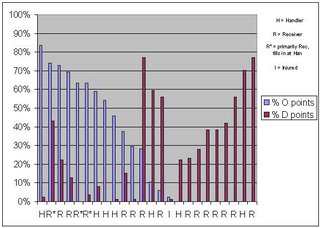
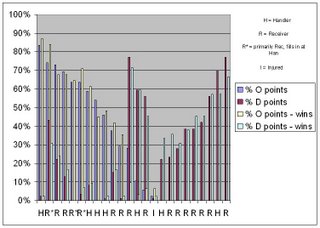
Some points:
Some of this is obviously do to a flatter talent level, which unfortunately is probably due to us not having the players who would be selected to an All-Nationals team, rather than having every player be that way. I found it hard to sit out so much and then try to take on an important role when in. The flat profile means that there are only a couple real starters (and even they are barely so) and everyone else is a sub. Ego has to be part of an offensive player's package, and being handled as subs destroys that ego. To belabor the point, starters do not merely play more than subs, but they do more when they are in. By telling each player that he is a sub, the team also tells them that they aren't good enough to be the man when he is in the game. Equally importantly, the player has to draw one of the following conclusions, depending on how the subbing is done: either whatever I do has little effect on my playing time, in which case I don’t have to play smart, or I am going to be benched if I make a mistake, in which case I probably should play so conservatively that I’m not going to help the team.
REQUEST: If you have subbing sheets for your team at Nationals, please contact me if you'd be willing to share them (after anonymizing).
At Nationals this year, DoG had the flattest playing time profile I’ve ever seen. Only one guy played more than ¾ of the O points, and even he was only at 83% (sitting out about 2 O points per game). In contrast, vintage DoG and practically all the top teams now have several guys who more or less played every O point.
Here’s the graph. Although not necessary for the purposes of this discussion, players are categorized as Handlers, Receivers, or Receivers who played handler if necessary.

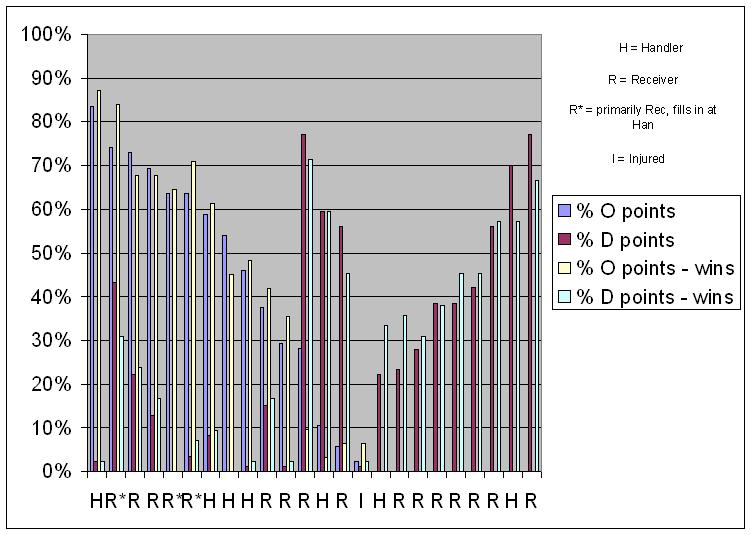
Some points:
- Lots of guys didn’t play any O; only me and Al didn’t play any D.
- The top 7 O played only 2/3 of the time, leaving an average of 2+ guys on the line each point who weren’t considered starters.
- D % played is less (7th most is less than 50%).
- Only 3 or 4 guys got more than a token amount of points on both sides.
- Although this is averaged over all games, and you would suspect that the numbers would be different for tough vs easy games, DoG didn’t have any easy games at Nationals last year, and there was no real difference between relatively easy and relatively tough. There were about an equal number of O and D points.
Some of this is obviously do to a flatter talent level, which unfortunately is probably due to us not having the players who would be selected to an All-Nationals team, rather than having every player be that way. I found it hard to sit out so much and then try to take on an important role when in. The flat profile means that there are only a couple real starters (and even they are barely so) and everyone else is a sub. Ego has to be part of an offensive player's package, and being handled as subs destroys that ego. To belabor the point, starters do not merely play more than subs, but they do more when they are in. By telling each player that he is a sub, the team also tells them that they aren't good enough to be the man when he is in the game. Equally importantly, the player has to draw one of the following conclusions, depending on how the subbing is done: either whatever I do has little effect on my playing time, in which case I don’t have to play smart, or I am going to be benched if I make a mistake, in which case I probably should play so conservatively that I’m not going to help the team.
Subscribe to:
Posts (Atom)