In baseball, the term leverage is used to quantify the importance of the next event in determining the outcome of that game. Events in close games have higher leverage than those in blowouts, and during a close game, events near the end of the game have higher leverage than those earlier in the game, since there is less time to recover. (You can also factor in how much a particular outcome will change the probability of winning, instead of just considering the state prior to the at-bat; google "Win Probability Added" for more detail.) One application of this is that teams should use their best relievers during the higher leverage moments where possible. Now, there is some debate as to what extent clutch hitting exists (i.e., the ability to perform better during high leverage situations), but
There are two applications to ultimate that I can think of (well, three if you count using fire in rocham). One is that I strongly prefer playing high leverage points, if such points are available that day. I think I realize that I'm not going to be able to play every point at any high level of output, so I'd rather those points be important to the outcome of the game. Thus, points when we're winning 5-2, or whole games where the outcome isn't in doubt, I don't have much desire to participate in. (For summer league or pickup where I don't much care about the outcome, even when it's in doubt, this doesn't factor in except maybe at double game point if I'm in or if there is someone on the other team I want to have lose.)
The other is in foul calls and contests. There are four calls I've been involved in these past two tournaments that come to mind. I held my ground on the two highest leverage calls and gave up on the other two (even though on one of those I was at least 100% in the right; in fairness, though, not only was this one not at an important part in the game, but it also didn't make a lot of difference in the expectation that we would score the point). I don't engage in gamesmanship in stuff like this, so it wasn't a matter of giving up a call now expecting to get one or more back later. Rather, I don't want to be a guy who is involved in a lot of calls or a guy who makes bad calls. I guess I'm willing to risk the latter a little bit in some circumstances because I also don't want to be a guy who helps his team lose by not making a (good) call.
I don't doubt that in each case, I was probably correct (and not just loophole/ticky tack correct, but spirit of the rule correct), although I'm not sure what an Observer would have ruled on them (or even what I as an Observer would have ruled).
Anyway, what really triggered this trip down angst lane was seeing a comment on the UPA Strategic Planning blog (and remembering similar comments elsewhere) about how unspirited it is to pull out calls when the game is on the line. The paradox is that the commenter would think it more unspirited to make those earlier calls, too, even though that would make the amount of rule-breaking required to call a foul more consistent. (I also tend to factor in how respectfully the other player plays and how he makes the call; given a certain level of how sure I am about a call, I find myself more likely to contest a call if the other player is belligerent about it.)
I can think of examples from other sports that back up this point of view. In pro football, the coach will throw the challenge flag only if either he's absolutely certain or if the difference in the outcome is huge (score/no score or possession). Years ago in pro hockey, many players had sticks with illegal curvature on the blade, but they were only challenged on it in the last minutes of tight games. And in the George Brett pine tar incident, the Yankees knew about it for a long time but waited until Brett had hit a 3 run homer to ask for a measurement.
For the record, the calls (the first two were detailed in the WMO post):
1. 12-11 us, game to 13, I'm chasing a hammer on defense, as I'm about to jump, the receiver shifts his position and jumps back toward me. The disc goes over his head, but my momentum carries me into him. I ask him twice if he's sure he doesn't want to take the call back, then don't contest.
2. 12-12, game to 13 (next point), 30 yard pass in the end zone for the game winner, I jump up and make the block, then have some (incidental?) contact on the receiver's body (nothing on the arm). I am more certain that an Observer would rule in my favor than I am that I did not commit a foul. I send it back without trying to convince the receiver to retract his call.
3. 0-1, we receive the pull, quick swing, defense is still not down yet, I cut (pretty much laterally) before I get to where the D is and catch the second pass (this is generally what I do as the Man (3rd person in the play, first downfield cutter) on a low pull, take the free yards rather than actually having to cut and possibly gain more). Pick is called. I pace off 6 steps to my man who called the pick and explain the 3m rule. I add that I was never within 5 yards of the spot where he was standing. Argument ensues. Dumbfounded and angry, I sent the disc back.
4. 13-12 us, game to 15, they throw a long pass. I am looking back at the disc as I run downfield. I feel there is an excellent chance (more than 50/50) that I will cause this pass to be incomplete. About 30 yards from where the disc ends up, while the disc is still high in the air and upfield (toward the thrower) from us, I run into the receiver, who has stopped so as to have me run into him. There is no possible way that he has simply misread the disc. I raise my arm immediately and stop running. He catches it in the end zone. I state "didn't play the disc! Sending it back!" I send it back. He doesn't argue much, but whether that is because he knows I'm right or if he just thinks it won't make a difference, I don't know. Of course I am aware that an offensive foul in this circumstance is a turnover, but I wouldn't want a turnover in that circumstance. I made a similar call in the game to go in 1986 Regionals.
Monday, June 04, 2007


Friday, June 01, 2007
Purposeful walking
At the White Mountain Open, I was given a backhanded compliment along the lines of "you're old and slow(er) but you still get way open. How?" After kicking him in the groin, I explained to him that it was all about positioning and knowing when to just run.
Good defensive positioning is a dynamic process. What might be good position at one point is suddenly way out of position a few seconds later as the disc is swung or the players move a few yards. The defender basically decides what cut is not a threat to the team and so doesn't have to respect that cut. Examples: player 50 yards away, a deep pass is not a threat, defender plays in front. Cutter at the back of the endzone, only cut is back to the disc, defender plays in front. Marker takes away dump pass, handler defender doesn't overcommit on a cut to the dump. The defender will follow if the cutter goes to those places, but the defender won't try to beat the cutter there.
So, what you do on offense is to try to change the position so that the defender either continues in their relative positioning (thus opening up what was previously not a threatening cut) or alters their positioning (thus opening up the cut they were trying to prevent at first). For instance, you are handling, standing about 10 yards directly in front of the thrower, being forced one direction, say, forehand. The inside-out is a very tough throw here, and the around break will take long enough to deliver that the continuation isn't that much of a threat, so a good defender will position himself to allow you to cut inside-out. What you do, then, is to take several steps to the open side. If the defender keeps the same relative position, the inside-out cut is now wide open and is an easy throw straight up the field, and a threat to deliver a continuation pass. If the defender adjusts to be more in front of you instead of to the side, you may be able to cut back to the disc for a swing or laterally for a leading "away" pass.
Downfield, you are more likely to work in/out positioning rather than side-to-side. Say the disc is being walked in, and you are planning on cutting first. Put yourself somewhere near the middle or middle-back of the stack. Prior to check in, you reposition yourself further back in the stack, slightly on the open side. By starting out in the middle, the defender will usually adopt a position that at a minimum respects the deep cut (and sometimes even takes it away and concedes the in-cut). As you get deeper, they will usually maintain the same relative position to you, but suddenly the deep cut is not an option, and the in-cut is that much more open. A smart defender will adjust at this point, but amazingly, there aren't that many smart defenders out there [insert general disparaging comment about the intelligence of defensive players versus offensive players]. In the last couple steps before you actually cut, you can also drift more out into the open, making it more of a straight shot clear of poachers. Then simply plant and run hard to the disc. You may also throw in a step away or right at the defender before cutting in, but it's just one step, and you are not waiting for a reaction from the defender before going.
(This is what I have previously called a "quick fake", where you do a fake and continue on to your real cut or throw without waiting for a response. A quick fake is a diversion. A "slow fake" involves making a motion and then reacting to the defender's response. A bunch of back-and-forth jukes from a handler is a slow fake (even if those jukes are quick), because the handler is waiting for a sign that a defender has overcommitted or not reacted before deciding where to go. Sometimes a quick fake becomes a slow fake. A thrower might lift the disc suddenly to set up a low breakmark forehand (the quick fake), but if the defender anticipates correctly and shuts off that forehand, the thrower pivots to the backhand break (the slow fake). A cutter is on the open side and has both short and long open. Do a quick fake out to set up the in cut, go hard in for two or three steps and then read the defender's reaction. If the defender has anticipated the in-cut and has maybe even overcommitted to that, you immediately stop and cut deep as hard as you can.)
Sometimes, through no effort on your part, an "opportunity cut" will present itself. Maybe you're in the stack a little on the open side, your defender is fronting you and not watching the disc at all. At that moment, you're not a deep threat because the disc is not in a position to be hucked. However, you see a swing pass go off to the open side and the receiver is someone who can huck it. Suddenly, you're in great position to cut deep, provided that your defender keeps his focus on you. Allow him to do that by pretending to prepare for your own in-cut. Then, you make a hard step in and immediately reverse and cut deep. The defender will be backing up and even if he is faster than you, you will have enough of a head start that it shouldn't matter.
So, the basic idea is that you need to identify an area that you would like to cut to, then purposefully walk (or shuffle, or run if you must, I suppose) in the opposite direction, giving the defender the opportunity to make a mistake in positioning.
Good defensive positioning is a dynamic process. What might be good position at one point is suddenly way out of position a few seconds later as the disc is swung or the players move a few yards. The defender basically decides what cut is not a threat to the team and so doesn't have to respect that cut. Examples: player 50 yards away, a deep pass is not a threat, defender plays in front. Cutter at the back of the endzone, only cut is back to the disc, defender plays in front. Marker takes away dump pass, handler defender doesn't overcommit on a cut to the dump. The defender will follow if the cutter goes to those places, but the defender won't try to beat the cutter there.
So, what you do on offense is to try to change the position so that the defender either continues in their relative positioning (thus opening up what was previously not a threatening cut) or alters their positioning (thus opening up the cut they were trying to prevent at first). For instance, you are handling, standing about 10 yards directly in front of the thrower, being forced one direction, say, forehand. The inside-out is a very tough throw here, and the around break will take long enough to deliver that the continuation isn't that much of a threat, so a good defender will position himself to allow you to cut inside-out. What you do, then, is to take several steps to the open side. If the defender keeps the same relative position, the inside-out cut is now wide open and is an easy throw straight up the field, and a threat to deliver a continuation pass. If the defender adjusts to be more in front of you instead of to the side, you may be able to cut back to the disc for a swing or laterally for a leading "away" pass.
Downfield, you are more likely to work in/out positioning rather than side-to-side. Say the disc is being walked in, and you are planning on cutting first. Put yourself somewhere near the middle or middle-back of the stack. Prior to check in, you reposition yourself further back in the stack, slightly on the open side. By starting out in the middle, the defender will usually adopt a position that at a minimum respects the deep cut (and sometimes even takes it away and concedes the in-cut). As you get deeper, they will usually maintain the same relative position to you, but suddenly the deep cut is not an option, and the in-cut is that much more open. A smart defender will adjust at this point, but amazingly, there aren't that many smart defenders out there [insert general disparaging comment about the intelligence of defensive players versus offensive players]. In the last couple steps before you actually cut, you can also drift more out into the open, making it more of a straight shot clear of poachers. Then simply plant and run hard to the disc. You may also throw in a step away or right at the defender before cutting in, but it's just one step, and you are not waiting for a reaction from the defender before going.
(This is what I have previously called a "quick fake", where you do a fake and continue on to your real cut or throw without waiting for a response. A quick fake is a diversion. A "slow fake" involves making a motion and then reacting to the defender's response. A bunch of back-and-forth jukes from a handler is a slow fake (even if those jukes are quick), because the handler is waiting for a sign that a defender has overcommitted or not reacted before deciding where to go. Sometimes a quick fake becomes a slow fake. A thrower might lift the disc suddenly to set up a low breakmark forehand (the quick fake), but if the defender anticipates correctly and shuts off that forehand, the thrower pivots to the backhand break (the slow fake). A cutter is on the open side and has both short and long open. Do a quick fake out to set up the in cut, go hard in for two or three steps and then read the defender's reaction. If the defender has anticipated the in-cut and has maybe even overcommitted to that, you immediately stop and cut deep as hard as you can.)
Sometimes, through no effort on your part, an "opportunity cut" will present itself. Maybe you're in the stack a little on the open side, your defender is fronting you and not watching the disc at all. At that moment, you're not a deep threat because the disc is not in a position to be hucked. However, you see a swing pass go off to the open side and the receiver is someone who can huck it. Suddenly, you're in great position to cut deep, provided that your defender keeps his focus on you. Allow him to do that by pretending to prepare for your own in-cut. Then, you make a hard step in and immediately reverse and cut deep. The defender will be backing up and even if he is faster than you, you will have enough of a head start that it shouldn't matter.
So, the basic idea is that you need to identify an area that you would like to cut to, then purposefully walk (or shuffle, or run if you must, I suppose) in the opposite direction, giving the defender the opportunity to make a mistake in positioning.
Thursday, May 24, 2007
White Mountain Open
WMO was good overall. It was disheartening to lose the quarterfinals after being up 12-9 and 14-12 in a game to 15, and against a team that is probably about an 8th-10th place at Regionals quality. No doubt about that feeling.
But considering our limited roster, it was a big success. 11 on Saturday, 9 on Sunday, including my wife, whose team bailed on Saturday morning. It was hardly a Murderers' Row, as few of the vintage DoG were there, although on average the team was much younger and probably more mobile than our full team.
In our first game, we beat Bro White, the male half of last year's Mixed finalists Slow White (minus a couple guys trying out for the new team or otherwise absent). Bro White would later give fairly close games to both halves ofBoston Ultimate. Overall it was probably our best game of the weekend for efficient offense and getting turns.The next two games also went pretty well. We handled Koob, the final remnants of the team that made (Masters) Nats in '05 and lost the game to go in '06, and also beat Chuck Wagon (formerly Log, ofBurlington) decently, although the final difference was but two. (They finished about 6th at Regionals last year). Last game was against half of Boston Ultimate. I had already conceded the game and the day, as we were going to get another shot at the other half, we had 9.5 (one had left, one was hobbling), and we were 98% certain of getting a 1st round bye (Bro White would have had to beat Boston Ultimate; I'll leave the Bayesian statistics to the reader, but I estimate that going in BU was a 13-7.5 favorite, final score was 13-10; ok, my Pythagorean estimator predicts somewhere between 74% and 96%). We had real matchup problems, regardless, both in height and speed, leading to lots of easy long goals for them. But I didn't really care, and I can't say I played too hard or got up too much for the game since it was our fourth in a row and we were old.
We were probably a four-goal favorite for Sunday's quarterfinal, even allowing for our small numbers (as mentioned above, lost four and added two). It started out looking like we'd beat the spread, but we let them back in it. We put on a zone and got two breaks and a chance at a third. We built up a lead to 12-9, made it to 14-12, then kept turning it and allowing goals.Our problems that game and on the weekend were mostly throwing execution and choice. Only against Boston Ultimate were they related to age and slow footspeed. Another problem on Sunday was the lack of handlers. As a result, two of us who normally are receivers ended up spending a lot of time near the disc instead of being freed up to cut downfield.
We didn't have a lot of spare time to hang out, often one of the best times of tournaments with old people. Two of our first three games went well into the cap, maybe even to the next round.
In the Bro White game, we went up 7-4, then they came back. Late in the game, I think the point prior to double game, they threw a high hammer, I went after it, I was decently positioned to make a play at it but their guy jumped back into where I was headed, not where the disc was going, but he went mostly up and I was going forward and so I bumped into his back and he called foul. I asked him at least twice if he was sure that he had a play on it and he didn't just misread it, but he insisted on the call, so I let him have it uncontested, and they scored. At double game point, we turned it, and someone threw a medium-range forehand into the endzone, I came off my guy, jumped, and knocked the disc away cleanly, but contacted the receiver on the body afterwards, not hard but not light, either. Foul call, I laugh and say for the first time in my life, "But I got the disc first." Everyone sitting around says no foul, but I just ask the guy to send it back. I had almost decided to give it to him, too, but then I saw Alex walk up (actually he was probably just trying to see what was happening rather than to influence me) and decided to stick with the contest, feeling that had there been an observer there, especially one named Mike G, it would not have been called a foul. It goes back, a couple passes later one of their guys drops a pass while on the goal line, we work it down for the win and the clear path to a 9 am pre-quarters bye. I felt that between the two plays, there was about 1 foul, probably about 0.4 on each one, so I don't feel bad about sending the second one back. Had the first not happened, or had it not been double game point, I probably would have just given up the second one, too.
New pick rule is stupid (but not the people who came up with it!) but I insisted on it being applied about 4 or 5 times (all in our favor), and let two slide (1 for, 1 against). Maybe 1 or 2 of those times, it was probably a good outcome that the play stood, but the other ones it probably should have gone back. Part of the reason for the pick rule is for safety, yet this encourages players not only to continue but to initiate movement. (The times it was a "good outcome" were when the throw was almost coincidental with the call and no one had time to react.)
Alex covered the tournament on his blog, although for some reason it's more Alex-centric.
Big Ego Ultimate lifetime: 17-6, 2 tournament victories, 1 runnerup, 1 "other". Next meeting: Masters Easterns, June 2-3.
But considering our limited roster, it was a big success. 11 on Saturday, 9 on Sunday, including my wife, whose team bailed on Saturday morning. It was hardly a Murderers' Row, as few of the vintage DoG were there, although on average the team was much younger and probably more mobile than our full team.
In our first game, we beat Bro White, the male half of last year's Mixed finalists Slow White (minus a couple guys trying out for the new team or otherwise absent). Bro White would later give fairly close games to both halves ofBoston Ultimate. Overall it was probably our best game of the weekend for efficient offense and getting turns.The next two games also went pretty well. We handled Koob, the final remnants of the team that made (Masters) Nats in '05 and lost the game to go in '06, and also beat Chuck Wagon (formerly Log, ofBurlington) decently, although the final difference was but two. (They finished about 6th at Regionals last year). Last game was against half of Boston Ultimate. I had already conceded the game and the day, as we were going to get another shot at the other half, we had 9.5 (one had left, one was hobbling), and we were 98% certain of getting a 1st round bye (Bro White would have had to beat Boston Ultimate; I'll leave the Bayesian statistics to the reader, but I estimate that going in BU was a 13-7.5 favorite, final score was 13-10; ok, my Pythagorean estimator predicts somewhere between 74% and 96%). We had real matchup problems, regardless, both in height and speed, leading to lots of easy long goals for them. But I didn't really care, and I can't say I played too hard or got up too much for the game since it was our fourth in a row and we were old.
We were probably a four-goal favorite for Sunday's quarterfinal, even allowing for our small numbers (as mentioned above, lost four and added two). It started out looking like we'd beat the spread, but we let them back in it. We put on a zone and got two breaks and a chance at a third. We built up a lead to 12-9, made it to 14-12, then kept turning it and allowing goals.Our problems that game and on the weekend were mostly throwing execution and choice. Only against Boston Ultimate were they related to age and slow footspeed. Another problem on Sunday was the lack of handlers. As a result, two of us who normally are receivers ended up spending a lot of time near the disc instead of being freed up to cut downfield.
We didn't have a lot of spare time to hang out, often one of the best times of tournaments with old people. Two of our first three games went well into the cap, maybe even to the next round.
In the Bro White game, we went up 7-4, then they came back. Late in the game, I think the point prior to double game, they threw a high hammer, I went after it, I was decently positioned to make a play at it but their guy jumped back into where I was headed, not where the disc was going, but he went mostly up and I was going forward and so I bumped into his back and he called foul. I asked him at least twice if he was sure that he had a play on it and he didn't just misread it, but he insisted on the call, so I let him have it uncontested, and they scored. At double game point, we turned it, and someone threw a medium-range forehand into the endzone, I came off my guy, jumped, and knocked the disc away cleanly, but contacted the receiver on the body afterwards, not hard but not light, either. Foul call, I laugh and say for the first time in my life, "But I got the disc first." Everyone sitting around says no foul, but I just ask the guy to send it back. I had almost decided to give it to him, too, but then I saw Alex walk up (actually he was probably just trying to see what was happening rather than to influence me) and decided to stick with the contest, feeling that had there been an observer there, especially one named Mike G, it would not have been called a foul. It goes back, a couple passes later one of their guys drops a pass while on the goal line, we work it down for the win and the clear path to a 9 am pre-quarters bye. I felt that between the two plays, there was about 1 foul, probably about 0.4 on each one, so I don't feel bad about sending the second one back. Had the first not happened, or had it not been double game point, I probably would have just given up the second one, too.
New pick rule is stupid (but not the people who came up with it!) but I insisted on it being applied about 4 or 5 times (all in our favor), and let two slide (1 for, 1 against). Maybe 1 or 2 of those times, it was probably a good outcome that the play stood, but the other ones it probably should have gone back. Part of the reason for the pick rule is for safety, yet this encourages players not only to continue but to initiate movement. (The times it was a "good outcome" were when the throw was almost coincidental with the call and no one had time to react.)
Alex covered the tournament on his blog, although for some reason it's more Alex-centric.
Big Ego Ultimate lifetime: 17-6, 2 tournament victories, 1 runnerup, 1 "other". Next meeting: Masters Easterns, June 2-3.
Friday, April 27, 2007
Call me Luke
It’s been awhile, thought I’d let you all catch up on my sports life.
I’ve been playing in an Over-40 pickup basketball game in town. There is only one guy who I would call a good player, about half the guys have some skills, and the rest are what you would expect from an old man pickup game in an affluent suburb. This has been a great environment for developing my game, much like summer league was back when I first started making a conscious effort to develop more throwing skills. I’m finally making some basketball moves for the first time since that one year in college where I played at lunchtime most days. I even try hard on defense, harder than on O. There are two guys who play unspiritedly. One guy is old and a bit fat and is a bad player, but he’ll take down anyone who beats him and is set for an uncontested layup attempt. He’s quite dangerous, to be honest. He’ll also yell occasionally when a player is shooting. “Very classy,” I said once, but I don’t think he heard. I can excuse his behavior a little bit, because if he didn’t cheat, his team would be at a great disadvantage because he’s so bad. The other guy is more irksome, and actually caused me to lose my cool a few weeks ago. He’s one of the guys with some skills. When he plays hard, he can get open and sometimes he’ll go on a hot streak. But most of the time he’ll just play some clutching and pushing game, usually subtle enough that you wouldn’t notice it but it is what makes it easy to get open or to get in the proper place for a rebound. I got tired of it one day and grabbed his arm as he was about to push off, then did it again the next time to make sure he knew it wasn’t an accident, then gave him a gentle shove just to make it absolutely sure. I’m come very close to making a deliberate bad makeup call, but have limited myself to making snide comments.
Softball season started last night, a thrilling 4-2 win for the Cougars. I saw five pitches in three at-bats, taking one for a strike, taking one for a ball, and putting the other three into play. All of the strikes seemed like pitches I could drive rather than strikes nibbling at the corner. First at-bat was a weak grounder to shortstop that I normally would have beaten out but my legs weren’t loose despite an adequate warmup. Second at-bat was a medium-hard liner into short right-center, an easy single from the moment it left the bat. Third at-bat came in the bottom of the sixth, two outs, runner on first, tie game. It was a hard grounder that the shortstop was able to get a glove on with a good play, but it was a hit no matter how good of a play he could have made. I had hoped/expected to hit a line drive over the left-center fielder’s head. Runners on the corner. I possibly could have made second had I been thinking of it out of the box, but I had expected it to be a clean single with no possibility of making second. The next batter hit a groundball to shortstop. The shortstop fielded it cleanly and looked to toss it to second for the inning-ending forceout, but I got a good jump and got there first. The SS’s throw to first was late and then bounced off the 1B’s glove and squirted down the line. I continued round third and headed home. The throw got there first, but I slide to the outside and swiped the plate with my hand, completely evading the tag. (Merely beating the tag isn’t enough in this league, since the umps generally call any close, cleanly- executed play an out.) This insurance run took the pressure off us in the last inning and we were able to close them out. This game was a big contrast to our previous game last year, a season-ending loss in the first round of the playoffs. That final score was 21-20, featured a ton of errors and walks and home runs, while this one was cleanly-played (we didn’t allow anyone to reach on error, although there were two errors that allowed them to take the extra base). (I really ought to move away from the paradigm of “lack of errors = good fielding”. More important than avoiding errors is making the marginal plays. Our game-winning hit was one of those plays not made. My first grounder to shortstop would have been a play not made had I run a little faster. Those type of plays are at least as frequent as the errors (and many errors happen on those marginal plays where the fielder has to zing the throw).)
I’ve only been out to the golf course once this year, but had a good time, playing 27 holes in about 4 hours. 42-39-44 on the always difficult Stow Acres North. I had a 10 hole stretch where I was only one over par. Many of my recent rounds have featured a stretch of 6-10 holes where I was almost even, so I’m optimistic about my chances of extending that stretch one day soon to a full 18 holes. I got a new 3 wood this winter, replacing a club which I hardly ever used because of a lack of confidence in it, and I am quite pleased. I hit seven fairways in a row with it, and also nailed two strong shots from the fairway over a pond onto the green, shots I knew were stupid but decided to go for anyway. Shot-by-shot available upon request. Unofficial Handicap Index stands at 9.7.
The Frisbee schedule is surprisingly full. I wouldn’t be surprised if I actually played more ultimate this year than in previous years, both in the number of tournaments and points played per tournament. Played Fools already, scheduled for WMO, Masters Easterns, and Boston Invite this spring, probably summer league tournament and Hingham, maybe another summer or fall tournament, then Sectionals (if Masters teams are still allowed to play Open), Regionals and Nationals. That’d be 10, and I’ve played 9, 12, 9, 5, and 10 the last five years.
Red Sox are doing well, Yankees less so. I don’t really get into the “Yankees Suck!” cheer (even though they do), since cheers that focus on the other team are for losers, plus the Red Sox have been the Evil Empire Lite with their big budget and gamesmanship and nearly-unmatched string of championships this century (only five other teams, none of them from NY, has as many titles as the Sox so far). I haven’t seen or even listened to more than a token amount this year, though.
No ski days this winter so far. No long cross-country runs, except for that one nice day this winter where I jogged for about 20 minutes and had to stop once for twice for sore feet.
I’ve been playing in an Over-40 pickup basketball game in town. There is only one guy who I would call a good player, about half the guys have some skills, and the rest are what you would expect from an old man pickup game in an affluent suburb. This has been a great environment for developing my game, much like summer league was back when I first started making a conscious effort to develop more throwing skills. I’m finally making some basketball moves for the first time since that one year in college where I played at lunchtime most days. I even try hard on defense, harder than on O. There are two guys who play unspiritedly. One guy is old and a bit fat and is a bad player, but he’ll take down anyone who beats him and is set for an uncontested layup attempt. He’s quite dangerous, to be honest. He’ll also yell occasionally when a player is shooting. “Very classy,” I said once, but I don’t think he heard. I can excuse his behavior a little bit, because if he didn’t cheat, his team would be at a great disadvantage because he’s so bad. The other guy is more irksome, and actually caused me to lose my cool a few weeks ago. He’s one of the guys with some skills. When he plays hard, he can get open and sometimes he’ll go on a hot streak. But most of the time he’ll just play some clutching and pushing game, usually subtle enough that you wouldn’t notice it but it is what makes it easy to get open or to get in the proper place for a rebound. I got tired of it one day and grabbed his arm as he was about to push off, then did it again the next time to make sure he knew it wasn’t an accident, then gave him a gentle shove just to make it absolutely sure. I’m come very close to making a deliberate bad makeup call, but have limited myself to making snide comments.
Softball season started last night, a thrilling 4-2 win for the Cougars. I saw five pitches in three at-bats, taking one for a strike, taking one for a ball, and putting the other three into play. All of the strikes seemed like pitches I could drive rather than strikes nibbling at the corner. First at-bat was a weak grounder to shortstop that I normally would have beaten out but my legs weren’t loose despite an adequate warmup. Second at-bat was a medium-hard liner into short right-center, an easy single from the moment it left the bat. Third at-bat came in the bottom of the sixth, two outs, runner on first, tie game. It was a hard grounder that the shortstop was able to get a glove on with a good play, but it was a hit no matter how good of a play he could have made. I had hoped/expected to hit a line drive over the left-center fielder’s head. Runners on the corner. I possibly could have made second had I been thinking of it out of the box, but I had expected it to be a clean single with no possibility of making second. The next batter hit a groundball to shortstop. The shortstop fielded it cleanly and looked to toss it to second for the inning-ending forceout, but I got a good jump and got there first. The SS’s throw to first was late and then bounced off the 1B’s glove and squirted down the line. I continued round third and headed home. The throw got there first, but I slide to the outside and swiped the plate with my hand, completely evading the tag. (Merely beating the tag isn’t enough in this league, since the umps generally call any close, cleanly- executed play an out.) This insurance run took the pressure off us in the last inning and we were able to close them out. This game was a big contrast to our previous game last year, a season-ending loss in the first round of the playoffs. That final score was 21-20, featured a ton of errors and walks and home runs, while this one was cleanly-played (we didn’t allow anyone to reach on error, although there were two errors that allowed them to take the extra base). (I really ought to move away from the paradigm of “lack of errors = good fielding”. More important than avoiding errors is making the marginal plays. Our game-winning hit was one of those plays not made. My first grounder to shortstop would have been a play not made had I run a little faster. Those type of plays are at least as frequent as the errors (and many errors happen on those marginal plays where the fielder has to zing the throw).)
I’ve only been out to the golf course once this year, but had a good time, playing 27 holes in about 4 hours. 42-39-44 on the always difficult Stow Acres North. I had a 10 hole stretch where I was only one over par. Many of my recent rounds have featured a stretch of 6-10 holes where I was almost even, so I’m optimistic about my chances of extending that stretch one day soon to a full 18 holes. I got a new 3 wood this winter, replacing a club which I hardly ever used because of a lack of confidence in it, and I am quite pleased. I hit seven fairways in a row with it, and also nailed two strong shots from the fairway over a pond onto the green, shots I knew were stupid but decided to go for anyway. Shot-by-shot available upon request. Unofficial Handicap Index stands at 9.7.
The Frisbee schedule is surprisingly full. I wouldn’t be surprised if I actually played more ultimate this year than in previous years, both in the number of tournaments and points played per tournament. Played Fools already, scheduled for WMO, Masters Easterns, and Boston Invite this spring, probably summer league tournament and Hingham, maybe another summer or fall tournament, then Sectionals (if Masters teams are still allowed to play Open), Regionals and Nationals. That’d be 10, and I’ve played 9, 12, 9, 5, and 10 the last five years.
Red Sox are doing well, Yankees less so. I don’t really get into the “Yankees Suck!” cheer (even though they do), since cheers that focus on the other team are for losers, plus the Red Sox have been the Evil Empire Lite with their big budget and gamesmanship and nearly-unmatched string of championships this century (only five other teams, none of them from NY, has as many titles as the Sox so far). I haven’t seen or even listened to more than a token amount this year, though.
No ski days this winter so far. No long cross-country runs, except for that one nice day this winter where I jogged for about 20 minutes and had to stop once for twice for sore feet.
Wednesday, April 04, 2007
Fools, again
Wow, I just finished reading last year's Fools report, and I realized I hardly need to type anything in for this year, even down to the comments. In fact, I'll comment on that article first:
1. It appears that this is the first use of the phrase "huck and hope" (although it wasn't capitalized or TMed yet).
2. "This is our year"
3. "I wouldn't want to win any tournament that this team could win."
4. Funny stories on the sideline and in the beer tent still abound.
I suppose I can add some comments about this year, too.
Day 1 was about the same as the previous years, with one notable exception being that I was mentally prepared for it and so did not get depressed at not being able to run.
We were really bad throwing deep all weekend, such that once again the Indefensible would have been a terrific defensive strategy.
No warmup again this year other than before the quarters.
I was excited when I got to the fields Sunday and saw that games were to 9 with a 50 minute cap. I was going to have to leave no later than 4, which would have been sometime during the final, so I probably would have had to tank us in the semis so as not to have to miss a game, but this enabled me to be around for everything. Plus, games to 9 are short and might favor an old team. I got moving around, actually ran some lengths before the game, and broke more of a sweat then than I had all day Friday. Alas, we made a few too many turnovers and let the game drift away.
Got screwed over by the airline on the trip back, getting bumped from our flight despite being frequent flyer members and checking in nearly two hours before our flight. They couldn't put us on the next flight either and we had to wait until 2 pm the next day. Also had a two hour delay on the outbound flight, and they left our carseat at the Dulles Airport and so had to give us a loaner in Boston. I remarked to my wife that the Man really took it to us this weekend, and the only thing we got to stick to the Man was sneaking into the hotel pool after they declared it closed from 10-3 because state law required a lifeguard in their 4' deep pool. But then I managed to make a slightly longer list of sticking it to the man: 18 year old got to drink beer, we sped, I took a banana from the hotel buffet, I fed the boy a couple of pieces of fruit from the buffet. But I think the Man beat us overall.
I can't believe that the pick rule is as it was being played. If a pick happens, 12 players stop playing, but the thrower and a cutter don't, the thrower can huck it to the cutter for a goal, and it stands because it doesn't "affect the play". I can see that if the call is nearly coincidental with the throw, then the pass should stand, but there ought to be a limit of something like 2 seconds after which it goes back. There is nothing in the rules that says that the thrower has to (or even ought to) acknowledge the call, so he should examine whether something is wide open prior to acknowledging it, per the rules, some will probably say. Since the pick is intended to reduce the risk of injury, writing the rules to demand that players play on after a pick call is made seems counterproductive.
I didn't break anything, although there was a point I wanted to take something made of wood and beat it against the ground repeatedly. Unfortunately, none of the Canadians' mallets were available. Oh, yeah, I beat the Canadians in a bocce-off for the flip one game. I warned them that I was Italian, but they didn't listen.
1. It appears that this is the first use of the phrase "huck and hope" (although it wasn't capitalized or TMed yet).
2. "This is our year"
3. "I wouldn't want to win any tournament that this team could win."
4. Funny stories on the sideline and in the beer tent still abound.
I suppose I can add some comments about this year, too.
Day 1 was about the same as the previous years, with one notable exception being that I was mentally prepared for it and so did not get depressed at not being able to run.
We were really bad throwing deep all weekend, such that once again the Indefensible would have been a terrific defensive strategy.
No warmup again this year other than before the quarters.
I was excited when I got to the fields Sunday and saw that games were to 9 with a 50 minute cap. I was going to have to leave no later than 4, which would have been sometime during the final, so I probably would have had to tank us in the semis so as not to have to miss a game, but this enabled me to be around for everything. Plus, games to 9 are short and might favor an old team. I got moving around, actually ran some lengths before the game, and broke more of a sweat then than I had all day Friday. Alas, we made a few too many turnovers and let the game drift away.
Got screwed over by the airline on the trip back, getting bumped from our flight despite being frequent flyer members and checking in nearly two hours before our flight. They couldn't put us on the next flight either and we had to wait until 2 pm the next day. Also had a two hour delay on the outbound flight, and they left our carseat at the Dulles Airport and so had to give us a loaner in Boston. I remarked to my wife that the Man really took it to us this weekend, and the only thing we got to stick to the Man was sneaking into the hotel pool after they declared it closed from 10-3 because state law required a lifeguard in their 4' deep pool. But then I managed to make a slightly longer list of sticking it to the man: 18 year old got to drink beer, we sped, I took a banana from the hotel buffet, I fed the boy a couple of pieces of fruit from the buffet. But I think the Man beat us overall.
I can't believe that the pick rule is as it was being played. If a pick happens, 12 players stop playing, but the thrower and a cutter don't, the thrower can huck it to the cutter for a goal, and it stands because it doesn't "affect the play". I can see that if the call is nearly coincidental with the throw, then the pass should stand, but there ought to be a limit of something like 2 seconds after which it goes back. There is nothing in the rules that says that the thrower has to (or even ought to) acknowledge the call, so he should examine whether something is wide open prior to acknowledging it, per the rules, some will probably say. Since the pick is intended to reduce the risk of injury, writing the rules to demand that players play on after a pick call is made seems counterproductive.
I didn't break anything, although there was a point I wanted to take something made of wood and beat it against the ground repeatedly. Unfortunately, none of the Canadians' mallets were available. Oh, yeah, I beat the Canadians in a bocce-off for the flip one game. I warned them that I was Italian, but they didn't listen.
Tuesday, April 03, 2007
change in Boston ultimate
Well, I guess the word is out, so there is no sense in keeping it a secret anymore. Many people asked me about the impending change to Boston ultimate, and yes, it's true.
I sent my retirement letter to DoG a couple weeks ago.
It was remarkably short and dry, I must admit. I tried to muster up some mush, but I got all of my teary-eyed feelings about retirement out of the way back in 2004, my first "final" season. That year, I went through the fall knowing that it would be my last, so I was able to deal with all the baggage of experiencing my last practice, last trip to Sarasota, last time leaving the fields, last free beer at the tent, etc. (at least as an Open player; at this point, I still don’t think that Masters counts, even as I plan to play this year). I still really wanted to play and felt that I could play, but it just seemed like too much to handle anymore, especially having a small child.
But then I got a couple months away from the season, and I had already begun to miss it, and to forget the bad parts. I decided that I didn't really have to retire, and you know we gave Furious a helluva game in the quarters, so who knows what another year would bring? So I plunged ahead. (Cynics say I came back just to sell more copies of the book.)
The next year wasn't nearly as hard to continue. I had a strong performance at Nationals, and the team made semis for the first time in three years.
But now, well, I'm perfectly fine with not playing, although of course Mr. Big Ego thinks he can still cut it at the highest level. It's not that I'm retiring to spend more time with my family (in his wonderful book "The Game", Ken Dryden talked about how he and his wife would laugh at any athlete who claimed that when retiring; I highly recommend the book, especially to anyone at the end of his athletic career). And it's not that I'm ready to move on with my life. It's just that all things considered, getting the band back together is a much more intriguing proposition. Yes, we're going to dust off the old DoG guys and relive the glory days, minus the glory.
We're still in the process of figuring out how to structure the team and what sort of goals to set. (One opponent this weekend asked if we planned to win six in a row in Masters. I replied that it's more likely that one of us would die on the field first. He replied, "That's morbid. Probably true, but morbid.") I tried at Fools to convince other old-timers to get their bands back together so we could all go at each other, but I'm not sure whether that will work out. Would anyone pay to attend a DoG vs NYNY match, maybe with an Earth vs Graffiti undercard (maybe as a fundraiser for some worthy cause)? Would we resort to breaking out the canes to hit each other for old times' sake?
I had a very satisfying and fun career, and while I feel that I earned what I accomplished, I know also that I was lucky, both genetically and environmentally. Even as I made fun of those who were perpetually injured, I probably didn't do much to escape being in that group other than avoiding collisions and knowing when not to push a tweaking muscle. And sure, though I did "bust my ass doing wind sprints in the cold and rain", so did a lot of other people.
I will miss being a nanocelebrity, and being able to make preposterous remarks about how infallible and worthy I am and draw laughs instead of strange stares. I don't think I'll miss people stopping me to ask about rules interpretations, even if the new pick rule is indeed stupid. I'll miss the camaraderie, although that should still be there in Masters, if not moreso (though not the sense of a shared struggle through the year). Most of all I'll miss the occasional game that is so consuming that you forget there is anything else in the world. I can mention "the Ring game" to an old teammate and not need to clarify which one, or "that one huck", or "Bim's catch", and I'll get teary-eyed and we'll both say, "yeah."
Aging of course was a factor in the decision. As recently as age 37 in 2002, the year we were a couple plays away from winning Worlds and Nationals (although we won neither), I felt as dominant as ever on offense, up there with 1995 and 1998 as my peak years. My overall awesomeness wasn’t as great in 2002, though, as I stopped being put in on defense in about 2000, our second year with a roster of 25. (I played about a dozen points of D in 1999, many of them important ones, as I was surprised to remember while watching the Above & Beyond DVD recently.) But now the peak isn't as high, but probably more importantly, I can't play at near-peak nearly as often. The warmup period is too long and the cooling down too quick such that the ebbs and flows of the game just make it really hard to be at that peak all the time.
Thus, big ego ultimate is dead, long live Big Ego Ultimate. All you other old guys, block off June 2-3 for Masters Easterns and the end of October for the UPA Championships, and I'll see you out there, if not on the field, then in the beer tent.
I sent my retirement letter to DoG a couple weeks ago.
It was remarkably short and dry, I must admit. I tried to muster up some mush, but I got all of my teary-eyed feelings about retirement out of the way back in 2004, my first "final" season. That year, I went through the fall knowing that it would be my last, so I was able to deal with all the baggage of experiencing my last practice, last trip to Sarasota, last time leaving the fields, last free beer at the tent, etc. (at least as an Open player; at this point, I still don’t think that Masters counts, even as I plan to play this year). I still really wanted to play and felt that I could play, but it just seemed like too much to handle anymore, especially having a small child.
But then I got a couple months away from the season, and I had already begun to miss it, and to forget the bad parts. I decided that I didn't really have to retire, and you know we gave Furious a helluva game in the quarters, so who knows what another year would bring? So I plunged ahead. (Cynics say I came back just to sell more copies of the book.)
The next year wasn't nearly as hard to continue. I had a strong performance at Nationals, and the team made semis for the first time in three years.
But now, well, I'm perfectly fine with not playing, although of course Mr. Big Ego thinks he can still cut it at the highest level. It's not that I'm retiring to spend more time with my family (in his wonderful book "The Game", Ken Dryden talked about how he and his wife would laugh at any athlete who claimed that when retiring; I highly recommend the book, especially to anyone at the end of his athletic career). And it's not that I'm ready to move on with my life. It's just that all things considered, getting the band back together is a much more intriguing proposition. Yes, we're going to dust off the old DoG guys and relive the glory days, minus the glory.
We're still in the process of figuring out how to structure the team and what sort of goals to set. (One opponent this weekend asked if we planned to win six in a row in Masters. I replied that it's more likely that one of us would die on the field first. He replied, "That's morbid. Probably true, but morbid.") I tried at Fools to convince other old-timers to get their bands back together so we could all go at each other, but I'm not sure whether that will work out. Would anyone pay to attend a DoG vs NYNY match, maybe with an Earth vs Graffiti undercard (maybe as a fundraiser for some worthy cause)? Would we resort to breaking out the canes to hit each other for old times' sake?
I had a very satisfying and fun career, and while I feel that I earned what I accomplished, I know also that I was lucky, both genetically and environmentally. Even as I made fun of those who were perpetually injured, I probably didn't do much to escape being in that group other than avoiding collisions and knowing when not to push a tweaking muscle. And sure, though I did "bust my ass doing wind sprints in the cold and rain", so did a lot of other people.
I will miss being a nanocelebrity, and being able to make preposterous remarks about how infallible and worthy I am and draw laughs instead of strange stares. I don't think I'll miss people stopping me to ask about rules interpretations, even if the new pick rule is indeed stupid. I'll miss the camaraderie, although that should still be there in Masters, if not moreso (though not the sense of a shared struggle through the year). Most of all I'll miss the occasional game that is so consuming that you forget there is anything else in the world. I can mention "the Ring game" to an old teammate and not need to clarify which one, or "that one huck", or "Bim's catch", and I'll get teary-eyed and we'll both say, "yeah."
Aging of course was a factor in the decision. As recently as age 37 in 2002, the year we were a couple plays away from winning Worlds and Nationals (although we won neither), I felt as dominant as ever on offense, up there with 1995 and 1998 as my peak years. My overall awesomeness wasn’t as great in 2002, though, as I stopped being put in on defense in about 2000, our second year with a roster of 25. (I played about a dozen points of D in 1999, many of them important ones, as I was surprised to remember while watching the Above & Beyond DVD recently.) But now the peak isn't as high, but probably more importantly, I can't play at near-peak nearly as often. The warmup period is too long and the cooling down too quick such that the ebbs and flows of the game just make it really hard to be at that peak all the time.
Thus, big ego ultimate is dead, long live Big Ego Ultimate. All you other old guys, block off June 2-3 for Masters Easterns and the end of October for the UPA Championships, and I'll see you out there, if not on the field, then in the beer tent.
Tuesday, February 06, 2007
Studs Theory vs Plug N Play
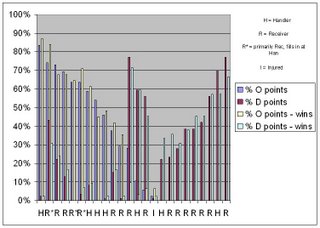
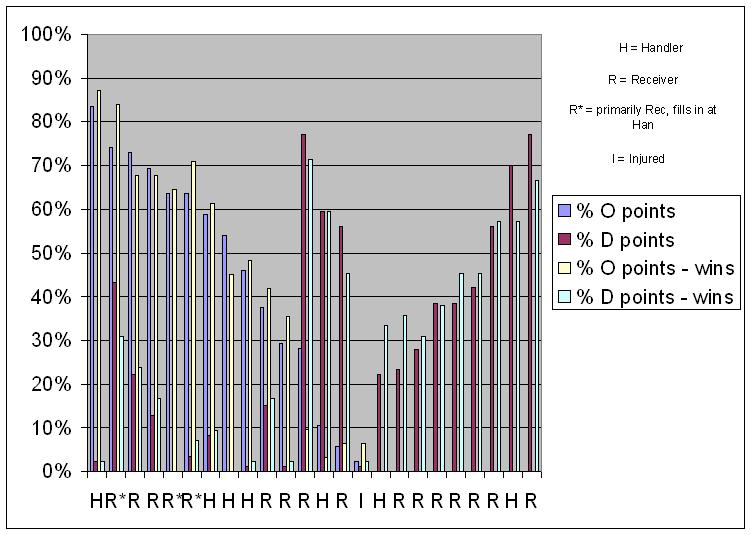
UPDATE: Added graph that showed profile in games DoG won.
REQUEST: If you have subbing sheets for your team at Nationals, please contact me if you'd be willing to share them (after anonymizing).
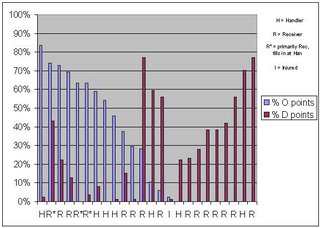
At Nationals this year, DoG had the flattest playing time profile I’ve ever seen. Only one guy played more than ¾ of the O points, and even he was only at 83% (sitting out about 2 O points per game). In contrast, vintage DoG and practically all the top teams now have several guys who more or less played every O point.
Here’s the graph. Although not necessary for the purposes of this discussion, players are categorized as Handlers, Receivers, or Receivers who played handler if necessary.
Some points:
Some of this is obviously do to a flatter talent level, which unfortunately is probably due to us not having the players who would be selected to an All-Nationals team, rather than having every player be that way. I found it hard to sit out so much and then try to take on an important role when in. The flat profile means that there are only a couple real starters (and even they are barely so) and everyone else is a sub. Ego has to be part of an offensive player's package, and being handled as subs destroys that ego. To belabor the point, starters do not merely play more than subs, but they do more when they are in. By telling each player that he is a sub, the team also tells them that they aren't good enough to be the man when he is in the game. Equally importantly, the player has to draw one of the following conclusions, depending on how the subbing is done: either whatever I do has little effect on my playing time, in which case I don’t have to play smart, or I am going to be benched if I make a mistake, in which case I probably should play so conservatively that I’m not going to help the team.
REQUEST: If you have subbing sheets for your team at Nationals, please contact me if you'd be willing to share them (after anonymizing).
At Nationals this year, DoG had the flattest playing time profile I’ve ever seen. Only one guy played more than ¾ of the O points, and even he was only at 83% (sitting out about 2 O points per game). In contrast, vintage DoG and practically all the top teams now have several guys who more or less played every O point.
Here’s the graph. Although not necessary for the purposes of this discussion, players are categorized as Handlers, Receivers, or Receivers who played handler if necessary.

Some points:
- Lots of guys didn’t play any O; only me and Al didn’t play any D.
- The top 7 O played only 2/3 of the time, leaving an average of 2+ guys on the line each point who weren’t considered starters.
- D % played is less (7th most is less than 50%).
- Only 3 or 4 guys got more than a token amount of points on both sides.
- Although this is averaged over all games, and you would suspect that the numbers would be different for tough vs easy games, DoG didn’t have any easy games at Nationals last year, and there was no real difference between relatively easy and relatively tough. There were about an equal number of O and D points.
Some of this is obviously do to a flatter talent level, which unfortunately is probably due to us not having the players who would be selected to an All-Nationals team, rather than having every player be that way. I found it hard to sit out so much and then try to take on an important role when in. The flat profile means that there are only a couple real starters (and even they are barely so) and everyone else is a sub. Ego has to be part of an offensive player's package, and being handled as subs destroys that ego. To belabor the point, starters do not merely play more than subs, but they do more when they are in. By telling each player that he is a sub, the team also tells them that they aren't good enough to be the man when he is in the game. Equally importantly, the player has to draw one of the following conclusions, depending on how the subbing is done: either whatever I do has little effect on my playing time, in which case I don’t have to play smart, or I am going to be benched if I make a mistake, in which case I probably should play so conservatively that I’m not going to help the team.
Saturday, January 27, 2007
UCPC, Day 1
Ok, there's only one day, but it feels like a multi-day event.
First, I was surprised to find that there were several people who traveled great distances. Kudos to everyone who made it out. I'm sure it was worth your while.
As a presenter, I was sorry that I only got to attend two of the other presentations, neither of them by my ex-teammates, who were presenting at the same time. Each presenter gave his talk twice during the four sessions (14 presenters total, I think). Even the full-time attendees still then had to choose between presentations.
My talk (powerpoint here, one-page summary here ) went well, I thought. The two sessions had different feels to them. I incorporated some of the questions from the first session into the second, and as a result of that and other changes, I ran over on the second session after having 10-15 minutes in the first one just for questions. The second session went smoother as well, as I didn't have to fight over as many words, and knew when to just go ahead and leave one slide and start on the next.
I left before the panel discussion, as it was already after 5 pm and there was still a presentation going on in the auditorium.
Good job by George and Tiina assembling the myriad volunteers and vendors. You never would have known that this was the first of its kind by how well things seemed to go. Thanks to them.
First, I was surprised to find that there were several people who traveled great distances. Kudos to everyone who made it out. I'm sure it was worth your while.
As a presenter, I was sorry that I only got to attend two of the other presentations, neither of them by my ex-teammates, who were presenting at the same time. Each presenter gave his talk twice during the four sessions (14 presenters total, I think). Even the full-time attendees still then had to choose between presentations.
My talk (powerpoint here, one-page summary here ) went well, I thought. The two sessions had different feels to them. I incorporated some of the questions from the first session into the second, and as a result of that and other changes, I ran over on the second session after having 10-15 minutes in the first one just for questions. The second session went smoother as well, as I didn't have to fight over as many words, and knew when to just go ahead and leave one slide and start on the next.
I left before the panel discussion, as it was already after 5 pm and there was still a presentation going on in the auditorium.
Good job by George and Tiina assembling the myriad volunteers and vendors. You never would have known that this was the first of its kind by how well things seemed to go. Thanks to them.
Thursday, January 18, 2007
what's in a name?
DoG, by any other name, would swill just as sweet.
So, who owns the name Death or Glory? A few years ago, a bunch of us got an email from some kid at a high school in Georgia, I think it was, who wanted to call themselves Death or Glory in our honor. Most of us, I think, didn’t want it to happen, as it might somehow sully the name, or perhaps would imply a relationship between the teams, and as we didn’t know them at all, couldn’t say they’d be good followers. It didn’t even occur to me at the time that there are tons of little Red Sox or Patriots teams out there without any hint of a link with the professional team, but then again, a Little League team would not be eligible for the World Series, while the junior DoG would technically have a shot at meeting big DoG in the finals of Nationals. Anyway, I don’t know if a few people responded or if every single one of us ignored the request, but we never heard from him again nor did we ever run across another DoG (not to say that there haven’t been copycat names like RoQ or BoG or anything else with the meme X or Y).
What got me thinking about this was that another old-timer suggested to me that now would be a good time to retire the name DoG, as Alex and I are almost certainly (usual disclaimer here) not coming back for another season in Open. Do we (and the other departed DoG from the early days) have any rights to the name? What if the team split into two factions and both wanted to keep the name? What if we wanted to call our Masters team DoG? What if the team started to play the HnH and the alumni decided that it wasn't appropriate for DoG? Could we ask the current players to think about a new name, and should they listen?
Who owns the name? There is no team owner. The members of the team have the right to come up with their own name, subject to decency requirements at big events, but what about when names are already taken? There have been a couple cases in ultimate history where teams have appropriated their names or logos from copyrighted entities (Arm and Hammer, Twisted Metal) and got into some trouble. How about Furious George even?
I knew I should have trademarked the name back in 1994.
PS. Did anything happen at the UPA Board meeting? Haven’t seen anything yet.
So, who owns the name Death or Glory? A few years ago, a bunch of us got an email from some kid at a high school in Georgia, I think it was, who wanted to call themselves Death or Glory in our honor. Most of us, I think, didn’t want it to happen, as it might somehow sully the name, or perhaps would imply a relationship between the teams, and as we didn’t know them at all, couldn’t say they’d be good followers. It didn’t even occur to me at the time that there are tons of little Red Sox or Patriots teams out there without any hint of a link with the professional team, but then again, a Little League team would not be eligible for the World Series, while the junior DoG would technically have a shot at meeting big DoG in the finals of Nationals. Anyway, I don’t know if a few people responded or if every single one of us ignored the request, but we never heard from him again nor did we ever run across another DoG (not to say that there haven’t been copycat names like RoQ or BoG or anything else with the meme X or Y).
What got me thinking about this was that another old-timer suggested to me that now would be a good time to retire the name DoG, as Alex and I are almost certainly (usual disclaimer here) not coming back for another season in Open. Do we (and the other departed DoG from the early days) have any rights to the name? What if the team split into two factions and both wanted to keep the name? What if we wanted to call our Masters team DoG? What if the team started to play the HnH and the alumni decided that it wasn't appropriate for DoG? Could we ask the current players to think about a new name, and should they listen?
Who owns the name? There is no team owner. The members of the team have the right to come up with their own name, subject to decency requirements at big events, but what about when names are already taken? There have been a couple cases in ultimate history where teams have appropriated their names or logos from copyrighted entities (Arm and Hammer, Twisted Metal) and got into some trouble. How about Furious George even?
I knew I should have trademarked the name back in 1994.
PS. Did anything happen at the UPA Board meeting? Haven’t seen anything yet.
Friday, December 01, 2006
decision-making
I'm going to be doing a presentation at the Ultimate Coaches & Players Conference to be held in a suburb of Boston on January 27 of next year. As George mentioned, registration is now live. Mention that you saw it on this blog and you can register for only $40 through January 7. I think the organizers also mentioned that their meeting space will limit the number of people that can attend, so register early.
Here is the abstract for my presentation:
What separates players with equal physical ability is the mental ability to process information and make decisions on the field. While innate differences exist in this mental ability, it can also be developed through practice. This presentation will examine many areas of ultimate where decision-making comes into play (throwing, cutting, reacting to poaches, defensive positioning) and will touch upon team-level decision-making during games.
Here is the abstract for my presentation:
What separates players with equal physical ability is the mental ability to process information and make decisions on the field. While innate differences exist in this mental ability, it can also be developed through practice. This presentation will examine many areas of ultimate where decision-making comes into play (throwing, cutting, reacting to poaches, defensive positioning) and will touch upon team-level decision-making during games.
Monday, November 27, 2006
WFDF congress
WFDF held their Congress at Worlds this month, apparently. Here’s the link to the minutes. Some comments:
- It seems that every single request for player eligibility was approved, even the one where there was a comment “at some point we’re actually going to have to enforce these eligibility rules.” WFDF still seems to have the old UPA mindset of “yeah, ok, I guess.” Which is good in many ways, and more in line with how ultimate used to be, just not what the UPA is doing now.
- There were many comments on the World Games and what to change, but nowhere did it mention even considering changing from Mixed to either Open or Women’s play.
- WFDF is considering alternating 4 men/3 women and 3 men/4 women for Mixed rather than offense chooses. The recommendation was to switch them “every other point”, but I’m not sure if they mean “two points with 4 men, then two points with 4 women” or “one of each”. The former is better, since the latter would have one team always going upwind with 4 women (or 4 men, take your pick) and the other going that way with 3.
- There was some discussion of bid allocation for the next World Clubs, and a new, semi-formal system put in place. These allotments always depend on the showing at the previous WUCC and WUGC. 25% (about 7-10 for Open) go for strength and 10% for attendance. It could mean that Japan gets more bids to the next one than does the US. Although everyone in the world who cared to attend this world championship did attend, in 2010 it will likely be in Europe and may be limited to “80-90 teams” for all divisions.
- They are looking to update the rules, and the rules sub-committee includes some of the usual suspects, but it's odd that they made no mention of the fact that the UPA is also in the process of updating their rules. Golf recently made a great effort to get the USGA and the R&A to iron out differences in the two sets, but now ultimate might be splitting further. Of course, there is an unreconciliable difference regarding Observers, but there are other things being changed in the 11th edition of the UPA rules that will probably not be in the WFDF's new set. I suppose I could look, but nah. But here are some things I did see:
- 2.7. Teams are guardians of the Spirit of the Game, and must:
2.7.1. take responsibility for teaching their players the rules and good spirit,
2.7.2. discipline players who display poor spirit; and
2.7.3. provide positive feedback to other teams about how to improve their adherence to the Spirit of the Game. - No exposed metal on cleats or wristwatches, even one with a strap and no metal. Not sure how that could be dangerous, other than someone getting into a fight because of an argument about timing.
- Pick distance is 5 meters.
- Ok, it says that men and women alternate 4/3 after every two points.
- Time limit is 75 seconds, not 90 as it is here.
- Let’s give Corey an asterisk, just because.
- There were many comments on the World Games and what to change, but nowhere did it mention even considering changing from Mixed to either Open or Women’s play.
Tuesday, November 21, 2006
HnH and SLG revisited
There are really two dimensions to the Huck ‘n’ Hope, and I’ve been ignoring one of them. Let’s consider four teams:
A: Cuts deep relentlessly, hucks it to 50% of those cuts
B: Cuts deep relentlessly, hucks it to 20% of those cuts
C: Cuts deep occasionally, hucks it to 50% of those cuts
D: Cuts deep occasionally, hucks it to 20% of those cuts
A and B might be considered aggressive. D would be labeled by all as conservative, and C probably would be considered conservative. But looking at it another way, the throwers on A and C are the aggressive players, while B and D’s throwers are considered conservative. I’ve only been considering how often teams throw deep, ignoring how often teams throw deep given the number of deep cuts they get.
I think B is probably the best strategy. This is what golf mental game guru Dr. Bob Rotella refers to as “conservative strategy, cocky swing.” The problem with A is related to decision-making. Other things being equal, B is going to have a much better huck percentage than A while still hucking on almost as many possessions (but will make more passes before hucking). A will chuck it any time the receiver has a step and they can get the throw off (think Allen Iverson). B will eschew these marginal choices and will require a little more before deciding that it’s a good choice.
It’s certainly possible to go too far. If you only take 90% chances, then maybe you’ll complete 90% of your hucks, but you’ll be passing up 80% shots when you only need maybe a 50-60% chance to come out ahead.
So, who wants to be the one to say who A, B, C, and D are? And who from those teams wants to refute?
A: Cuts deep relentlessly, hucks it to 50% of those cuts
B: Cuts deep relentlessly, hucks it to 20% of those cuts
C: Cuts deep occasionally, hucks it to 50% of those cuts
D: Cuts deep occasionally, hucks it to 20% of those cuts
A and B might be considered aggressive. D would be labeled by all as conservative, and C probably would be considered conservative. But looking at it another way, the throwers on A and C are the aggressive players, while B and D’s throwers are considered conservative. I’ve only been considering how often teams throw deep, ignoring how often teams throw deep given the number of deep cuts they get.
I think B is probably the best strategy. This is what golf mental game guru Dr. Bob Rotella refers to as “conservative strategy, cocky swing.” The problem with A is related to decision-making. Other things being equal, B is going to have a much better huck percentage than A while still hucking on almost as many possessions (but will make more passes before hucking). A will chuck it any time the receiver has a step and they can get the throw off (think Allen Iverson). B will eschew these marginal choices and will require a little more before deciding that it’s a good choice.
It’s certainly possible to go too far. If you only take 90% chances, then maybe you’ll complete 90% of your hucks, but you’ll be passing up 80% shots when you only need maybe a 50-60% chance to come out ahead.
So, who wants to be the one to say who A, B, C, and D are? And who from those teams wants to refute?
Monday, November 06, 2006
100 000
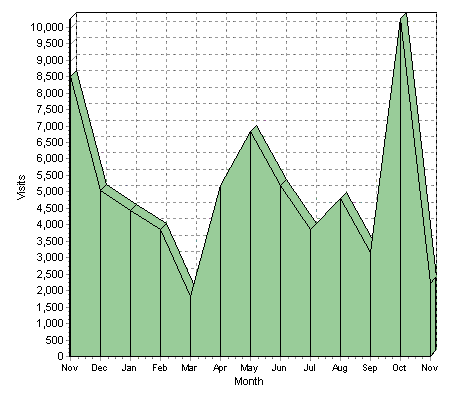
Congrats to a visitor from lmdi.com from Southfield, Michigan, who is visitor #100 000 to this blog. Condolences to centra.ind.com (99999) and 216.113.168.# (100001) who barely missed.
Interestingly, I also got page view #200 000 today.
This blog started on 3/24/05. The 1000th visitor came on 5/3/05. October had over 10 000 visitors, the most to date.
From its inception until the end of the 2005 season, the site grew every month, but then an off-season and more sporadic posting since then has resulted in up-and-down numbers. Take a look at the graph of the monthly total since last year.
I reckon this traffic puts me in the top million blogs out there, so thanks for your support!
Friday, November 03, 2006
nats comment
Welcome back to AJ, who was obviously holding onto his secrets for the past 9 months. Congrats, AJ and all of Chain, except Kid, of course, for a great tournament.
I'm reposting what I wrote at the end of the comments, just so those who only check in at ultimatetalk will be able to read about me. Nothing else new here.
I felt like I played pretty well, although I had only one play worthy of a highlight film (at least one I'd want to be part of; I also got skyed once by a taller player, although I have evidence that my feet were higher than his). It was mostly just getting open and completing passes. I think I had four turnovers and two other incompletions on passes to me. First turnover came when Forch changed his cut as I was throwing and I couldn't stop it; I almost nailed the marker in the face with that one. Second came when I threw a with-the-force backhand into the ground a lot shy of my target; there was something funky with the mark that made me think I was just going to be fouled or maybe I just lost sight of where I was throwing or something that my mechanics were way off. I dropped a low pass in the wind against Rhino (got a brushburn from that one). And I threw a pass to BVH when he wasn't open but was still cutting; it was my first point after being on the massage table for 20 minutes (I took this long only because we were up by several and there was only one O point in that time) and I was out of the flow of the game a bit, so when I caught a swing I just turned and threw, but his defender was already on his way by him by that time. He called a foul, there was some bitching about it, after about two minutes the coach went up to him and said something and I came up to him and tried to say that it wasn't a foul but he had already put the disc down. On the receiving end, Alex threw me a huck in the Furious game after we were already down by 6, I looked up to the forehand side because there was a lot of room there and I thought the force was that way, and by the time I caught sight of it and turned the other way, I had lost too much momentum and couldn't catch up to it. Had I been expecting the backhand the whole way, I would have caught it. And Doug threw me a too-weak forehand in the Sockeye game where another cutter took too long to clear out and his defender got the layout poach block.
I felt that Friday was my best day of the tournament, in sharp contrast to the past several years where Saturday was my best day. I once again felt stronger on Saturday, but the space wasn't there or something such that I didn't get the disc as much as I wanted to against Sockeye, without feeling that it was because my man was on me (although maybe he was, I don't know). Sockeye was effective at clogging the lanes against us, and maybe our overall team speed (especially on offense) killed us.
Defensively, I felt ok. No blocks, but I created several high stalls (some of them leading to turnovers) due to good non-fouling marking, and I remember preventing some cuts. There were two long passes thrown to my man and caught on the first day, but none after that despite playing some HnH teams who got the disc plenty of times when I was on the field. There were a few passes over the weekend where my guy beat me right away on an in-cut so I just ambled in after him. Maybe it's a little lazy, but there is no practical difference (given that I'm not going to administer a bump as soon as he catches it even though the kids today seem to think it's cool) since I'm not going to be able to catch up anyway and I was there by the time he caught it and turned and the force didn't change.
I played a little more than I expected and probably about as much as I deserved, maybe a little more, maybe a little less. Forch played well offensively except for a bunch of forced hucks, but otherwise I didn't feel anyone on the O stood out as playing well.
I had two points that stood out for me. One was against Furious on the first point of the game. Pitted against a defender that apparently everyone on Furious knows I can't stand playing against because of his hands and bumpiness, I was determined to show him, but I established that I wasn't going to be intimidated, got open for four or five passes with the force, and scored the goal. The other point was an upwinder against Rhino. I was called as the third handler, and got open on several resets and quickly got the disc moving again, leading to a big goal.
Overall, I was somewhat disappointed in the amount of contact and petty calls. In order, among the teams I played with and against, I would rank them Furious, Sockeye, Revolver, us, Rhino, the others. 3 of the 4 NW teams outcalled/outfouled us despite us being a little chippy ourselves. I didn't watch either semi (beer tent was too far from the fields), so I can't comment on them.
I'm reposting what I wrote at the end of the comments, just so those who only check in at ultimatetalk will be able to read about me. Nothing else new here.
I felt like I played pretty well, although I had only one play worthy of a highlight film (at least one I'd want to be part of; I also got skyed once by a taller player, although I have evidence that my feet were higher than his). It was mostly just getting open and completing passes. I think I had four turnovers and two other incompletions on passes to me. First turnover came when Forch changed his cut as I was throwing and I couldn't stop it; I almost nailed the marker in the face with that one. Second came when I threw a with-the-force backhand into the ground a lot shy of my target; there was something funky with the mark that made me think I was just going to be fouled or maybe I just lost sight of where I was throwing or something that my mechanics were way off. I dropped a low pass in the wind against Rhino (got a brushburn from that one). And I threw a pass to BVH when he wasn't open but was still cutting; it was my first point after being on the massage table for 20 minutes (I took this long only because we were up by several and there was only one O point in that time) and I was out of the flow of the game a bit, so when I caught a swing I just turned and threw, but his defender was already on his way by him by that time. He called a foul, there was some bitching about it, after about two minutes the coach went up to him and said something and I came up to him and tried to say that it wasn't a foul but he had already put the disc down. On the receiving end, Alex threw me a huck in the Furious game after we were already down by 6, I looked up to the forehand side because there was a lot of room there and I thought the force was that way, and by the time I caught sight of it and turned the other way, I had lost too much momentum and couldn't catch up to it. Had I been expecting the backhand the whole way, I would have caught it. And Doug threw me a too-weak forehand in the Sockeye game where another cutter took too long to clear out and his defender got the layout poach block.
I felt that Friday was my best day of the tournament, in sharp contrast to the past several years where Saturday was my best day. I once again felt stronger on Saturday, but the space wasn't there or something such that I didn't get the disc as much as I wanted to against Sockeye, without feeling that it was because my man was on me (although maybe he was, I don't know). Sockeye was effective at clogging the lanes against us, and maybe our overall team speed (especially on offense) killed us.
Defensively, I felt ok. No blocks, but I created several high stalls (some of them leading to turnovers) due to good non-fouling marking, and I remember preventing some cuts. There were two long passes thrown to my man and caught on the first day, but none after that despite playing some HnH teams who got the disc plenty of times when I was on the field. There were a few passes over the weekend where my guy beat me right away on an in-cut so I just ambled in after him. Maybe it's a little lazy, but there is no practical difference (given that I'm not going to administer a bump as soon as he catches it even though the kids today seem to think it's cool) since I'm not going to be able to catch up anyway and I was there by the time he caught it and turned and the force didn't change.
I played a little more than I expected and probably about as much as I deserved, maybe a little more, maybe a little less. Forch played well offensively except for a bunch of forced hucks, but otherwise I didn't feel anyone on the O stood out as playing well.
I had two points that stood out for me. One was against Furious on the first point of the game. Pitted against a defender that apparently everyone on Furious knows I can't stand playing against because of his hands and bumpiness, I was determined to show him, but I established that I wasn't going to be intimidated, got open for four or five passes with the force, and scored the goal. The other point was an upwinder against Rhino. I was called as the third handler, and got open on several resets and quickly got the disc moving again, leading to a big goal.
Overall, I was somewhat disappointed in the amount of contact and petty calls. In order, among the teams I played with and against, I would rank them Furious, Sockeye, Revolver, us, Rhino, the others. 3 of the 4 NW teams outcalled/outfouled us despite us being a little chippy ourselves. I didn't watch either semi (beer tent was too far from the fields), so I can't comment on them.
Sunday, October 29, 2006
Nationals Q&A
Any questions? I'll blog in more detail in a few days, but if you have questions, fire away.
Sunday, October 22, 2006
Once more unto the breach
1989. 2006. Missed 1991, as we made some mistakes and lost out to Graffiti. This is my 17th Nationals, and about the 12th or 13th where I went in somewhat planning to win the title. And last. If you don't count Masters.
Last practice of the season was today, possibly ever. After, we hung around and made fun of ourselves and joked and had a good time. I couldn't run down one long pass because my hamstrings were sore from 58 sprints on Tuesday's workouts. "If I were 39," I said, but I could still have had it at 41, or not had it at 39, depending on how I felt. That's a problem not frequently mentioned with age, that every day is not the same. You hear old people talk about some days being better than others, but it's true. Some days I feel 39, or 35, or 30, or 25, or whatever, if only for the times I'm playing. Recovery is always a problem, but the doing, well, that goes well sometimes. Luckily, I know more than any of you about how to get open, and I'm lucky genetically that I haven't fallen off the cliff yet due to advancing years, although I can see the cliff just in front of me (actually, it's been a gradual downslope mostly, too subtle to recognize while you're on it but when you're at the end, you say, "Huh"). I still have to make adjustments in my head as to what I can handle over the course of a weekend, but let's hope I can do it.
Once more. 17 years ago, attending my first Nationals, I was really just happy to be there, and had no idea what to expect from future years. Since then, I've had some good years, and some disappointing years, and while you'd think I might know what to expect, still it's a surprise when it happens. Others speak more eloquently about it, but seeing the dew-laden fields first thing on Thursday is chilling. So much ahead of you, so much having happened over the past few months and years, you hate the guys you've been playing against and now they're your teammates again, and the RRIs and seedings and blog entries are no longer just fun hypotheticals but they're people in different colored shirts who just want to kick your ass (possibly a little extra because you called them out). I can still do it, I tell myself, and yes, sometimes I still do it. The disc doesn't care if you're 41 or 21, and neither do I.
I'll still kick your ass, kid.
And good luck.
Last practice of the season was today, possibly ever. After, we hung around and made fun of ourselves and joked and had a good time. I couldn't run down one long pass because my hamstrings were sore from 58 sprints on Tuesday's workouts. "If I were 39," I said, but I could still have had it at 41, or not had it at 39, depending on how I felt. That's a problem not frequently mentioned with age, that every day is not the same. You hear old people talk about some days being better than others, but it's true. Some days I feel 39, or 35, or 30, or 25, or whatever, if only for the times I'm playing. Recovery is always a problem, but the doing, well, that goes well sometimes. Luckily, I know more than any of you about how to get open, and I'm lucky genetically that I haven't fallen off the cliff yet due to advancing years, although I can see the cliff just in front of me (actually, it's been a gradual downslope mostly, too subtle to recognize while you're on it but when you're at the end, you say, "Huh"). I still have to make adjustments in my head as to what I can handle over the course of a weekend, but let's hope I can do it.
Once more. 17 years ago, attending my first Nationals, I was really just happy to be there, and had no idea what to expect from future years. Since then, I've had some good years, and some disappointing years, and while you'd think I might know what to expect, still it's a surprise when it happens. Others speak more eloquently about it, but seeing the dew-laden fields first thing on Thursday is chilling. So much ahead of you, so much having happened over the past few months and years, you hate the guys you've been playing against and now they're your teammates again, and the RRIs and seedings and blog entries are no longer just fun hypotheticals but they're people in different colored shirts who just want to kick your ass (possibly a little extra because you called them out). I can still do it, I tell myself, and yes, sometimes I still do it. The disc doesn't care if you're 41 or 21, and neither do I.
I'll still kick your ass, kid.
And good luck.
Monday, October 16, 2006
ranking algorithm
Here are the results, along with the official seed and this year's RRI:
Rank Team PMR Seed RRI
1 Sockeye 3009 2 2838
2 Furious 2997 1 2774
3 DoG 2870 3 2728
4 Bravo 2803 5 2722
5 Ring 2750 4 2731
6 SubZero 2737 7 2687
7 Revlvr 2728 6 2710
8 Chain 2719 10 2670
9 Rhino 2704 8 2690
10 Condors 2674 9 2665
11 Vicious 2673 11 2715
12 Metal 2634 12 2591
13 Machine 2608 14 2599
14 BAT 2577 13 2554
15 TrkStop 2556 15 2565
16 Monster 2365 16 2373
Here's how:
1. Enter in the tournament RRI for every team. Give a 40 point bonus for winning. Give a 20 point bonus for finishing 2nd. (Possible enhancements: make additional changes (5 or 10 points) for each win or loss in the tournament. I think RRI underweights wins, since it relies on point differential to make accurate predictions.)
2. Assign a weight to each tournament, since some are more important than others. I gave a weight of 2 to the major tournaments held in July or later (Colorado Cup, ECC, Chesapeake, Labor Day, Tuneup, each Regionals), a weight of 1 to lesser tournaments later on (including Sectionals) and major tournamentes earlier (Boston Invite, Solstice, Live Logic), and a weight of 0.5 to the lesser early tournaments. (Enhancements: tweak the weights further).
3. Take a weighted average for each team. If a team has fewer than 8 weight points, add tournaments with the RRI of a low-level Nationals team. For instance, a team has only Regionals (2 points), Sectionals (1 point), and one lesser tournament (1 point) for an average RRI of 2700. Add 4 tournaments worth of 2500 RRI for a modified RRI of 2600. This is to encourage play, make sure one fluke performance doesn't put someone too high, whatever.
4. Add points for last year's Nationals. I chose 200 points for the winner, 150 for 2nd, 100 for the semifinalists, 50 for quarters, 25 for 9-16. I decided to give partial credit to teams who didn't make it but whose regional equivalent did well. For the first iteration, the only team affected was Revolver, getting 25% credit for Jam's semis appearance. I didn't do anything to any of the Mid-Atlantic teams, though, which might not be right. (Enhancement: finer gradations; incorporate entire season.)
Comparison to my previous ranking:
Subzero down 3 to 7th
Ring up 2 to 5th
Chain up 2 to 8th
Machine up 2 to 13th
Others within 1
I can live with either, or the official.
Rank Team PMR Seed RRI
1 Sockeye 3009 2 2838
2 Furious 2997 1 2774
3 DoG 2870 3 2728
4 Bravo 2803 5 2722
5 Ring 2750 4 2731
6 SubZero 2737 7 2687
7 Revlvr 2728 6 2710
8 Chain 2719 10 2670
9 Rhino 2704 8 2690
10 Condors 2674 9 2665
11 Vicious 2673 11 2715
12 Metal 2634 12 2591
13 Machine 2608 14 2599
14 BAT 2577 13 2554
15 TrkStop 2556 15 2565
16 Monster 2365 16 2373
Here's how:
1. Enter in the tournament RRI for every team. Give a 40 point bonus for winning. Give a 20 point bonus for finishing 2nd. (Possible enhancements: make additional changes (5 or 10 points) for each win or loss in the tournament. I think RRI underweights wins, since it relies on point differential to make accurate predictions.)
2. Assign a weight to each tournament, since some are more important than others. I gave a weight of 2 to the major tournaments held in July or later (Colorado Cup, ECC, Chesapeake, Labor Day, Tuneup, each Regionals), a weight of 1 to lesser tournaments later on (including Sectionals) and major tournamentes earlier (Boston Invite, Solstice, Live Logic), and a weight of 0.5 to the lesser early tournaments. (Enhancements: tweak the weights further).
3. Take a weighted average for each team. If a team has fewer than 8 weight points, add tournaments with the RRI of a low-level Nationals team. For instance, a team has only Regionals (2 points), Sectionals (1 point), and one lesser tournament (1 point) for an average RRI of 2700. Add 4 tournaments worth of 2500 RRI for a modified RRI of 2600. This is to encourage play, make sure one fluke performance doesn't put someone too high, whatever.
4. Add points for last year's Nationals. I chose 200 points for the winner, 150 for 2nd, 100 for the semifinalists, 50 for quarters, 25 for 9-16. I decided to give partial credit to teams who didn't make it but whose regional equivalent did well. For the first iteration, the only team affected was Revolver, getting 25% credit for Jam's semis appearance. I didn't do anything to any of the Mid-Atlantic teams, though, which might not be right. (Enhancement: finer gradations; incorporate entire season.)
Comparison to my previous ranking:
Subzero down 3 to 7th
Ring up 2 to 5th
Chain up 2 to 8th
Machine up 2 to 13th
Others within 1
I can live with either, or the official.
Thursday, October 12, 2006
Nationals seeding, by parinella
Here are the correct seedings, along with an explanation of allowable deviations from those seedings. Mentally, I start off with last year’s results and adjust based on this year. However, I really think you’d get about the same result if you started with this year’s and adjusted based on last year. There is a remarkable consistency from year to year.
First, I put the teams into groups. Deviations are allowable within a group but not between groups.
Furious
Sockeye
DoG
Ring, Bravo, Subzero, Revolver
Condors, Rhino, Chain
Vicious
Metal, BAT
Machine, Truck Stop
Monster
Sockeye really should be first, which I found to be a big surprise to me since I weight a championship last year so highly, but they beat Furious 4-1 this year, three of those wins coming in August/September. But Furious won the Region, so there. And the two teams met in the finals of the two best tournaments and finished 1-2 last year.
At first I was going to group DoG with the teams below before putting us 3rd, but the body of work coupled with a semis appearance last year is too much. The lowlight of the season (DoG's only non-victory, in fact) was ECC, but Condors and Rhino finished just one win above DoG, and the two had easier schedules since they each got to face all of the East Coast times while DoG had to play all the West Coast teams (and in fact DoG had about the same RRI at the tournament).
[But a quick note about RRI or any other true-strength predictor. For purposes of seeding, it overweights close losses.]
Before looking at the data, I was going to put Bravo and Revolver 4/5, but neither has a strong body of work this year. Bravo's win at Colorado Cup (early August, at home) is outweighed by dismal performances at ECC and Labor Day. Revolver has done OK but not worthy of top 4, other than being NW #3 (only one tournament final, which they lost). Ring has a high RRI, but part of that is from winning in Texas in early May, hardly relevant. They did about the same as DoG at ECC, but lost twice at Chesapeake in their only other tournament, and they finished 13th at Nats last year. Subzero lost by 1 to Furious in the quarters last year, made semis at Labor Day, and got knocked out by DoG in finals of Tuneup and semis of Boston Invite. They trailed at Colorado Cup, but the body of work makes them the surprise #4 seed.
Rhino is like Revolver, but finished 4th at Regionals. Condors have a decent RRI, but finished in the middle at all of their competitive tournaments, and lost big to Bravo. Chain finished low at Nats last year, made finals of Chesapeake but lost three times, played .500 at Labor Day.
Vicious won Chesapeake in their only tournament, finished 15th at Nats last year. Lost big in the finals to Chain, but beat DW handily twice, and DW made quarters last year and probably would have earned about a 12 seed had they made it this year.
Metal and BAT finished 11/12 last year, both finished 2nd in their Region. Metal seems to have done a little better this year.
Truck Stop could conceivably be included with those guys, and maybe they should. Machine is C#3.
Monster has lost to Oaks, Illinois X, Old and In The Way, and Haymaker this year.
So, the seedings:
Furious
Sockeye
DoG
Subzero
Bravo (won CC and made quarters)
Revolver
Ring
Condors (get the nod based on last year)
Rhino
Chain
Vicious
Metal
BAT
Truck Stop
Machine
Monster
Of course, all of this may be wrong.
First, I put the teams into groups. Deviations are allowable within a group but not between groups.
Furious
Sockeye
DoG
Ring, Bravo, Subzero, Revolver
Condors, Rhino, Chain
Vicious
Metal, BAT
Machine, Truck Stop
Monster
Sockeye really should be first, which I found to be a big surprise to me since I weight a championship last year so highly, but they beat Furious 4-1 this year, three of those wins coming in August/September. But Furious won the Region, so there. And the two teams met in the finals of the two best tournaments and finished 1-2 last year.
At first I was going to group DoG with the teams below before putting us 3rd, but the body of work coupled with a semis appearance last year is too much. The lowlight of the season (DoG's only non-victory, in fact) was ECC, but Condors and Rhino finished just one win above DoG, and the two had easier schedules since they each got to face all of the East Coast times while DoG had to play all the West Coast teams (and in fact DoG had about the same RRI at the tournament).
[But a quick note about RRI or any other true-strength predictor. For purposes of seeding, it overweights close losses.]
Before looking at the data, I was going to put Bravo and Revolver 4/5, but neither has a strong body of work this year. Bravo's win at Colorado Cup (early August, at home) is outweighed by dismal performances at ECC and Labor Day. Revolver has done OK but not worthy of top 4, other than being NW #3 (only one tournament final, which they lost). Ring has a high RRI, but part of that is from winning in Texas in early May, hardly relevant. They did about the same as DoG at ECC, but lost twice at Chesapeake in their only other tournament, and they finished 13th at Nats last year. Subzero lost by 1 to Furious in the quarters last year, made semis at Labor Day, and got knocked out by DoG in finals of Tuneup and semis of Boston Invite. They trailed at Colorado Cup, but the body of work makes them the surprise #4 seed.
Rhino is like Revolver, but finished 4th at Regionals. Condors have a decent RRI, but finished in the middle at all of their competitive tournaments, and lost big to Bravo. Chain finished low at Nats last year, made finals of Chesapeake but lost three times, played .500 at Labor Day.
Vicious won Chesapeake in their only tournament, finished 15th at Nats last year. Lost big in the finals to Chain, but beat DW handily twice, and DW made quarters last year and probably would have earned about a 12 seed had they made it this year.
Metal and BAT finished 11/12 last year, both finished 2nd in their Region. Metal seems to have done a little better this year.
Truck Stop could conceivably be included with those guys, and maybe they should. Machine is C#3.
Monster has lost to Oaks, Illinois X, Old and In The Way, and Haymaker this year.
So, the seedings:
Furious
Sockeye
DoG
Subzero
Bravo (won CC and made quarters)
Revolver
Ring
Condors (get the nod based on last year)
Rhino
Chain
Vicious
Metal
BAT
Truck Stop
Machine
Monster
Of course, all of this may be wrong.
Sunday, October 08, 2006
Regionals -- DoG
DoG earns 3 seed at Nationals; asses kicked; names not taken.
15-0. 15-6. 15-5. 15-5. No breaks. 2 turnovers in the finals. Huck-N-Hope, meet Plug-N-Play.
I have to admit that I hadn't bought my plane ticket to Nationals yet, because I have three of us (plus my parents, who are coming down to see their grandson and ohbytheway his dad) to purchase for, but I was reasonably sure we'd make it. Althought it's not as distinct as the women's (there were probably only a literal handful of games in the entire women's bracket that were closer than 15-10), the teams were stratified in playing ability and most games weren't really in doubt. That's the one area that Mixed is preferable to Open or Women's, in that there is real excitement and doubt about who is going to win. It's a better sporting event where the underdog has a fighting chance. Baseball is the best at this (suck it, Yankees fans, by the way), but ultimate would have to go to games to 3 to achieve the same level of parity.
So, Regionals. I skipped the first game to hang out with my incredibly sweet although worthy of being slapped around (although of course I wouldn't do that) boy while my wife played. Somehow we won 15-0 without me. Then 15-6 against Montreal, about what the point spread said. O turned it a couple times, D played their technological advances, we won. There was one rules discussion that thankfully kept Fortch occupied for about 45 minutes looking through the rule book (although I think most of that was him looking for his own name), but otherwise it went according to seed. I applaud those guys and wished I still loved the game like they do. They've been shafted a few times at Easterns with their seeding, but still they play and win some and lose some and play. I didn't see the one guy with the long curly hair, but those guys gave it and didn't roll just because we're "DoG". O Canada!
Semis were against PoNY. They seemed to fear us. We played well, but they cooperated even more and we won 15-5. The skinny kid played some good D against me, just like the muscular kid who I didn't see today did this spring, but overall they seemed content to give us the game.
Finals were today, DoG vs Metal, "Boston" vs "Cambridge." For awhile, it looked like the famed semifinal of 2002. In the first half, Metal had three turnovers, all of them on missed or defended hucks, and found themselves down three breaks, since DoG had none. The D is starting to get their shit together on offense. Guys who were hesitant before are now starting to figure out when they should cut. We had a few long passes, no forced stalll 9 throws, and we converted. For the last few months, these guys have been bringing it on defense, generating turnovers, but the scorebook hasn't reflected it since they've sucked on O. Now, it's beginning to work. Personally, I hate them all (yes, I'm talking to you), but I am glad to have them as teammates, and if you want to keep me on the sideline by scoring, may your god bless you. You still can't cover me, but rock on.
So, finals. First point was a classic Huck-n-Hope. It went off, I said, "Sweet, turnover." But Ryan tracked it down, an amazing run at the disc, goal. We answered, although they played tough D and it took us about a dozen passes. Them, swing, swing, huck, great catch for a goal. We answered, a little more slowly, but more surely (I love the huck, don't get me wrong, but we're just not as good at putting it as these other teams so we have to be more careful). One of these next points, the huck was a little too far for Ryan's fast little legs (although again I was amazed that he was able to get there; too bad he and his buddies forsook us for Metal this spring), and we worked it down, break. I can't remember the timing, but the rest of the first half featured good O and two more missed long throws from Metal (I think Zip got one 50/50 throw and Pallaver got another). No more turns, 8-5. At some point in the second half, they gave up and decided to wait for the 2/3 game, but we took it to them with our variety of D's and intensity. This clearly was not the same team that went on to destroy GOAT in the game to go. Listless in one, a little fearful and unsure, transformed into confident and skillful the next. If you want to use this as bulletin board material, be my guest, but since this is my last year in Open (I think, for the third straight year), be my guest. I just want to play good ultimate against good opponents.
So, I think this puts us as the 3 seed. Furious/Sockeye are 1/2, and anyone who votes otherwise should have his license revoked. But 3? JAM lost at Regionals. Ring and Condors would be considerations, but they went oh-fer on Day 1 at Nationals last yaer. We beat Bravo in quarters last year and nothing has distinguished us from them this year. NW 3 and 4 are tough, I know, but they're unproven. I see it F/S 1/2, DoG 3, Revolver/Rhino/Bravo 4/5/6 (in some order), Subzero/Chain 7/8, other teams 9-16. (Oh, another point about seedings is tht you're really only qualified to argue about teams at your level. #1 should have no real opinion about #12 v #13.) On the one hand, we don't deserve the #3 seed, but otoh, we don't deserve it less than any other team.
So, a few words about Plug-N-Play. Historically, our team has had positions built around the players occupying them. I said once, way back, that our O positions were not called man and buddy but were Cork, Jim, Moons, Alex, etc., since they were tailored to each's talents and interests. Now, we have more redundancy and can afford to sit out our O guys for 1/4 of the points or to have a few Bozos out there who can handle the key D positions. Zip may be our best player, but I don't think he's indispensable in a way that half a dozen guys were 10 years ago.
So, you read it here first, DoG '06 upset champions. The retiring Parinella and de Frondeville cry while they leave their cleats at the field, saying that this was one of their seven best championships, and surely among the three least expected. We attempt to take all the glory despite the obviously contrasting stats, which we will squelch, and no one will say anything just to make sure we don't come back next year.
This is the Word of DoG.
15-0. 15-6. 15-5. 15-5. No breaks. 2 turnovers in the finals. Huck-N-Hope, meet Plug-N-Play.
I have to admit that I hadn't bought my plane ticket to Nationals yet, because I have three of us (plus my parents, who are coming down to see their grandson and ohbytheway his dad) to purchase for, but I was reasonably sure we'd make it. Althought it's not as distinct as the women's (there were probably only a literal handful of games in the entire women's bracket that were closer than 15-10), the teams were stratified in playing ability and most games weren't really in doubt. That's the one area that Mixed is preferable to Open or Women's, in that there is real excitement and doubt about who is going to win. It's a better sporting event where the underdog has a fighting chance. Baseball is the best at this (suck it, Yankees fans, by the way), but ultimate would have to go to games to 3 to achieve the same level of parity.
So, Regionals. I skipped the first game to hang out with my incredibly sweet although worthy of being slapped around (although of course I wouldn't do that) boy while my wife played. Somehow we won 15-0 without me. Then 15-6 against Montreal, about what the point spread said. O turned it a couple times, D played their technological advances, we won. There was one rules discussion that thankfully kept Fortch occupied for about 45 minutes looking through the rule book (although I think most of that was him looking for his own name), but otherwise it went according to seed. I applaud those guys and wished I still loved the game like they do. They've been shafted a few times at Easterns with their seeding, but still they play and win some and lose some and play. I didn't see the one guy with the long curly hair, but those guys gave it and didn't roll just because we're "DoG". O Canada!
Semis were against PoNY. They seemed to fear us. We played well, but they cooperated even more and we won 15-5. The skinny kid played some good D against me, just like the muscular kid who I didn't see today did this spring, but overall they seemed content to give us the game.
Finals were today, DoG vs Metal, "Boston" vs "Cambridge." For awhile, it looked like the famed semifinal of 2002. In the first half, Metal had three turnovers, all of them on missed or defended hucks, and found themselves down three breaks, since DoG had none. The D is starting to get their shit together on offense. Guys who were hesitant before are now starting to figure out when they should cut. We had a few long passes, no forced stalll 9 throws, and we converted. For the last few months, these guys have been bringing it on defense, generating turnovers, but the scorebook hasn't reflected it since they've sucked on O. Now, it's beginning to work. Personally, I hate them all (yes, I'm talking to you), but I am glad to have them as teammates, and if you want to keep me on the sideline by scoring, may your god bless you. You still can't cover me, but rock on.
So, finals. First point was a classic Huck-n-Hope. It went off, I said, "Sweet, turnover." But Ryan tracked it down, an amazing run at the disc, goal. We answered, although they played tough D and it took us about a dozen passes. Them, swing, swing, huck, great catch for a goal. We answered, a little more slowly, but more surely (I love the huck, don't get me wrong, but we're just not as good at putting it as these other teams so we have to be more careful). One of these next points, the huck was a little too far for Ryan's fast little legs (although again I was amazed that he was able to get there; too bad he and his buddies forsook us for Metal this spring), and we worked it down, break. I can't remember the timing, but the rest of the first half featured good O and two more missed long throws from Metal (I think Zip got one 50/50 throw and Pallaver got another). No more turns, 8-5. At some point in the second half, they gave up and decided to wait for the 2/3 game, but we took it to them with our variety of D's and intensity. This clearly was not the same team that went on to destroy GOAT in the game to go. Listless in one, a little fearful and unsure, transformed into confident and skillful the next. If you want to use this as bulletin board material, be my guest, but since this is my last year in Open (I think, for the third straight year), be my guest. I just want to play good ultimate against good opponents.
So, I think this puts us as the 3 seed. Furious/Sockeye are 1/2, and anyone who votes otherwise should have his license revoked. But 3? JAM lost at Regionals. Ring and Condors would be considerations, but they went oh-fer on Day 1 at Nationals last yaer. We beat Bravo in quarters last year and nothing has distinguished us from them this year. NW 3 and 4 are tough, I know, but they're unproven. I see it F/S 1/2, DoG 3, Revolver/Rhino/Bravo 4/5/6 (in some order), Subzero/Chain 7/8, other teams 9-16. (Oh, another point about seedings is tht you're really only qualified to argue about teams at your level. #1 should have no real opinion about #12 v #13.) On the one hand, we don't deserve the #3 seed, but otoh, we don't deserve it less than any other team.
So, a few words about Plug-N-Play. Historically, our team has had positions built around the players occupying them. I said once, way back, that our O positions were not called man and buddy but were Cork, Jim, Moons, Alex, etc., since they were tailored to each's talents and interests. Now, we have more redundancy and can afford to sit out our O guys for 1/4 of the points or to have a few Bozos out there who can handle the key D positions. Zip may be our best player, but I don't think he's indispensable in a way that half a dozen guys were 10 years ago.
So, you read it here first, DoG '06 upset champions. The retiring Parinella and de Frondeville cry while they leave their cleats at the field, saying that this was one of their seven best championships, and surely among the three least expected. We attempt to take all the glory despite the obviously contrasting stats, which we will squelch, and no one will say anything just to make sure we don't come back next year.
This is the Word of DoG.
Tuesday, October 03, 2006
Making Nationals
Reading Cash’s blog about Revolver qualifying for Nationals, I am reminded of my own more innocent days.
The year was 1989…
Nah, I’ve used that stylistic device too many times. This really started back in the mid-80s. I was in college at Case Western in Cleveland, playing the fall season with the team there (first Ubiquidisc, then North Coast) and summered at my family home in Pittsburgh, playing the spring Easterns series and summer league. CMU had a strong college team which made College Nationals a few times, and though there was never any real exploration of this option, I thought about trying to play with them as a ringer (the rules might have allowed for students from other colleges that did not have their own teams, or maybe it didn’t). The Pittsburgh club team (Slag, Crash) couldn’t compete with the real top teams, but could give good games to the top Mid-Atlantic teams. Cleveland was getting stronger, too, finally winning Sectionals in 1985 before going 0-3 at Regionals in Kansas City, a 17 hour van drive away. In 1986, Pittsburgh got a little stronger still, I felt comfortable and important on the team, and so I decided in my senior year to blow off the Cleveland team (which was in a Region which was dominated by Windy City and Tunas, two of the top five teams in the country) and try to qualify for Nationals with Pittsburgh, figuring that I had no idea where I would be the following year or if I would still be playing frisbee and that this might be my only chance in life to qualify for Nationals. We lost the 4/5 winner’s bracket game but clawed back to make the backdoor final. We even led by three at halftime before faltering in the second half to lose to R&B, 19-15. My parents were extremely disappointed when I told them that I would have chosen to go to Nationals had we qualified instead of spending Thanksgiving with them.
The next year, I was out of college and living in Cleveland, and again lost in the game to go, this time with North Coast to the Tunas. We took out Henry Thorne’s (and the Greffs’, or maybe just Greff Minor’s) Coffee and Donuts in the game before that. I remember that both teams wanted to wear black but C&D invoked their higher seed and we somehow allowed it (not sure why we wouldn’t have flipped for it). This gave us a little extra spark and we knocked them out. This carried over to the game to go, for a little bit. We were as close as 8-7, I think, before our best player got point-blocked near the goal line, and we only mustered one more goal en route to a 21-8 defeat. (Writing this reminds me of another game. In the semis of Worlds in 1991 with Earth Atomizer against NY, we were determined that this finally was the game where we gave them a battle, and we were in it all the way up to the opening pull, which we dropped. 21-7.)
Somewhere around this time, I was amazed by the choice one of my old summer league teammates had made. He had moved to DC and qualified for Nationals with Yo Mama (this must have been 1987 according to the UPA Hall of Champions. By the way, UPA, there have been championships played since 2002. Perhaps you could update this.). However, he decided not to go to Nationals, figuring they would get crushed. What? This would be a dream come true for some of us lowly toilers, and he just threw it away like it was nothing.
In 1988 we thought we had a chance, and went into Regionals as the #3 seed, but played a listless game in newfallen snow (Halloween weekend, Madison) against Kansas’ Dover team and got knocked out early Sunday morning.
In the spring of 1989, shortly after my 24th birthday, I moved to Boston. The move was almost completely unrelated to Frisbee. I liked my job in Cleveland well enough, but they wanted me to relocate to their manufacturing facility 60 miles east of Cleveland, so I started looking around. A headhunter found a position for me in the Boston area, and I jumped at it, because Boston had always seemed like a great place to live, and where I could actually live _in_ the city (definitely would not want to do that in Pittsburgh or Cleveland). I figured that my life path (as a right-thinking Middle American) would be to settle down in a few years anyway (a majority of my high school and college friends got married at about age 25), so might as well live a little first. I went out to one practice that spring with one of the B teams, just to get a little Frisbee time in before joining up with the Pittsburghers for one last tournament at Easterns. I went to some of the open practices that Titanic had, and despite some encouraging words from one of their leaders (no, not Mooney, it was Bob Harding), I just wasn’t willing to accept that I might be good enough for the #2 team in the country and didn’t pursue it much. I also went to a few Earth Atomizer practices but wasn’t committed to that, either, instead preferring the social life.
One day at work, I serendipitously ran into Alex (we worked in the same building at the behemoth GE plant in Lynn), who had managed to back his way into a spot on Earth that spring after being cut by Z’s captain Ted Munter (who as DoG coach now will complete the circle by cutting Alex again next spring). Alex told me that Earth was getting close to settling their fall roster so I better start coming out to practice. I missed the game a little bit by then, so I went to the next day’s tryout, skied their best jumper several times (and this reminds me of when Bob Lobel came to his first DoG practice in 1994 and made Seeger his girlfriend repeatedly that day and thus bypassed the remainder of the tryout process), and was immediately put on the team without a vote. We practiced on Tuesday and Thursday nights in Jamaica Plain under the lights, then went to tournaments on the weekend. Our performance that fall was unremarkable. Graffiti was the incumbent #3 team in the region, but we also lost to Loisaida (Lower East Side of NY), Father Throws Best (old Boston guys (old = 31)), and Nationals candidates from other regions (Philmore, DC, Chain). A typical tournament would end with us being pummeled by NY or Boston in the quarters. We almost beat Titanic at Purchase, but also lost to NY 17-1. We even had close games against Slipped Disc (Connecticut). But still we thought we had a chance.
We finished 4th in the Boston section, behind Titanic, FTB, and someone else who I can’t for the life of me figure out. This put us as the 6th seed at Regionals. We knocked off 3rd seed Graffiti in the 2nd round, got drubbed by NY or Titanic in a game to qualify (back then, the finals participants were guaranteed 1st and 2nd without any of this silly modified double secret triple elimination format. We eventually found ourselves against Graffiti again in the game for the 3rd spot to Nationals. Unlike Billy, I don’t seem to remember point-by-point details of this game, just a few hazy memories (might have even involved some shutdown D, but maybe that’s someone else I’m thinking of). But what sticks is the anticipation of waiting for the game to end, and being thrilled with finally making it to the show after all those years (it seemed like a lot at the time). The next few weeks of practice and Nationals itself were just icing, almost an afterthought. We were happy to win a game, finishing in a 3 way tie with Chain and Philmore with 1-4 records.
The following year was similar. We had a better year, but still went into Regionals as the 4th seed. We lobbied hard to be seeded ahead of Graffiti since we wanted to square off against Titanic (now First Time Gary) in the semis. We had beaten them in a recent scrimmage and played them tight at other times, while we had never given a full NY squad a game (we lost by about 3 once in the semis at Van Cortlandt Park to a split squad). But Andy B was too powerful and we had to take our licking as the 4 seed. (Interestingly, Graffiti seemed to play closer games against NY than against Titanic. When the big matchup against Graffiti came, it was almost a letdown as we were just on fire and routed them, 19-9. The following week, we played off against FTG for the #2 spot (they didn’t want to play at the Regionals tournament) and pulled off what still ranks as one of my favorite all-time victories, 21-17 at the Wellesley High School fields. This victory over a four-time defending Nationals semifinalist earned us a, wait, wait, 9th seed (out of 12) at Nationals. This time, Nationals wasn’t an afterthought. We started out slowly, getting crushed by LA, 19-7, then had to face off against #2 seed Windy City in our other game of the day. (The seeding and the scheduling helped to shape my opinions on these matters.) The only detail I remember from that game is spraining my ankle badly and missing a bunch of it while getting it taped up and testing it out. Oh, and losing 19-16. We went on to win our last three games, including a tight one against my old friends from Pittsburgh, but it was too late for any semifinals hopes we had.
We hit our peak the following summer. While never actually winning a tournament except for one Clambake, we played a little better, and went into Club Worlds extremely excited. We lost an initial pool play game to Philmore, recovered to win several close games against Pittsburgh, the Condors, Dallas, and Chain, lost a close one to a bunch of cheating LA guys, then pulled off another “upset” over the other Boston team (who yet again switched their name (this time to Big Brother) in search of an identity) to qualify for the semis. It looked like we were going to get our rematch against Windy City which had surprised NY in pool play, but LA (which had already been eliminated on point differential) went and lost a “meaningless” game to the Condors to change a 3 way tie into a 2 way tie, which shifted us from 2nd in our pool to 1st, giving us NY instead. As I mentioned above, we thought we were going to give them a game this time, but folded immediately after the opening pull.
But accomplishment led to our downfall, as for some reason we decided that we needed to change things in order to compete against NY. We expanded our roster from about 16 to 25 and changed around our offense, then Dennis and I suffered injuries and hardly practiced that fall (me a sore foot, him a wanker hip injury). We entered Regionals still expecting to qualify for Nationals, but it was Graffiti’s turn to emerge from the shadows. This being only 15 years ago instead of 17, I have a few more memories remaining of this game, but the clearest is of the ride home from Dartmouth, where the Tea Party reviewed the stat book pass by pass, reliving good and bad moments one more time.
This was to be the last Regionals for me that really mattered. We’ve since won 13 of 14 Regionals, and most of those years our Region got three bids to Nationals, and only once did one of those third place teams win more than one game at Nationals. I had a tiny bit of uncertainty in 1995, when we were playing absolutely horribly and I feared that we were going to get knocked out in a 3 way tie on the first day while I was at a wedding. And again last year, I didn’t have a good feeling about how we were going to do, and Twisted Metal and Goat were big unknowns in the battle for two spots, but we needn’t have worried.
Of course, Nationals has held its share of anticipation and excitement, so do not cry for me, gentle reader. But if you so desire, you can pray for one final unexciting Regionals for me this weekend.
The year was 1989…
Nah, I’ve used that stylistic device too many times. This really started back in the mid-80s. I was in college at Case Western in Cleveland, playing the fall season with the team there (first Ubiquidisc, then North Coast) and summered at my family home in Pittsburgh, playing the spring Easterns series and summer league. CMU had a strong college team which made College Nationals a few times, and though there was never any real exploration of this option, I thought about trying to play with them as a ringer (the rules might have allowed for students from other colleges that did not have their own teams, or maybe it didn’t). The Pittsburgh club team (Slag, Crash) couldn’t compete with the real top teams, but could give good games to the top Mid-Atlantic teams. Cleveland was getting stronger, too, finally winning Sectionals in 1985 before going 0-3 at Regionals in Kansas City, a 17 hour van drive away. In 1986, Pittsburgh got a little stronger still, I felt comfortable and important on the team, and so I decided in my senior year to blow off the Cleveland team (which was in a Region which was dominated by Windy City and Tunas, two of the top five teams in the country) and try to qualify for Nationals with Pittsburgh, figuring that I had no idea where I would be the following year or if I would still be playing frisbee and that this might be my only chance in life to qualify for Nationals. We lost the 4/5 winner’s bracket game but clawed back to make the backdoor final. We even led by three at halftime before faltering in the second half to lose to R&B, 19-15. My parents were extremely disappointed when I told them that I would have chosen to go to Nationals had we qualified instead of spending Thanksgiving with them.
The next year, I was out of college and living in Cleveland, and again lost in the game to go, this time with North Coast to the Tunas. We took out Henry Thorne’s (and the Greffs’, or maybe just Greff Minor’s) Coffee and Donuts in the game before that. I remember that both teams wanted to wear black but C&D invoked their higher seed and we somehow allowed it (not sure why we wouldn’t have flipped for it). This gave us a little extra spark and we knocked them out. This carried over to the game to go, for a little bit. We were as close as 8-7, I think, before our best player got point-blocked near the goal line, and we only mustered one more goal en route to a 21-8 defeat. (Writing this reminds me of another game. In the semis of Worlds in 1991 with Earth Atomizer against NY, we were determined that this finally was the game where we gave them a battle, and we were in it all the way up to the opening pull, which we dropped. 21-7.)
Somewhere around this time, I was amazed by the choice one of my old summer league teammates had made. He had moved to DC and qualified for Nationals with Yo Mama (this must have been 1987 according to the UPA Hall of Champions. By the way, UPA, there have been championships played since 2002. Perhaps you could update this.). However, he decided not to go to Nationals, figuring they would get crushed. What? This would be a dream come true for some of us lowly toilers, and he just threw it away like it was nothing.
In 1988 we thought we had a chance, and went into Regionals as the #3 seed, but played a listless game in newfallen snow (Halloween weekend, Madison) against Kansas’ Dover team and got knocked out early Sunday morning.
In the spring of 1989, shortly after my 24th birthday, I moved to Boston. The move was almost completely unrelated to Frisbee. I liked my job in Cleveland well enough, but they wanted me to relocate to their manufacturing facility 60 miles east of Cleveland, so I started looking around. A headhunter found a position for me in the Boston area, and I jumped at it, because Boston had always seemed like a great place to live, and where I could actually live _in_ the city (definitely would not want to do that in Pittsburgh or Cleveland). I figured that my life path (as a right-thinking Middle American) would be to settle down in a few years anyway (a majority of my high school and college friends got married at about age 25), so might as well live a little first. I went out to one practice that spring with one of the B teams, just to get a little Frisbee time in before joining up with the Pittsburghers for one last tournament at Easterns. I went to some of the open practices that Titanic had, and despite some encouraging words from one of their leaders (no, not Mooney, it was Bob Harding), I just wasn’t willing to accept that I might be good enough for the #2 team in the country and didn’t pursue it much. I also went to a few Earth Atomizer practices but wasn’t committed to that, either, instead preferring the social life.
One day at work, I serendipitously ran into Alex (we worked in the same building at the behemoth GE plant in Lynn), who had managed to back his way into a spot on Earth that spring after being cut by Z’s captain Ted Munter (who as DoG coach now will complete the circle by cutting Alex again next spring). Alex told me that Earth was getting close to settling their fall roster so I better start coming out to practice. I missed the game a little bit by then, so I went to the next day’s tryout, skied their best jumper several times (and this reminds me of when Bob Lobel came to his first DoG practice in 1994 and made Seeger his girlfriend repeatedly that day and thus bypassed the remainder of the tryout process), and was immediately put on the team without a vote. We practiced on Tuesday and Thursday nights in Jamaica Plain under the lights, then went to tournaments on the weekend. Our performance that fall was unremarkable. Graffiti was the incumbent #3 team in the region, but we also lost to Loisaida (Lower East Side of NY), Father Throws Best (old Boston guys (old = 31)), and Nationals candidates from other regions (Philmore, DC, Chain). A typical tournament would end with us being pummeled by NY or Boston in the quarters. We almost beat Titanic at Purchase, but also lost to NY 17-1. We even had close games against Slipped Disc (Connecticut). But still we thought we had a chance.
We finished 4th in the Boston section, behind Titanic, FTB, and someone else who I can’t for the life of me figure out. This put us as the 6th seed at Regionals. We knocked off 3rd seed Graffiti in the 2nd round, got drubbed by NY or Titanic in a game to qualify (back then, the finals participants were guaranteed 1st and 2nd without any of this silly modified double secret triple elimination format. We eventually found ourselves against Graffiti again in the game for the 3rd spot to Nationals. Unlike Billy, I don’t seem to remember point-by-point details of this game, just a few hazy memories (might have even involved some shutdown D, but maybe that’s someone else I’m thinking of). But what sticks is the anticipation of waiting for the game to end, and being thrilled with finally making it to the show after all those years (it seemed like a lot at the time). The next few weeks of practice and Nationals itself were just icing, almost an afterthought. We were happy to win a game, finishing in a 3 way tie with Chain and Philmore with 1-4 records.
The following year was similar. We had a better year, but still went into Regionals as the 4th seed. We lobbied hard to be seeded ahead of Graffiti since we wanted to square off against Titanic (now First Time Gary) in the semis. We had beaten them in a recent scrimmage and played them tight at other times, while we had never given a full NY squad a game (we lost by about 3 once in the semis at Van Cortlandt Park to a split squad). But Andy B was too powerful and we had to take our licking as the 4 seed. (Interestingly, Graffiti seemed to play closer games against NY than against Titanic. When the big matchup against Graffiti came, it was almost a letdown as we were just on fire and routed them, 19-9. The following week, we played off against FTG for the #2 spot (they didn’t want to play at the Regionals tournament) and pulled off what still ranks as one of my favorite all-time victories, 21-17 at the Wellesley High School fields. This victory over a four-time defending Nationals semifinalist earned us a, wait, wait, 9th seed (out of 12) at Nationals. This time, Nationals wasn’t an afterthought. We started out slowly, getting crushed by LA, 19-7, then had to face off against #2 seed Windy City in our other game of the day. (The seeding and the scheduling helped to shape my opinions on these matters.) The only detail I remember from that game is spraining my ankle badly and missing a bunch of it while getting it taped up and testing it out. Oh, and losing 19-16. We went on to win our last three games, including a tight one against my old friends from Pittsburgh, but it was too late for any semifinals hopes we had.
We hit our peak the following summer. While never actually winning a tournament except for one Clambake, we played a little better, and went into Club Worlds extremely excited. We lost an initial pool play game to Philmore, recovered to win several close games against Pittsburgh, the Condors, Dallas, and Chain, lost a close one to a bunch of cheating LA guys, then pulled off another “upset” over the other Boston team (who yet again switched their name (this time to Big Brother) in search of an identity) to qualify for the semis. It looked like we were going to get our rematch against Windy City which had surprised NY in pool play, but LA (which had already been eliminated on point differential) went and lost a “meaningless” game to the Condors to change a 3 way tie into a 2 way tie, which shifted us from 2nd in our pool to 1st, giving us NY instead. As I mentioned above, we thought we were going to give them a game this time, but folded immediately after the opening pull.
But accomplishment led to our downfall, as for some reason we decided that we needed to change things in order to compete against NY. We expanded our roster from about 16 to 25 and changed around our offense, then Dennis and I suffered injuries and hardly practiced that fall (me a sore foot, him a wanker hip injury). We entered Regionals still expecting to qualify for Nationals, but it was Graffiti’s turn to emerge from the shadows. This being only 15 years ago instead of 17, I have a few more memories remaining of this game, but the clearest is of the ride home from Dartmouth, where the Tea Party reviewed the stat book pass by pass, reliving good and bad moments one more time.
This was to be the last Regionals for me that really mattered. We’ve since won 13 of 14 Regionals, and most of those years our Region got three bids to Nationals, and only once did one of those third place teams win more than one game at Nationals. I had a tiny bit of uncertainty in 1995, when we were playing absolutely horribly and I feared that we were going to get knocked out in a 3 way tie on the first day while I was at a wedding. And again last year, I didn’t have a good feeling about how we were going to do, and Twisted Metal and Goat were big unknowns in the battle for two spots, but we needn’t have worried.
Of course, Nationals has held its share of anticipation and excitement, so do not cry for me, gentle reader. But if you so desire, you can pray for one final unexciting Regionals for me this weekend.
Sunday, October 01, 2006
format question
An irate reader asks, yet again:
Can you ask some UPA type this question: "What other sport uses the UPAs 16.3.1
format?" ..you know, the one in which you have to beat everyone twice. I all
tried to convince them it was idiotic and failed. Format switches from
double to triple elimination, is designed to have repeat games, even on the same
day, and it simply silly. I understand the point -it protects from a specific
instance of bad seeding - but it is solving a problem that likely doesn't exist.
I will field this one.
The UPA is at the cutting edge of tournament
formatting. Some tournaments do have losers' brackets
but those are for sports where underdogs have a
fighting chance in any game and the format is designed
to pick a winner, not to sort out places 2-N.
Generally, few other sports care about picking
non-winners, simply calling the finals loser the 2nd
place team, the semis losers joint 3-4, etc., and if
they have a need to pick only 3, say, they will
declare the team that lost to the eventual winner to
be the 3rd place team. In a case like that, since the
semis are generally 1-4 and 2-3, the 4th seed would be
the most likely one to finish 3rd.
Now, onto the 16.3.1 format, the modified triple-elim
to pick three teams. Yeah, it's screwy, since the
most likely scenario is that 3 beats 4 in the backdoor
"final", loses to 2 in the 2nd place game while 4
beats 5 again (which had just beat 6), then 3 plays 4
again for 3rd. But, you know, it's easy to come up
with scenarios where N did not play N+1 and just
happened to lose to the same teams in a slightly
different order because of the seeding (which might
even be a fair seeding).
And it's always to a team's advantage to win a round,
even if the most likely scenario is that they'll lose
next round and have a rematch.
The problem, of course, is that the format thinks that
if A beats B once, it will always beat B, when that
doesn't happen all the time, and people are
uncomfortable when B beats A in the rematch, and angry
when A beats B for a second time in three rounds.
How's that?
--
And he irately responded:
A format that expects rematches is a bad one. I think what happened at
college regionals a few years back is a good example. Basically a bunch of
teams played each other twice and they all split. Umass lost to brown by a
point in the finals, a guy broke his leg, then went on to lose 2 more games
and be knocked out. More interesting, I think Dartmouth lost to Harvard ten
beat Harvard, same with Dartmouth Williams or something, certainly with
Dartmouth umass. It leaves a very bad taste to have to play a team twice, as a
matter of course, not some screwy 15 beats 2 scenario, and have them split,
and make the winner of the 2nd game the victor. If you want teams to play
multiple times, make it 3 and have it be a best of 3. the way it sits,
there will be multiple rematches, and likely multiple splits. I realize we
are unique in having to pick seeds 1-3 and not just 1-2, but there is a
limit to "fairness", especially when it introduces more "unfairness".
Bunch of tree-hugging wussie liberals, if you lose you don't get a
rematch just bc its nice.
Can you ask some UPA type this question: "What other sport uses the UPAs 16.3.1
format?" ..you know, the one in which you have to beat everyone twice. I all
tried to convince them it was idiotic and failed. Format switches from
double to triple elimination, is designed to have repeat games, even on the same
day, and it simply silly. I understand the point -it protects from a specific
instance of bad seeding - but it is solving a problem that likely doesn't exist.
I will field this one.
The UPA is at the cutting edge of tournament
formatting. Some tournaments do have losers' brackets
but those are for sports where underdogs have a
fighting chance in any game and the format is designed
to pick a winner, not to sort out places 2-N.
Generally, few other sports care about picking
non-winners, simply calling the finals loser the 2nd
place team, the semis losers joint 3-4, etc., and if
they have a need to pick only 3, say, they will
declare the team that lost to the eventual winner to
be the 3rd place team. In a case like that, since the
semis are generally 1-4 and 2-3, the 4th seed would be
the most likely one to finish 3rd.
Now, onto the 16.3.1 format, the modified triple-elim
to pick three teams. Yeah, it's screwy, since the
most likely scenario is that 3 beats 4 in the backdoor
"final", loses to 2 in the 2nd place game while 4
beats 5 again (which had just beat 6), then 3 plays 4
again for 3rd. But, you know, it's easy to come up
with scenarios where N did not play N+1 and just
happened to lose to the same teams in a slightly
different order because of the seeding (which might
even be a fair seeding).
And it's always to a team's advantage to win a round,
even if the most likely scenario is that they'll lose
next round and have a rematch.
The problem, of course, is that the format thinks that
if A beats B once, it will always beat B, when that
doesn't happen all the time, and people are
uncomfortable when B beats A in the rematch, and angry
when A beats B for a second time in three rounds.
How's that?
--
And he irately responded:
A format that expects rematches is a bad one. I think what happened at
college regionals a few years back is a good example. Basically a bunch of
teams played each other twice and they all split. Umass lost to brown by a
point in the finals, a guy broke his leg, then went on to lose 2 more games
and be knocked out. More interesting, I think Dartmouth lost to Harvard ten
beat Harvard, same with Dartmouth Williams or something, certainly with
Dartmouth umass. It leaves a very bad taste to have to play a team twice, as a
matter of course, not some screwy 15 beats 2 scenario, and have them split,
and make the winner of the 2nd game the victor. If you want teams to play
multiple times, make it 3 and have it be a best of 3. the way it sits,
there will be multiple rematches, and likely multiple splits. I realize we
are unique in having to pick seeds 1-3 and not just 1-2, but there is a
limit to "fairness", especially when it introduces more "unfairness".
Bunch of tree-hugging wussie liberals, if you lose you don't get a
rematch just bc its nice.
Saturday, September 02, 2006
glory days
For those of you who missed it in the comments, a loyal reader watched a tape of the 1994 Nationals semifinals between DoG and Cojones, a terrific, dramatic game. In the Ultimate History Book, Tony Leonardo wrote, “This was the greatest game we had ever seen.”
Anyway, the reader wrote:
So a couple of questions are:
1.) why were you guys playing on what looked to be a brown hayfield with green grass all around you.
2.) Where was it, and was it windy?
3.) besides the very intense celebrations and field rushing, i have heard that these years ultimate was very intense, gritty, and physical, but it didn't come off as that on camera. rather, there looked to be a lack of hard marks, a lot of zone, and not a whole lot of bodying up the downfield cutters or fouls. i dont' mean to insult anyone by saying the D wasn't good, just saying that it seemed less physical and more cushiony/poachy.
4.) all things being equal, if you had a time machine and put '94 dog in the 05 nationals, how would they stack up, athletically, skill-wise, etc.
5.) there seemed to be a general lack of dump-swinging and a lack of flow (like it seemed the thrower would have the disc for 6 or 7 seconds before throwing to the force side). was this due to each teams D or was that just how the O was played?
6.)hammers. holy crap there was a lot of hammers, but i don't really recall any other break throws (except al with a couple low backhands), and there seemed to be not a whole lot of pivoting and/or trying to get the disc to the breakside.
7.) the huck-n-hope seemed to be alive and kicking in '94. thoughts?
8.) were those observers in the orange suits? what role did they serve?
9.) would you say the avearge club national player in those years had better or worse throws than the current average club national player?
10.) do you think the clam was more effective then when teams didn't have a dump (thus making the 0-1-2's jobs a bit more dynamic) than now when a lot of teams have a 2 dump system kind of taking out the 1-2 from taking the first in cutters?
11.) is DoG ever going to wear "throwback" jerseys with the cotton T's and the umbro short shorts? please.
My answers:
1 and 2) 1994 nationals was at a horse farm in Lexington, KY, cold (50s?) and windy. Semis (and finals) were on a strong upwind/downwind field. Only a few people could huck upwind, and putting it deep to just an ok cut wasn't a bad strategy. It wasn’t quite windy enough that you would just punt it to avoid the easy upwinder, though. On the final point, Cojones worked the disc to within about 25 yards of our endzone, then dumped it back to their own 20 before turning it over.
3) Downfield bodying is a recent tactic. "Hard marking" is much more common now, although it existed then, too. In general, what I typically call bs tactics or pussy calls weren't nearly as widespread. The finals against Double Happiness was criticized as being a hackorama, but there was a foul call on 5% of the throws, and a total of 47 calls on 554 passes. I think this is less than we see today typically. (I know this because someone called us out on being too aggressive on the mark, so I watched the tape and found out that Double committed more fouls per pass than we did (or rather that we called more fouls per pass).
4) You know I’m a curmudgeon, right? These kids today think they gotz skillz, but they ain’t nothin’. Anyway, at about 11-9 in one of the games we lost last year at Nationals, I said that any of the vintage DoG teams would have already won that game 15-7. Whether that’s true or not (see “curmudgeon”), it’s hard to say as the game has changed. DoG had a higher concentration of the game’s top talent (several probable Hall of Famers playing at close to their peak levels plus several more members of the Hall of Very Good), we were technologically ahead of the curve, and we were smart and experienced players. The overall level today is probably higher (it’s certainly more athletic), but I’d still take vintage DoG, if for no other reason than we didn’t lose a game at Nationals during our run, while every champion since then has lost at least once when they one.
5, 7) DoG's offense was much more north-south back then. We had two modes of operation. One was to jam it up the line all the way, and the other was to set up an iso and huck it. But we had only 5 hucks that game, 2 complete, probably all of them downwind. Our “normal” hucking game at that point probably had 75% completions without requiring many good catches.
6) I'd guess that most of the 16 hammers were upwind against the zone. DoG's zone O was still in conceptual development, but even then we eschewed the dump/swing in favor of an attack through and over the middle.
A lack of break throws could be explained by a greater distance between the marker and thrower and a deeper stack (an article I wrote way back states "The prototypical stack begins with a handler 15 to 20 yards away from the disc and spaces the remaining players at five yard intervals"). Breaks would have had to have been “around” instead of “through”, and those passes aren’t as sure in the wind.
8) Observers were there, same basic setup as today, to make a ruling if the involved parties wanted one.
9) Not sure about the average guy, since my team back then was clearly on top. The game is more specialized today, I guess.
10) The Clam was more effective when teams had a long stack and cut from in front of the disc. But one purpose of the Clam is to disrupt the offense, so if teams are moving to a different setup simply to avoid a junk D, then the D has served its purpose.
11) Let me tell you, the chicks would love it.
Anyway, the reader wrote:
So a couple of questions are:
1.) why were you guys playing on what looked to be a brown hayfield with green grass all around you.
2.) Where was it, and was it windy?
3.) besides the very intense celebrations and field rushing, i have heard that these years ultimate was very intense, gritty, and physical, but it didn't come off as that on camera. rather, there looked to be a lack of hard marks, a lot of zone, and not a whole lot of bodying up the downfield cutters or fouls. i dont' mean to insult anyone by saying the D wasn't good, just saying that it seemed less physical and more cushiony/poachy.
4.) all things being equal, if you had a time machine and put '94 dog in the 05 nationals, how would they stack up, athletically, skill-wise, etc.
5.) there seemed to be a general lack of dump-swinging and a lack of flow (like it seemed the thrower would have the disc for 6 or 7 seconds before throwing to the force side). was this due to each teams D or was that just how the O was played?
6.)hammers. holy crap there was a lot of hammers, but i don't really recall any other break throws (except al with a couple low backhands), and there seemed to be not a whole lot of pivoting and/or trying to get the disc to the breakside.
7.) the huck-n-hope seemed to be alive and kicking in '94. thoughts?
8.) were those observers in the orange suits? what role did they serve?
9.) would you say the avearge club national player in those years had better or worse throws than the current average club national player?
10.) do you think the clam was more effective then when teams didn't have a dump (thus making the 0-1-2's jobs a bit more dynamic) than now when a lot of teams have a 2 dump system kind of taking out the 1-2 from taking the first in cutters?
11.) is DoG ever going to wear "throwback" jerseys with the cotton T's and the umbro short shorts? please.
My answers:
1 and 2) 1994 nationals was at a horse farm in Lexington, KY, cold (50s?) and windy. Semis (and finals) were on a strong upwind/downwind field. Only a few people could huck upwind, and putting it deep to just an ok cut wasn't a bad strategy. It wasn’t quite windy enough that you would just punt it to avoid the easy upwinder, though. On the final point, Cojones worked the disc to within about 25 yards of our endzone, then dumped it back to their own 20 before turning it over.
3) Downfield bodying is a recent tactic. "Hard marking" is much more common now, although it existed then, too. In general, what I typically call bs tactics or pussy calls weren't nearly as widespread. The finals against Double Happiness was criticized as being a hackorama, but there was a foul call on 5% of the throws, and a total of 47 calls on 554 passes. I think this is less than we see today typically. (I know this because someone called us out on being too aggressive on the mark, so I watched the tape and found out that Double committed more fouls per pass than we did (or rather that we called more fouls per pass).
4) You know I’m a curmudgeon, right? These kids today think they gotz skillz, but they ain’t nothin’. Anyway, at about 11-9 in one of the games we lost last year at Nationals, I said that any of the vintage DoG teams would have already won that game 15-7. Whether that’s true or not (see “curmudgeon”), it’s hard to say as the game has changed. DoG had a higher concentration of the game’s top talent (several probable Hall of Famers playing at close to their peak levels plus several more members of the Hall of Very Good), we were technologically ahead of the curve, and we were smart and experienced players. The overall level today is probably higher (it’s certainly more athletic), but I’d still take vintage DoG, if for no other reason than we didn’t lose a game at Nationals during our run, while every champion since then has lost at least once when they one.
5, 7) DoG's offense was much more north-south back then. We had two modes of operation. One was to jam it up the line all the way, and the other was to set up an iso and huck it. But we had only 5 hucks that game, 2 complete, probably all of them downwind. Our “normal” hucking game at that point probably had 75% completions without requiring many good catches.
6) I'd guess that most of the 16 hammers were upwind against the zone. DoG's zone O was still in conceptual development, but even then we eschewed the dump/swing in favor of an attack through and over the middle.
A lack of break throws could be explained by a greater distance between the marker and thrower and a deeper stack (an article I wrote way back states "The prototypical stack begins with a handler 15 to 20 yards away from the disc and spaces the remaining players at five yard intervals"). Breaks would have had to have been “around” instead of “through”, and those passes aren’t as sure in the wind.
8) Observers were there, same basic setup as today, to make a ruling if the involved parties wanted one.
9) Not sure about the average guy, since my team back then was clearly on top. The game is more specialized today, I guess.
10) The Clam was more effective when teams had a long stack and cut from in front of the disc. But one purpose of the Clam is to disrupt the offense, so if teams are moving to a different setup simply to avoid a junk D, then the D has served its purpose.
11) Let me tell you, the chicks would love it.
Wednesday, August 23, 2006
Randomness vs out of control
In ultimate, you occasionally see great upsets, games with few turnovers, and runs of 3 or 4 breaks in a row against a good offense. Now imagine a Strat-o-Matic Ultimate game. You would still see great upsets, games with few turnovers, and runs of 3 or 4 breaks in a row against a good offense. This article either does or does not say (I can’t figure it out) that the frequency of these things in Strat-o-Matic Ultimate is no different from the frequency in real ultimate.
This says to me (if it does say anything) that it’s probably folly to use a goal/no goal system to determine if you’re playing unnaturally well or badly. The human mind is terrific at finding patterns, but sometimes it finds patterns that aren’t really there. “Uhoh, tails came up twice in a row, better change the coin.” If you perceive a pattern that isn’t there, you may end up switching to a suboptimal strategy or set of personnel.
This is where your “scouts” are useful. Sometimes experienced eyes can tell whether a run is due to bad play or bad luck. It’s harder still to know whether a good run is due to play or luck, since a bad run forces you to consider making a change, while a good run is just business as usual, or so you think. Experienced eyes will go beyond just whether you scored or not and will look at the constituents of the point. Did we force any high stall counts? Were there any near-blocks? How many first options did we shut down? For the offense, did we make any bad throw choices that came out well? Were we clogging? Are we moving the disc? Did we just take good shots that didn't work out?
But these are hard to tell. If you were to ask me how our offense is doing, I would probably take how I felt out there and project it to the squad, with perhaps an observation or two about some non-turnover-causing mistake I witnessed (e.g., so-and-so cut me off so we’re not creating space well). It’s not that I’m being petty about it, but that’s the world I’m seeing for those 12 seconds of offense.
Who has better ideas of what to focus on? Anyone have any cues to focus on?
This says to me (if it does say anything) that it’s probably folly to use a goal/no goal system to determine if you’re playing unnaturally well or badly. The human mind is terrific at finding patterns, but sometimes it finds patterns that aren’t really there. “Uhoh, tails came up twice in a row, better change the coin.” If you perceive a pattern that isn’t there, you may end up switching to a suboptimal strategy or set of personnel.
This is where your “scouts” are useful. Sometimes experienced eyes can tell whether a run is due to bad play or bad luck. It’s harder still to know whether a good run is due to play or luck, since a bad run forces you to consider making a change, while a good run is just business as usual, or so you think. Experienced eyes will go beyond just whether you scored or not and will look at the constituents of the point. Did we force any high stall counts? Were there any near-blocks? How many first options did we shut down? For the offense, did we make any bad throw choices that came out well? Were we clogging? Are we moving the disc? Did we just take good shots that didn't work out?
But these are hard to tell. If you were to ask me how our offense is doing, I would probably take how I felt out there and project it to the squad, with perhaps an observation or two about some non-turnover-causing mistake I witnessed (e.g., so-and-so cut me off so we’re not creating space well). It’s not that I’m being petty about it, but that’s the world I’m seeing for those 12 seconds of offense.
Who has better ideas of what to focus on? Anyone have any cues to focus on?
Friday, August 18, 2006
Training, ECC preview
The four stages of training in a stud's career:
Bonus training tips:
ECC Preview:
DoG has won all of its tournaments so far this year, the first time we have gone this far since 2001, which was also the year of our only previous ECC. We started with 14 on the only hot weekend of the year there, three of whom were on their way back from a grueling week in Japan at the World Games. We lost a couple one-pointers off the bat, played some more, and survived our way to a 2-5 record. Now let us never speak of this again.
Game 1: DoG v Rhino. I don't know these guys, but I presume they're a Huck n Hope offense. DoG's patience should prevail in this one. 13-1.
Game 2: DoG v San Francisco. Huck n Hope merged with Hope n Huck. They got Safdie but have lost all their other Boston imports, but the Boston influence should make this a close game. DoG 13-6.
Game 3: DoG v Condors. They beat us handily last time at this tournament, so that ought to be worth a couple points. I don't know anyone on their team anymore except for Hollywood. He's a top-notch Boggler in his own right, although I'm still the best, so let's say DoG 13-9.
Game 4: DoG v Furious. This is the only team that has a bunch of guys I remember playing against, and we'll be tired and a little overconfident, so it'll come down to the wire. DoG 13-10.
Party: Jim and Al again dominate, although it would be a miracle if Al loses the ro-cham-dirty-dance-with-Mr.-Sensitive-Ponytail-Guy again. However, the absence of our teammates gives the party victory to some chick team, unless the Sockeye guys get really obnoxious and start heckling them for no good reason.
Game 5: DoG v Sockeye. DoG brilliantly picks up Lou Burruss, Luke Smith, and Chris van Holmes for this game and know all the Sockeye calls as well as pointers for telling apart the really big kids. However, we also pick up Brian Cameros, and his infectious attitude keeps it close. DoG 13-11, guaranteeing a finals appearance.
Game 6: DoG v Bravo. A lot of hucking, no hoping. Will Deaver threatens DoG with sanctions for years of roster abuse and Sectional tournament shenanigans. A Little League coach is seen huddling with the DoG team, and suddenly every huck from Bravo is complete. Bravo 13-2.
Round 7: DoG v bye. Grab a beer and a burrito and start diagramming all the hucks to figure out whether it's the 2nd or the 3rd pass.
Seriously, I'm looking forward to the tournament. We don't get to see the West Coast teams except at Nationals. We expect to be behind them right now, but maybe seeing them complete 85% of their 50% hucks against us will clue us in on what we need to do to stop them. Obviously, the answer is to play me on D, but I'm not a machine anymore.
- Training? I don't need to train.
- Bring it on, beeyotch.
- Whenever I try, I win the race.
- I have to train for the training.
Bonus training tips:
- Plan the work, work the plan. Don't cut corners.
- If you do decide to stop in the middle of a workout, stop at the beginning of a rep, not at the end. That little extra rest between reps can change your mind.
ECC Preview:
DoG has won all of its tournaments so far this year, the first time we have gone this far since 2001, which was also the year of our only previous ECC. We started with 14 on the only hot weekend of the year there, three of whom were on their way back from a grueling week in Japan at the World Games. We lost a couple one-pointers off the bat, played some more, and survived our way to a 2-5 record. Now let us never speak of this again.
Game 1: DoG v Rhino. I don't know these guys, but I presume they're a Huck n Hope offense. DoG's patience should prevail in this one. 13-1.
Game 2: DoG v San Francisco. Huck n Hope merged with Hope n Huck. They got Safdie but have lost all their other Boston imports, but the Boston influence should make this a close game. DoG 13-6.
Game 3: DoG v Condors. They beat us handily last time at this tournament, so that ought to be worth a couple points. I don't know anyone on their team anymore except for Hollywood. He's a top-notch Boggler in his own right, although I'm still the best, so let's say DoG 13-9.
Game 4: DoG v Furious. This is the only team that has a bunch of guys I remember playing against, and we'll be tired and a little overconfident, so it'll come down to the wire. DoG 13-10.
Party: Jim and Al again dominate, although it would be a miracle if Al loses the ro-cham-dirty-dance-with-Mr.-Sensitive-Ponytail-Guy again. However, the absence of our teammates gives the party victory to some chick team, unless the Sockeye guys get really obnoxious and start heckling them for no good reason.
Game 5: DoG v Sockeye. DoG brilliantly picks up Lou Burruss, Luke Smith, and Chris van Holmes for this game and know all the Sockeye calls as well as pointers for telling apart the really big kids. However, we also pick up Brian Cameros, and his infectious attitude keeps it close. DoG 13-11, guaranteeing a finals appearance.
Game 6: DoG v Bravo. A lot of hucking, no hoping. Will Deaver threatens DoG with sanctions for years of roster abuse and Sectional tournament shenanigans. A Little League coach is seen huddling with the DoG team, and suddenly every huck from Bravo is complete. Bravo 13-2.
Round 7: DoG v bye. Grab a beer and a burrito and start diagramming all the hucks to figure out whether it's the 2nd or the 3rd pass.
Seriously, I'm looking forward to the tournament. We don't get to see the West Coast teams except at Nationals. We expect to be behind them right now, but maybe seeing them complete 85% of their 50% hucks against us will clue us in on what we need to do to stop them. Obviously, the answer is to play me on D, but I'm not a machine anymore.
Tuesday, August 15, 2006
softball season, with stats
The Cougars finished up our softball season on Monday this week, getting knocked out in the first round of the B Division playoffs in the Sudbury Men’s Softball modified fast-pitch league. We gave up five runs in the last of the seventh to lose 21-20 after getting crushed 27-11 in Game 1 of the best of three.
We almost duplicated the Miracle of Castel di Sangro of getting promoted two years in a row. As longtime readers will remember, we won the C division last year to earn promotion to B. We started this year 1-3 amid a bunch of rainouts and began to fear that we would be relegated again, but won a couple close ones, then ran off our last six games to finish 10-6. Unfortunately for us, our rivals for first place won their last game to finish in a tie and took the tiebreaker.
We averaged almost exactly two runs per inning this year with remarkably little power. We probably got outhomered by a ratio of 2 or 3 to 1 this year (gave up 5 or 6 in our last playoff game versus none for us) but got on base well. We had a line (avg/OBP/slg) of .419/.475/.569 (my line was .535/.549/1.070; a late surge in walks prevented me from the dubious distinction of having an OBP less than my average (sac flies count for OBP but not avg)), our opponents were probably .350/.400/.600 or so. It’s Ichiro (but even moreso) vs Manny Ramirez.
One of the quests of baseball statistics (and all sports statistics) is to take the individual actions and figure out how they contribute to the greater good. There are many, many, many stats that do this for major league baseball, but they generally have problems dealing with extreme cases. Do you consider what a team of that player would score, or do you insert a player into a team of league average players, or do you replace the player on his actual team with an average player? For most players, there is not much difference between these methods, but if you have a Barry Bonds, it matters a lot.
Such is the problem with evaluating the Cougars. I tried using a couple run estimators (Bill James’ Runs Created, linear weights) and they dramatically underestimated how many runs we should have scored, and I’m not sure how to go about reconciling the difference. It’s probably due to a combination of the high OBP/low power offense and to having the power concentrated in the bats of a few. About ¾ of the at-bats were taken up by guys who had 140 singles, 4 doubles, and 3 singles (.378/.440/.424). I don’t think the problem is due to plays scored as errors, since our total of at-bats minus hits is pretty close to the number of outs we have made (using innings played). Adding wild pitches would get us back about a run per game, but that’s still not nearly enough to bridge the gap.
It’s not really going to help pick an MVP or anything like that, since small sample size and luck overwhelm many differences (a homer in a 40 at-bat season adds 100 points to slugging, for instance). But it probably could reveal something about the optimal strategies at this level. How often does a bunter need to get on base in order for it to make sense (note: I have never seen a sacrifice bunt attempt in this league, only bunts for hits)? Should I start uppercutting in order to hit more home runs (at the expense of other hits)? Should I start swinging down in order to get more singles and reached on errors (at the expense of power)? How good does a hitter have to be in order for it to make sense to walk him every time (although of course I would call that a pussy move)?
Anyway, Jim through the years:
2006: .535/.549/1.070
2005: .439/.465/.756
2004: played 2 games
2003: .536/.567/1.000
All: .508/.554/.958
I do not remember grounding out this year, and can only remember a few ground balls at all. Most of my outs came on poorly-hit fly balls or popups. About ¾ of my well-struck balls were line drives, with the others about split between ground balls and fly balls, and it seems that 80-90% of those fell in for hits. I did hit a few balls to the right side this year, including a fielder-aided home run, but those were all mistakes. Real men, if indeed they play softball, pull the ball.
We almost duplicated the Miracle of Castel di Sangro of getting promoted two years in a row. As longtime readers will remember, we won the C division last year to earn promotion to B. We started this year 1-3 amid a bunch of rainouts and began to fear that we would be relegated again, but won a couple close ones, then ran off our last six games to finish 10-6. Unfortunately for us, our rivals for first place won their last game to finish in a tie and took the tiebreaker.
We averaged almost exactly two runs per inning this year with remarkably little power. We probably got outhomered by a ratio of 2 or 3 to 1 this year (gave up 5 or 6 in our last playoff game versus none for us) but got on base well. We had a line (avg/OBP/slg) of .419/.475/.569 (my line was .535/.549/1.070; a late surge in walks prevented me from the dubious distinction of having an OBP less than my average (sac flies count for OBP but not avg)), our opponents were probably .350/.400/.600 or so. It’s Ichiro (but even moreso) vs Manny Ramirez.
One of the quests of baseball statistics (and all sports statistics) is to take the individual actions and figure out how they contribute to the greater good. There are many, many, many stats that do this for major league baseball, but they generally have problems dealing with extreme cases. Do you consider what a team of that player would score, or do you insert a player into a team of league average players, or do you replace the player on his actual team with an average player? For most players, there is not much difference between these methods, but if you have a Barry Bonds, it matters a lot.
Such is the problem with evaluating the Cougars. I tried using a couple run estimators (Bill James’ Runs Created, linear weights) and they dramatically underestimated how many runs we should have scored, and I’m not sure how to go about reconciling the difference. It’s probably due to a combination of the high OBP/low power offense and to having the power concentrated in the bats of a few. About ¾ of the at-bats were taken up by guys who had 140 singles, 4 doubles, and 3 singles (.378/.440/.424). I don’t think the problem is due to plays scored as errors, since our total of at-bats minus hits is pretty close to the number of outs we have made (using innings played). Adding wild pitches would get us back about a run per game, but that’s still not nearly enough to bridge the gap.
It’s not really going to help pick an MVP or anything like that, since small sample size and luck overwhelm many differences (a homer in a 40 at-bat season adds 100 points to slugging, for instance). But it probably could reveal something about the optimal strategies at this level. How often does a bunter need to get on base in order for it to make sense (note: I have never seen a sacrifice bunt attempt in this league, only bunts for hits)? Should I start uppercutting in order to hit more home runs (at the expense of other hits)? Should I start swinging down in order to get more singles and reached on errors (at the expense of power)? How good does a hitter have to be in order for it to make sense to walk him every time (although of course I would call that a pussy move)?
Anyway, Jim through the years:
2006: .535/.549/1.070
2005: .439/.465/.756
2004: played 2 games
2003: .536/.567/1.000
All: .508/.554/.958
I do not remember grounding out this year, and can only remember a few ground balls at all. Most of my outs came on poorly-hit fly balls or popups. About ¾ of my well-struck balls were line drives, with the others about split between ground balls and fly balls, and it seems that 80-90% of those fell in for hits. I did hit a few balls to the right side this year, including a fielder-aided home run, but those were all mistakes. Real men, if indeed they play softball, pull the ball.
Wednesday, August 02, 2006
Happy Birthday to my boy

Happy Birthday to my boy, who turns 3 today. Hard to believe how fast he’s growing. Just in the last month or two, he:
- Learned to peddle his tricycle
- Began riding a bicycle (with training wheels) just a week after he starting pedaling the trike.
- Began swinging a bat. For a few weeks, every swing would be in the same plane, so a pitch had to hit a 3 inch area at his eye level in order for him to hit it, but he’s since leveled out his swing and can now move the bat to hit the ball. He still misses it a bunch, and doesn’t have any plate discipline, but there is at least a 50/50 chance that he’ll hit the pitch if it’s a strike.
- Began hitting a golf club. He had some plastic clubs, but was using them more like an ax than like a club, chopping into the ground. But then he started taking more of an arc, and on Sunday some friends gave him a metal club and he’s been hitting balls with that now. Unfortunately, it’s a righty club and he decided to hit the ball lefty, so he’s hitting it with the back of the club. I need to go to the golf store to look for a lefty club before he develops bad habits.
- Got potty-trained. He still sleeps at night in a diaper, but manages without one all day with only an occasional accident.
- Began sleeping in a toddler bed. He now can climb in and out of the bed on his own. We were worried because we traveled a bit in July and thought about bringing a portable crib with us, but he did just fine sleeping on a mattress on the floor (although we had to put pillows next to the mattress for when he rolls off). At home, he has a low rail in his bed for this purpose.
And a bit of advice for new fathers: you will get hit in the crotch and face, many times.

Subscribe to:
Comments (Atom)